Verifying a BPC-157 catalog item means matching four fields that can disagree if you only read the compound name: the SKU, the nominal milligrams in each vial, how many vials are in the pack, and the certificate of analysis (COA) issued for that SKU’s batch. Use the product listing for catalog sizes and a named batch record for analytical results; one does not replace the other.
Listed SKUs, vial size and pack quantity
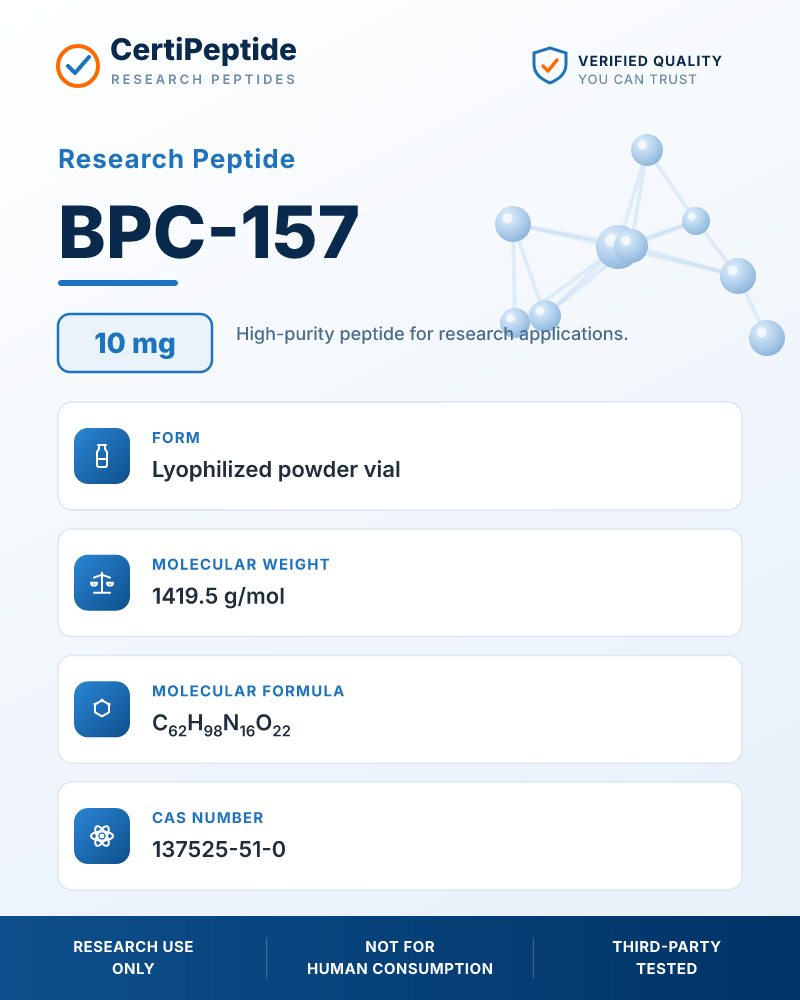
The public BPC-157 listing gives CAS number 137525-51-0, molecular formula C62H98N16O22 and molecular weight 1419.5. Those are catalog identity fields, not a substitute for a batch mass-spectrum result. The same listing publishes these variants only; it is not a claim that the list is exhaustive:
| SKU | Nominal size per vial | Vials per pack |
|---|---|---|
| BC2 | 2 mg | 10 |
| BC5 | 5 mg | 10 |
| BC10 | 10 mg | 10 |
| BC20 | 20 mg | 10 |
Site guidance on per-vial size versus pack quantity is editorial, not independent scientific evidence. It treats per-vial size, vials per pack and pack price as three separate fields. A description such as “10 mg × 10 vials” means ten vials with a nominal size of 10 mg each. It is not one vial that contains 100 mg. The sum across a pack is label arithmetic, not an analytical measurement. Actual fill and peptide-content measurements belong to the particular batch report.
A short pre-order check from that guidance is: match the exact product and SKU; check the per-vial size and unit; check the number of vials per pack; set the number of packs required; then review the matching batch records and confirm the order details. If a quotation or product documentation uses a different packaging description, ask support to reconcile it before relying on the calculation.
How to find and verify the matching COA
Finding a COA by SKU and batch is editorial guidance. A SKU identifies a listed product variant, and a batch number identifies a batch record. A product name alone is not enough when several sizes or batches exist. Compare product, SKU, batch and certificate number.
Open the product page, select the SKU, and read the matching certificate panel. Selecting a SKU updates the report. Two common mismatches to avoid: a report for one BPC-157 size is not evidence for another size, and an older published batch is not evidence of the batch that will be shipped next.
How to verify a CertiPeptide COA outlines this sequence: read product and SKU from the product page or order documentation; find the batch (ask support if the allocated batch is not stated); open the batch page and check certificate number, sample identity, test date and listed laboratory; open the original report and compare values and units with the summary; then follow the report-specific verification link. A verification page may require an account with the report provider. Seeing a link alone does not prove that a report is currently valid. If the provider requests login or the record cannot be confirmed, resolve that before treating verification as complete.
A published report does not mean every order receives that batch; confirm the allocated batch separately. A missing public result is not automatically a failed test, and it is not a passed test either. If details differ, do not substitute a similar product or a different size. Send support the SKU, batch number and the specific difference.
The batch pages below state that provider verification links were not independently fetched, and that the recorded results are not evidence of clinical suitability or of every batch.
Named-batch COA examples
The figures in this section apply only to the tested SKU and batch. There is no published example here for BC10. Absence of a public result is not a pass, a fail, or a fill weight of zero.
All three records name the laboratory as Stand Science & Technology Pharmaceutical (Qingdao) Co., Ltd. (Stand Group). Each listed test item is recorded as Pass on that batch page. Analytes are written as BPC-157 plus the SKU (for example BPC-157 BC20).
| Field | 3DVY0XVINYZZ | PGWQDNJRD7LX | 6TO3HNKVPBW5 |
|---|---|---|---|
| SKU / nominal size | BC20, 20 mg | BC2, 2 mg | BC5, 5 mg |
| Certificate | QC-2026-PHDT8JJEFR | QC-2026-N6LJ8G3UJW | QC-2026-UTETQDMV5N |
| Test date | 2026-08-18 | 2026-08-08 | 2026-08-08 |
| Appearance (visual) | White loose powder (spec: White or almost white loose powder) | White loose powder (spec: White or almost white loose powder) | White loose powder (spec: White or almost white loose powder) |
| Mass spectrum (MS) | 1418.8 Da | 1419.2 Da | 1418.5 Da |
| MS specification | 1419.5 +/- 1.0 Da | 1419.5 +/- 1.0 Da | 1419.5 +/- 1.0 Da |
| Purity (HPLC) | 99.3 % | 98.7 % | 99.0 % |
| Purity specification | NLT 98.0 % | NLT 98.0 % | NLT 98.0 % |
| Peptide content (HPLC) | 90.7 % | 92.9 % | 93.1 % |
| Peptide-content specification | NLT 90.0 % | NLT 90.0 % | NLT 90.0 % |
| Actual fill (gravimetric) | 24.00 mg | 2.21 mg | 5.47 mg |
| Fill specification | 20 mg | 2 mg | 5 mg |
| Water content (Karl Fischer) | 3.4 % | 4.7 % | 5.4 % |
| Water specification | NMT 8.0 % | NMT 8.0 % | NMT 8.0 % |
| Bacterial endotoxins (LAL, gel-clot) | <3 EU/mg | <3 EU/mg | <3 EU/mg |
| Endotoxin specification | NMT 10 EU/mg | NMT 10 EU/mg | NMT 10 EU/mg |
Nominal catalog size and gravimetric actual fill are different fields. On these three records the actual-fill results are 24.00 mg against a 20 mg specification (BC20), 2.21 mg against 2 mg (BC2), and 5.47 mg against 5 mg (BC5). Do not copy those fill weights, purity values or water results onto another lot.
Verification checklist
| Check | What to match |
|---|---|
| Product | BPC-157 |
| SKU | BC2, BC5, BC10 or BC20 as ordered |
| Per-vial size | 2 mg, 5 mg, 10 mg or 20 mg with that same SKU |
| Pack quantity | 10 vials per pack on the listed variants |
| Batch | The number on the allocated lot, not an example lot |
| Certificate | Certificate number and test date on the batch page |
| Analyte | Report lines name the same SKU (for example BPC-157 BC20) |
| Original report | Same values, units, methods and determinations |
| Scope | This batch and SKU only |
Keep the catalog SKU table and the batch COA side by side. If any identifier disagrees, stop and reconcile the SKU and batch before treating the paperwork as complete.
Frequently Asked Questions
Which public BPC-157 SKUs are listed?
The public listing shows BC2 (2 mg per vial), BC5 (5 mg), BC10 (10 mg) and BC20 (20 mg), each with 10 vials per pack. That is a list of public variants only, not a claim that every possible SKU is shown.
Does a published BPC-157 COA mean every order receives that batch?
No. Confirm the batch allocated to the order separately. An older published batch is not evidence of the batch that will be shipped next, and a published report is not evidence of every batch.
Can a COA for one BPC-157 size be used for another size?
No. A report for one SKU, such as BC5, should not be used as evidence for another SKU, such as BC20, merely because both are labeled BPC-157. Match product name, SKU, batch number and certificate number.
What if a public COA is missing for a listed SKU such as BC10?
A missing public result is not automatically a failed test, and it is not a passed test either. Ask support for the exact SKU and batch rather than substituting a different size or lot.
Explore Further
Browse our research peptide catalog and review third-party lab reports & COAs for published batches.
---
Research use only. The information above is provided for educational and laboratory research purposes only. The compounds discussed are not approved for human or veterinary use, diagnosis, treatment, or the prevention of any disease. Nothing here is medical advice.