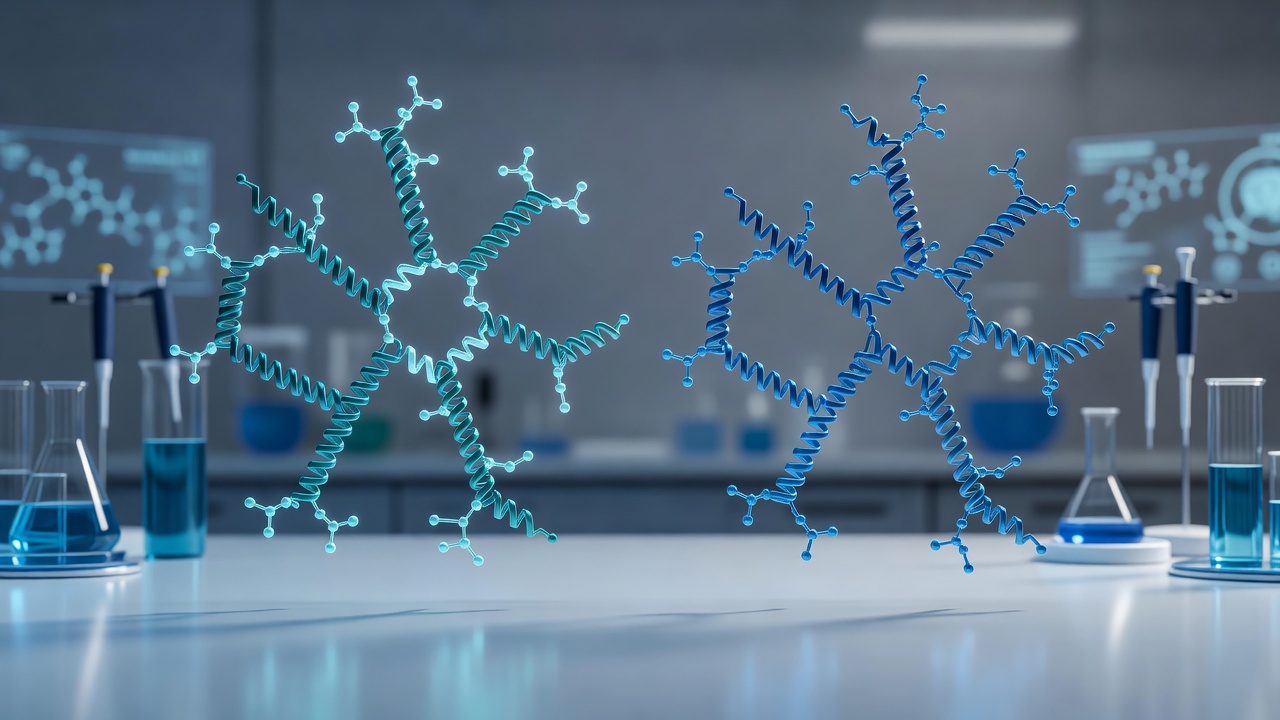
TL;DR In laboratory settings, the **CJC-1295 + Ipamorelin Blend vs Tesamorelin + Ipamorelin Blend** comparison centers on GHRH-analog design, receptor kinetics, and how each pair is used to probe GH-axis signaling. CJC-1295 (often studied with or without DAC) pairs with Ipamorelin as a GHRH-mimetic plus selective GHS-R agonist combination. Tesamorelin is a stabilized GHRH(1-44) analog frequently examined alongside Ipamorelin for pulsatile GH-release models. Researchers select between them based on desired half-life profile, assay endpoints (IGF-1, GH AUC, lipolysis markers), and experimental duration—not clinical outcomes.
Why Compare These Blends in Research? Peptide laboratories frequently evaluate growth-hormone secretagogue (GHS) and growth-hormone-releasing hormone (GHRH) analogs in combination. The **CJC-1295 + Ipamorelin Blend or Tesamorelin + Ipamorelin Blend** decision appears in protocol design when investigators need controlled GH pulses, measurable IGF-1 responses, or tissue-specific gene-expression readouts. Both blends share Ipamorelin’s selective ghrelin-receptor (GHS-R1a) activity, which minimizes cortisol and prolactin crosstalk observed with older GHRPs. The differentiating factor is the GHRH-pathway partner: CJC-1295 versus Tesamorelin.
Understanding structural and pharmacokinetic contrasts helps standardize in-vitro receptor assays, ex-vivo pituitary preparations, and carefully controlled animal models. This article outlines mechanistic overlap, key research differences, common study endpoints, and practical considerations when sourcing **CJC-1295 + Ipamorelin Blend** or **Tesamorelin + Ipamorelin Blend** for bench work.
Shared Research Features: Ipamorelin as the Common Partner Ipamorelin is a pentapeptide ghrelin mimetic that selectively activates GHS-R1a. In combination studies it is valued for:
- High receptor selectivity relative to GHRP-2 or GHRP-6
- Limited off-target stimulation of ACTH/cortisol pathways in many models
- Synergy with GHRH-receptor agonists via dual-pathway amplification of somatotroph GH release
When Ipamorelin is blended with either CJC-1295 or Tesamorelin, researchers typically aim to:
1. Engage both GHRH-R and GHS-R1a concurrently
2. Produce more robust GH pulses than either agent alone in the same preparation
3. Map downstream IGF-1, STAT5, and metabolic gene programs under dual stimulation
Thus any **CJC-1295 + Ipamorelin Blend Tesamorelin + Ipamorelin Blend comparison** must hold Ipamorelin concentration, vehicle, and sampling windows constant while varying only the GHRH analog.
Structural and Mechanistic Differences ### CJC-1295 (with or without DAC) CJC-1295 is a tetrasubstituted GHRH(1-29) analog. Research literature often distinguishes: - **CJC-1295 with DAC** (Drug Affinity Complex / maleimidopropionic acid linker): binds albumin, extending circulating half-life substantially in animal PK studies - **CJC-1295 without DAC** (Mod GRF 1-29): shorter half-life, more physiologic pulse-like exposure when dosed repeatedly in timed protocols
Both forms retain affinity for the GHRH receptor (GHRHR) and stimulate cAMP/PKA cascades in somatotrophs. DAC-modified material is frequently chosen for multi-day exposure experiments where trough levels matter; non-DAC material suits pulse-design studies.
Tesamorelin Tesamorelin is a synthetic 44-amino-acid GHRH analog with a hexenoyl moiety at the N-terminus that improves stability against DPP-IV degradation. It preserves the full GHRH(1-44) sequence length rather than the truncated 1-29 core. In research models it produces GHRHR activation with a half-life intermediate between native GHRH and albumin-bound CJC-1295 DAC constructs. Investigators often select Tesamorelin when they want: - Sequence fidelity closer to endogenous GHRH(1-44) - Stability without albumin conjugation - Clearance kinetics suitable for once-daily or timed multi-dose regimens in animals
Implications for Blend Behavior | Feature | CJC-1295 (+ Ipamorelin) | Tesamorelin (+ Ipamorelin) | | --- | --- | --- | | GHRH analog length | 1-29 core (modified) | 1-44 + N-terminal hexenoyl | | Typical half-life focus | Extended (DAC) or short (no DAC) | Intermediate, DPP-IV resistant | | Albumin binding | Yes (DAC form) | No | | Common research use | Sustained or pulsed GH-axis drive | Physiologic-pattern GHRH tone + GHS | | Primary shared partner | Ipamorelin (GHS-R1a) | Ipamorelin (GHS-R1a) |
These differences drive distinct GH area-under-curve (AUC) shapes and IGF-1 time courses even when Ipamorelin content is matched.
Pharmacokinetic and Pharmacodynamic Contrasts in Studies Laboratory PK/PD work consistently shows:
- **DAC-CJC-1295 combinations** can maintain elevated GH/IGF-1 signals over longer sampling intervals, useful for chronic gene-expression or body-composition surrogate studies in rodents.
- **Non-DAC CJC-1295 + Ipamorelin** protocols emphasize repeated discrete pulses; sampling must capture peak and return-to-baseline within hours.
- **Tesamorelin + Ipamorelin** often yields a single daily-type GH elevation with a decay profile shorter than DAC-CJC-1295 yet longer than native GHRH, facilitating standardized morning/evening administration designs in animal facilities.
Researchers measuring pituitary GHRHR desensitization, somatostatin feedback, or hepatic IGF-1 mRNA should align blood-draw schedules to each blend’s expected kinetics. Failure to do so confounds head-to-head **CJC-1295 + Ipamorelin Blend vs Tesamorelin + Ipamorelin Blend** datasets.
Typical Laboratory Endpoints and Model Systems Common readouts when either blend is applied under research-use-only conditions include:
- Serial GH and IGF-1 concentrations (ELISA/RIA)
- Pituitary cAMP accumulation or CREB phosphorylation
- Hepatic and muscle IGF-1, IGFBP, and SOCS expression
- Indirect calorimetry or labeled-substrate lipolysis/glucose-uptake assays
- Body-composition imaging (DEXA, NMR) in longitudinal animal cohorts
- Safety-signal panels: glucose, insulin, cortisol, prolactin (to confirm Ipamorelin selectivity)
In-vitro systems (primary somatotrophs, GHRHR-transfected lines) allow concentration-response curves for each GHRH analog ± fixed Ipamorelin. Ex-vivo hypothalamic-pituitary slices can test pulse coordination. In-vivo work remains restricted to approved animal protocols; human administration is outside research-peptide supplier scope.
Designing a Head-to-Head Comparison Study To generate interpretable **CJC-1295 + Ipamorelin Blend Tesamorelin + Ipamorelin Blend comparison** data:
1. **Match molar GHRH-receptor ligand amounts** where possible, or justify equipotent GH-release doses from pilot curves.
2. **Fix Ipamorelin concentration** and vehicle (e.g., bacteriostatic water or acetic acid solutions appropriate for peptides).
3. **Predefine sampling windows** that capture both early GH peaks and later IGF-1 changes for each kinetic profile.
4. **Include single-agent arms** (CJC-1295 alone, Tesamorelin alone, Ipamorelin alone) plus vehicle to quantify synergy.
5. **Control for DAC vs non-DAC** if CJC-1295 identity is ambiguous—state the exact analog used.
6. **Report peptide purity, lot COA, and storage** (lyophilized stability, reconstitution time-limits) so others can replicate.
Blinding of assay technicians and randomization of treatment order further reduce bias.
Practical Sourcing and Handling Notes Laboratories evaluating the **CJC-1295 + Ipamorelin Blend** typically verify whether the CJC component includes DAC, because albumin binding changes both solubility behavior and in-vivo persistence. The **Tesamorelin + Ipamorelin Blend** should be confirmed as the hexenoyl-GHRH(1-44) sequence. Both products are supplied for in-vitro and legitimate preclinical research only. Standard peptide-handling practices apply: protect from repeated freeze-thaw, use low-adsorptive tubes, and validate concentrations after reconstitution.
Choosing Between the Blends for a Given Protocol - Prefer **CJC-1295 (DAC) + Ipamorelin** when the hypothesis requires prolonged receptor occupancy or fewer daily manipulations in chronic models. - Prefer **CJC-1295 (no DAC) + Ipamorelin** when physiologic multi-pulse patterns are essential. - Prefer **Tesamorelin + Ipamorelin** when full-length GHRH sequence representation and DPP-IV resistance without albumin conjugation are priorities, or when intermediate half-life simplifies once-per-cycle dosing schedules.
No blend is universally “superior”; suitability is hypothesis- and model-dependent. Document rationale in the methods section so literature comparisons remain transparent.
Summary of Research Similarities and Differences **Similarities** - Dual GHRH-R + GHS-R1a engagement via Ipamorelin pairing - Utility for GH-pulse and IGF-1 pathway studies - Preference for selective secretagogue profiles over older GHRPs
**Differences**
- Peptide backbone length and modifications (1-29 ± DAC vs hexenoyl-1-44)
- Half-life and albumin interaction
- Optimal sampling and dosing-interval design in animal or cell systems
- Sequence homology to native GHRH(1-44)
Investigators running comparative work on the **CJC-1295 + Ipamorelin Blend vs Tesamorelin + Ipamorelin Blend** should is researched in the context of kinetic mismatch as the primary design variable and keep all other factors tightly controlled.
Frequently Overlooked Variables - Counter-regulatory somatostatin tone differing by species and time of day - Nutritional state (fasted vs fed) altering GH responsiveness - Sex and age of animal subjects - Assay cross-reactivity between GH isoforms - Residual TFA content in lyophilized peptides affecting cell-culture pH
Addressing these improves reproducibility across labs studying either blend.
Frequently Asked Questions
What is the main research difference between CJC-1295 and Tesamorelin when each is blended with Ipamorelin?
CJC-1295 is a modified GHRH(1-29) analog that may include a DAC albumin-binding group for extended half-life, whereas Tesamorelin is a hexenoyl-stabilized full-length GHRH(1-44) analog with intermediate, DPP-IV-resistant kinetics. Both pair with Ipamorelin’s GHS-R1a activity, but their GH AUC shapes and optimal sampling windows differ.
Does the CJC-1295 + Ipamorelin Blend always contain DAC?
Not necessarily. Research materials may be supplied as CJC-1295 with DAC or as Mod GRF 1-29 (without DAC). Protocols and COAs should state which form is used because half-life and study design change substantially.
Why is Ipamorelin commonly combined with either GHRH analog in laboratory work?
Ipamorelin selectively activates GHS-R1a with comparatively low off-target effects on cortisol or prolactin pathways in many models, allowing cleaner dual-pathway stimulation of somatotroph GH release when co-administered with a GHRH-receptor agonist.
Which blend is better for long-duration animal GH-axis studies?
Neither is universally better. DAC-containing CJC-1295 + Ipamorelin is often chosen when prolonged exposure and fewer manipulations are desired; Tesamorelin + Ipamorelin suits intermediate half-life designs. Choice depends on the hypothesis, species, and sampling schedule.
What endpoints are typically measured in CJC-1295 + Ipamorelin versus Tesamorelin + Ipamorelin comparison studies?
Common laboratory endpoints include serial GH and IGF-1 levels, pituitary cAMP/CREB signaling, hepatic IGF-1 gene expression, metabolic flux assays, and body-composition surrogates in approved animal models, plus selectivity checks for cortisol and prolactin.
Explore Further
Browse our [research peptide catalog](/shop) and review third-party [lab reports & COAs](/lab-reports) for every batch.
---
**Research use only.** The information above is provided for educational and laboratory research purposes only. The compounds discussed are not approved for human or veterinary use, diagnosis, treatment, or the prevention of any disease. Nothing here is medical advice.