Knowledge Hub
Guides on quality verification, reconstitution, and safe handling of research peptides. For laboratory research use only.

Reading Identity and Purity Results on Research Peptide COAs
These site guides do not document third-party HPLC programs. They show how to read identity and purity COA rows without treating missing tests as passes.
Read more →
Reading Bacterial Endotoxin Results on Research-Grade Peptide COAs
How to read bacterial endotoxin lines on research peptide COAs—qualifiers, units, and missing tests—and why those results do not prove sterility.
Read more →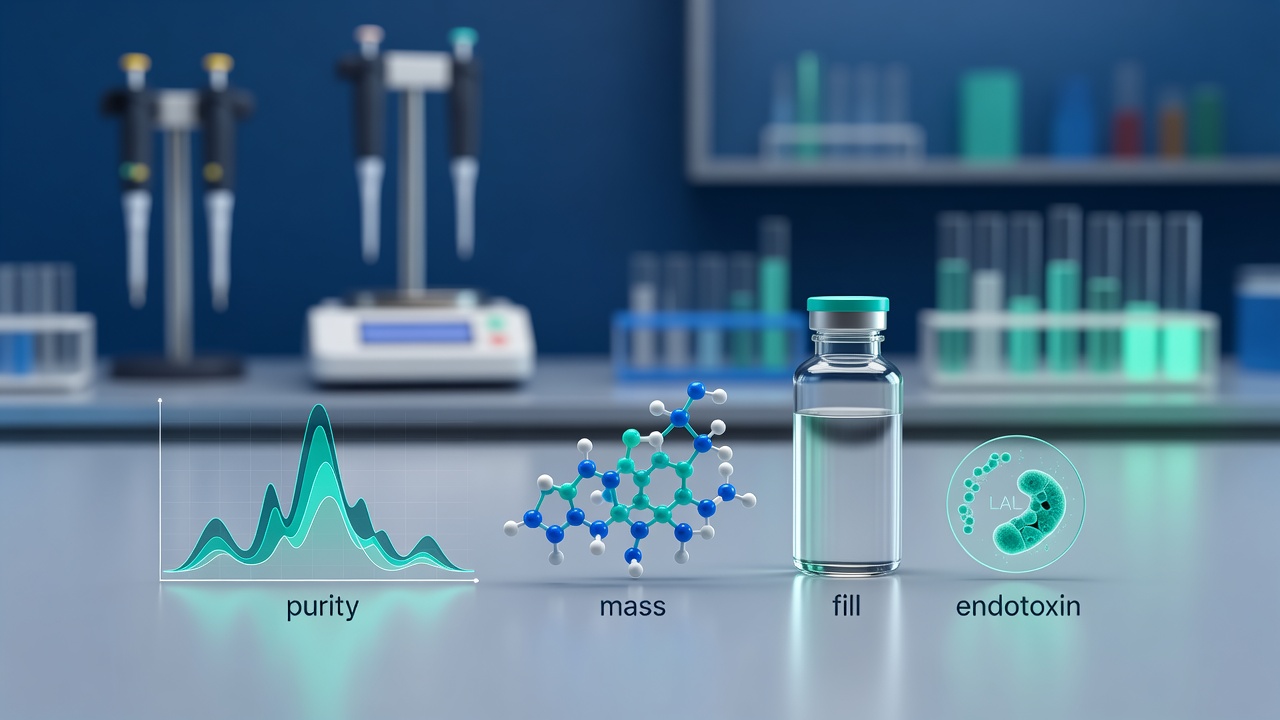
How to Read a Peptide Certificate of Analysis: Purity, Mass, Fill, and Endotoxin
How to read peptide COA rows for HPLC purity, mass identity, fill, and endotoxin—keeping methods, units, and less-than qualifiers with each result.
Read more →
How to Read Peptide Content Versus Purity on a COA
Purity is not peptide content. Read each COA row with its units, then match the SKU and batch. Missing results are not passes, and labels are not measurements.
Read more →
Understanding a Certificate of Analysis (COA)
How to read a peptide COA: purity by HPLC, mass verification, and what a lot number tells you.
Read more →
Why Third Party Tested Peptides Matter for Research
Independent HPLC purity testing and mass spec verify identity and purity—core peptide quality control for reproducible research results.
Read more →
Endotoxin Testing for Research Peptides
Detailed guide to endotoxin testing, peptide sterility, and the LAL test for maintaining quality in research-grade peptides within laboratory environments.
Read more →
How to Read a COA: Peptide Purity & Testing
Learn how to read a COA for research peptides, covering HPLC purity, mass spectrometry, endotoxin levels, and sterility results.
Read more →