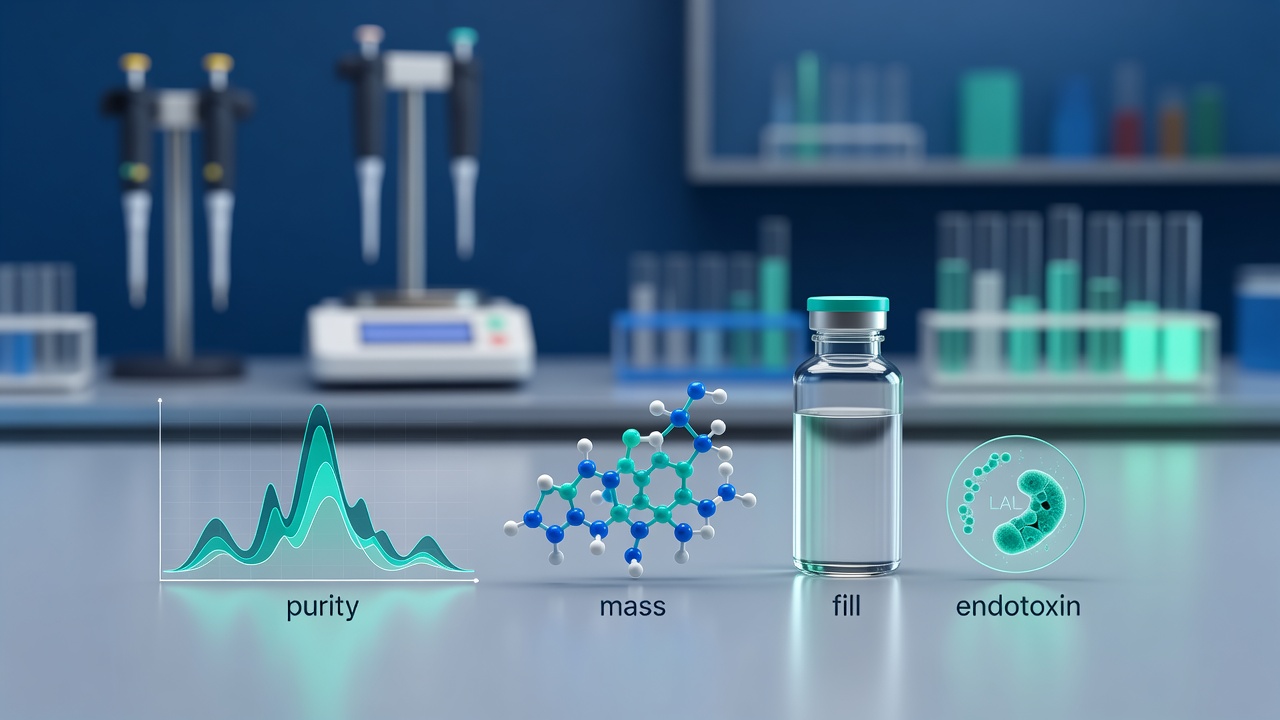
A Certificate of Analysis (COA) is the primary quality document for a research peptide. It reports third-party test results for a specific production lot, so each value belongs to a lot number rather than to a catalog name alone (Understanding a Certificate of Analysis (COA)). Read the file one test at a time. Identity, purity, fill, and endotoxin rows answer different questions. Keep the reported method, unit, specification, and any qualifier attached to each value. Do not replace a less-than sign with zero, and do not treat a missing result as a pass (How to read identity, purity, fill and endotoxin results).
Start with lot traceability
Every COA is bound to a lot number. Matching the lot on the vial to the published COA is the single most important verification step (Understanding a Certificate of Analysis (COA)).
A summary can make reported values easier to scan. The original document still holds the complete context and is the reference if a summary appears inconsistent. Contact support about any discrepancy. Different reports can contain different tests, so read the terminology used by the specific report rather than forcing every record into the same labels (How to read identity, purity, fill and endotoxin results).
The row names in the table below come from a published RT10 example used in the site reading guide. They illustrate how to parse those rows. They are not a claim that every lot includes the same panel.
How to read common COA rows
| Row | What to read | What not to infer |
|---|---|---|
| Mass spectrum / identity | Recorded mass and method against the stated specification | That every other test passed |
| Purity | The reported percentage and analytical method | That the same percentage is net peptide content |
| Peptide content | Its separate result and definition in the report | That it is the same as nominal fill |
| Actual fill | Measured quantity, units, and nominal specification | That a label is itself a measured result |
| Bacterial endotoxins | Result, qualifier, units, and stated limit | That a less-than result means zero or proves sterility |
That comparison is site editorial guidance for reading published records, not independent scientific evidence (How to read identity, purity, fill and endotoxin results).
Preserve units and component names. A value in milligrams cannot be compared directly with a percentage or with a result in EU/mg. If multiple components are measured in a blend, retain the component name beside each result.
Mass identity versus HPLC purity
Mass spectrometry confirms that the molecular weight matches the expected sequence, which verifies identity (Understanding a Certificate of Analysis (COA)). On the report, record the measured mass with the method and the specification used for comparison. An identity match does not imply that purity, fill, or endotoxin rows also passed.
High-performance liquid chromatography (HPLC) separates the peptide from related impurities and reports purity as a percentage of total peak area. The supplier COA overview states that, for research work, readers look for 98% or higher (Understanding a Certificate of Analysis (COA)). Treat that 98% figure as editorial guidance on how to inspect an HPLC row. The controlling number is still the percentage, method, and specification printed for the named lot.
HPLC purity is not net peptide content. Peptide content, when listed, is a separate result with its own definition in the report. Actual fill is a measured quantity with units and a nominal specification. A label quantity is not itself a measured fill result (How to read identity, purity, fill and endotoxin results).
Endotoxin bounds and sterility
Bacterial endotoxin results should be copied with the qualifier, units, and stated limit. A result written as “less than” a threshold states a bound, not an exact measured value of zero. That bound does not prove sterility (How to read identity, purity, fill and endotoxin results).
Sterility is a different question from endotoxin. If a report does not include a sterility test, the gap is not a pass and is not evidence of absence. Read only tests that appear on that lot’s COA, with the methods and units those rows actually use. Neither a purity percentage nor a set of passing results establishes suitability for human or animal use (How to read identity, purity, fill and endotoxin results). Site COA pages are editorial guides to product and batch records, not independent proof of a protocol outcome.
Checklist for reading a peptide COA
- Confirm the vial lot number matches the COA lot number.
- Keep method, specification, result, unit, and qualifier together for each row.
- Read mass/identity only against the stated specification; do not assume other tests passed.
- Record HPLC purity as a peak-area percentage; do not treat it as peptide content or fill.
- If peptide content and actual fill are present, keep their definitions and units separate from the label.
- Copy endotoxin results with “less than” language and units such as EU/mg; do not rewrite a bound as zero.
- Do not treat a missing sterility result, or any other missing test, as a pass.
- Use the original report when a summary looks inconsistent, and contact support about discrepancies.
Frequently Asked Questions
What is a peptide Certificate of Analysis?
A COA is the primary quality document for a research peptide. It reports third-party test results for a specific production lot, so results always tie back to a lot number.
Does HPLC purity mean the same thing as peptide content or fill?
No. Purity is the reported percentage and analytical method. Peptide content is a separate result with its own definition in the report. Actual fill is a measured quantity with units and a nominal specification, and a label is not itself a measured result.
Does a “less than” endotoxin result mean the material is sterile?
No. A result written as “less than” a threshold is a bound, not an exact value of zero, and it does not prove sterility. A missing sterility result is not a pass.
What should I check first on a COA?
Matching the lot on the vial to the published COA is the single most important verification step. If a summary appears inconsistent with the original report, use the original document and contact support about any discrepancy.
Explore Further
Browse our research peptide catalog and review third-party lab reports & COAs for published batches.
---
Research use only. The information above is provided for educational and laboratory research purposes only. The compounds discussed are not approved for human or veterinary use, diagnosis, treatment, or the prevention of any disease. Nothing here is medical advice.