Wholesale-first · factory-direct pricing · Bulk & custom-volume discounts|For laboratory research use only. Not for human or animal consumption.
CertiPeptideRESEARCH PEPTIDES
Sign in
BPC-157 + TB-500 Blend

BPC-157 + TB-500 Blend

Research Peptide | Lyophilized Powder | Batch Tested

Tested for
Purity
Size
$110.00
$1.10/mg
In StockLatest batch: BB10-260601
1

For laboratory research use only. Not for human or animal consumption. Insulated shipping · Styrofoam box available.

Product Overview

This blend combines BPC-157 and TB-500 — the two most widely studied tissue-repair peptides — in a single research vial. The pairing is one of the most common combinations in recovery research.

Batch BB10-260601Tested Jun 1, 2026
TestResultStatus
Purity98.8%Passed ✓
Batch BB20-260601Tested Jun 1, 2026
TestResultStatus
Purity99.1%Passed ✓
Batch BB30-260601Tested Jun 1, 2026
TestResultStatus
Purity99.4%Passed ✓
Batch BB40-260601Tested Jun 1, 2026
TestResultStatus
Purity99.7%Passed ✓
500+ Certificates of Analysis
6+ Years of Testing
Best $/mg
Tested for More Than Purity
Batch # on Every Vial

Research Information

The combination is used to study complementary repair mechanisms, contrasting BPC-157's cytoprotective and angiogenic activity with TB-500's actin-regulation and cell-migration effects, to see whether the two peptides act synergistically in regeneration models. Supplied strictly for in-vitro and laboratory research use only — not for human or animal consumption.

BPC-157 + TB-500 Blend Research & Studies

What is BPC-157 + TB-500 Blend?

BPC-157 + TB-500 Blend is a laboratory research preparation that combines two peptides frequently examined in tissue-repair models: BPC-157, a synthetic pentadecapeptide sequence derived from a gastric protein fragment, and TB-500, a synthetic fragment related to thymosin beta-4. The blend is supplied for controlled in-vitro and laboratory investigation of complementary regenerative pathways. Research interest centers on pairing BPC-157 cytoprotective and angiogenic activity with TB-500 actin-regulation and cell-migration effects within the same experimental system.

Mechanism of Action

In research models, BPC-157 is studied for interactions with growth-factor signaling, nitric-oxide pathways, and endothelial responses that support vessel formation and cellular protection. TB-500 is examined primarily for its role in sequestering G-actin and promoting cytoskeletal reorganization that facilitates cell motility and migration. Together, the peptides are investigated for whether concurrent modulation of angiogenesis and actin dynamics produces additive or synergistic outcomes in regeneration assays. All observations remain confined to non-clinical laboratory systems.

Primary Areas of Research

Laboratory work with this blend commonly focuses on wound-closure assays, fibroblast and endothelial migration studies, and models of soft-tissue or tendon-like matrix repair. Investigators also explore angiogenic sprouting, inflammatory-mediator profiles, and extracellular-matrix remodeling under controlled culture conditions. Comparative designs often contrast single-peptide arms against the combination to evaluate pathway complementarity. The material is intended solely for in-vitro and laboratory research use.

Key Research Findings

Published peptide literature describes BPC-157 activity in cytoprotection and accelerated angiogenic responses across multiple experimental platforms, while TB-500 literature emphasizes enhanced cell migration and actin-driven cytoskeletal changes. Combination studies remain exploratory and typically assess whether simultaneous pathway engagement alters migration rates, vessel-like structure formation, or matrix deposition relative to individual peptides. Results are model-dependent and do not extrapolate beyond the laboratory setting. No clinical claims are associated with these research observations.

Research Handling & Considerations

The blend is provided as a research reagent for qualified laboratory personnel and must be handled under standard peptide storage and reconstitution protocols appropriate to the experimental design. Investigators should verify peptide identity, purity, and concentration by analytical methods before use in assays. All work is restricted to in-vitro and controlled laboratory models; the material is not for human or animal consumption or administration. Proper documentation of lot, solvent, and handling conditions supports reproducibility.

Frequently Asked Questions

The combination allows investigators to examine whether cytoprotective and angiogenic effects associated with BPC-157 interact with actin-regulation and migration effects associated with TB-500 in the same regeneration model.

Explore Other High-Purity Peptides

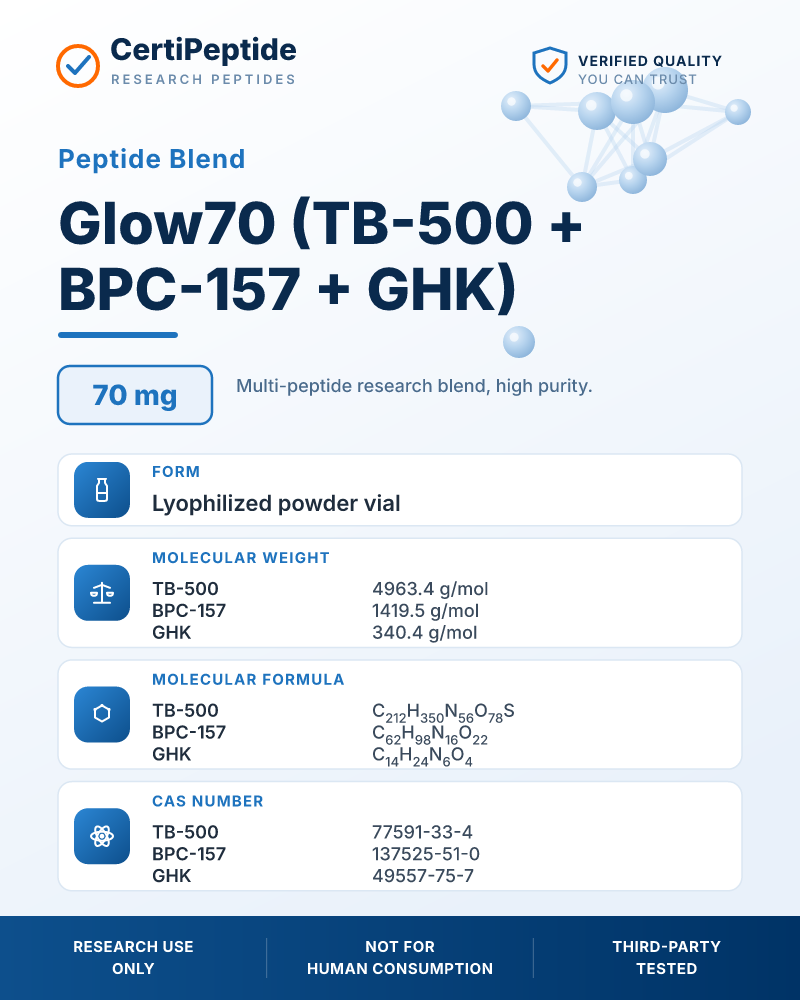
Glow70 (TB-500 + BPC-157 + GHK)
Peptide Blends99.7% pure

Glow70 (TB-500 + BPC-157 + GHK)

$199.00($0.28/mg)
10 vials × 70 mg · 700 mg total
Wholesale · bulk discountsIn Stock
Klow80 (TB-500 + BPC-157 + GHK + KPV)
Peptide Blends99.6% pure

Klow80 (TB-500 + BPC-157 + GHK + KPV)

$239.00($0.30/mg)
10 vials × 80 mg · 800 mg total
Wholesale · bulk discountsIn Stock
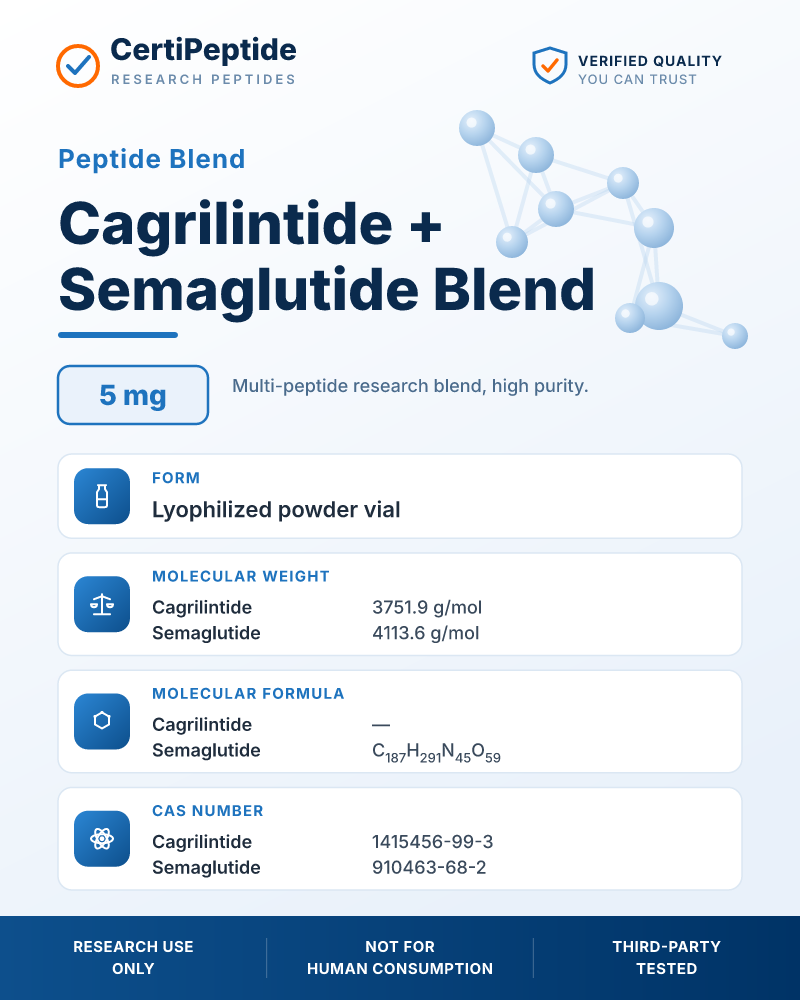
Cagrilintide + Semaglutide Blend
Peptide Blends99.7% pure

Cagrilintide + Semaglutide Blend

From$99.00($1.98/mg)
10 vials × 5 mg · 50 mg total
Wholesale · bulk discountsIn Stock
Semax + Selank Blend
Peptide Blends99.6% pure

Semax + Selank Blend

$172.00($0.86/mg)
10 vials × 20 mg · 200 mg total
Wholesale · bulk discountsIn Stock