TL;DR
Thymosin Alpha-1 vs Cortagen is a frequent comparison when labs design immune- versus CNS-oriented peptide studies. Thymosin Alpha-1 is a 28-residue thymic peptide widely used in immunology and host-response models. Cortagen is a short tetrapeptide bioregulator studied mainly in cortical, neuroprotective, and gene-expression contexts. They differ in length, proposed targets, and typical endpoints, yet both are handled as research peptides under controlled in vitro or preclinical protocols. Choice depends on hypothesis, assay readout, and tissue focus—not interchangeable substitution.
Why Compare Thymosin Alpha-1 vs Cortagen?
Investigators searching for Thymosin Alpha-1 vs Cortagen, Thymosin Alpha-1 or Cortagen, or a full Thymosin Alpha-1 Cortagen comparison usually need clarity on mechanism scope and experimental fit. Both compounds appear in peptide catalogs for laboratory work, but they arise from different research traditions and map to distinct biological systems.
Thymosin Alpha-1 (also studied as thymalfasin in the literature) is linked to thymic peptide biology and adaptive immune signaling. Cortagen belongs to the short synthetic peptide bioregulators associated with cortical tissue models and cytoprotective gene-expression work. A structured comparison helps teams avoid mismatched endpoints, poorly powered designs, or incorrect positive controls.
This article summarizes structural features, reported research themes, methodological overlap, and practical selection criteria for laboratory studies only.
Structural and Biochemical Profiles
Thymosin Alpha-1
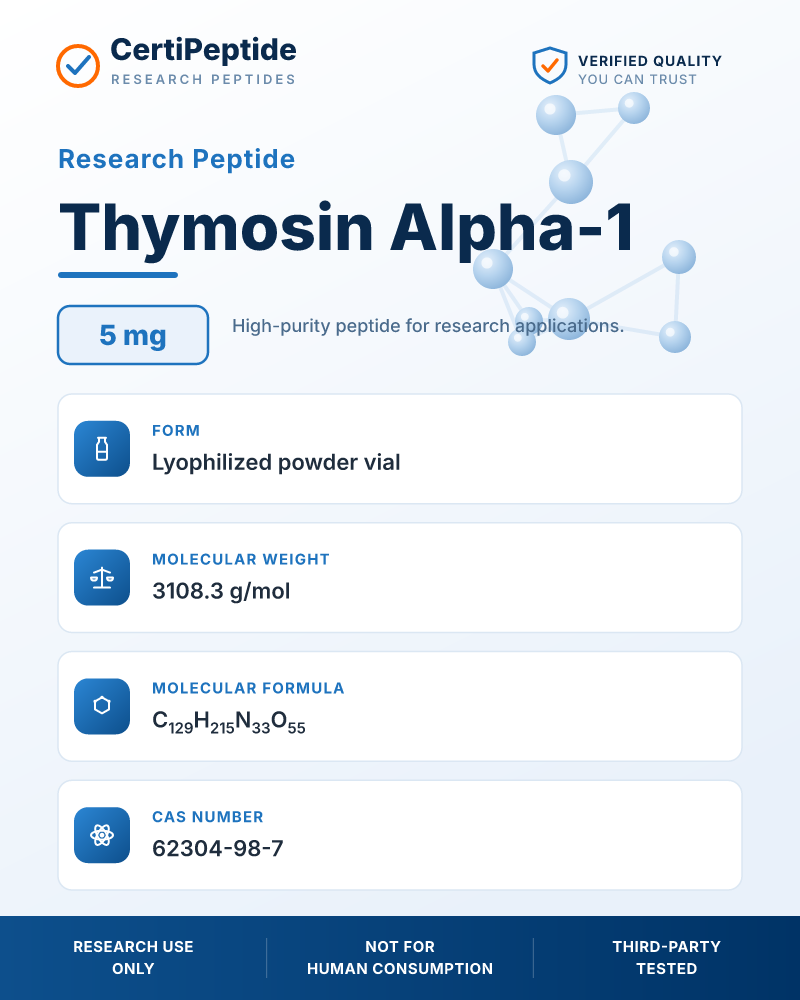
Thymosin Alpha-1 is a 28-amino-acid peptide corresponding to an N-terminal fragment of prothymosin alpha. Key research-relevant traits include:
- Defined primary sequence with multiple acidic residues
- Amphipathic character that has been discussed in receptor-interaction and membrane-context studies
- Commercial research material typically supplied as acetate or similar salt forms for reconstitution in aqueous buffers
- Stability and handling profiles that favor cold storage, protection from repeated freeze–thaw, and documentation of lot purity (HPLC/MS)
In experimental systems, investigators track immune-cell phenotype, cytokine patterns, antigen-presentation markers, and infection or oncology model readouts when using Thymosin Alpha-1.
Cortagen
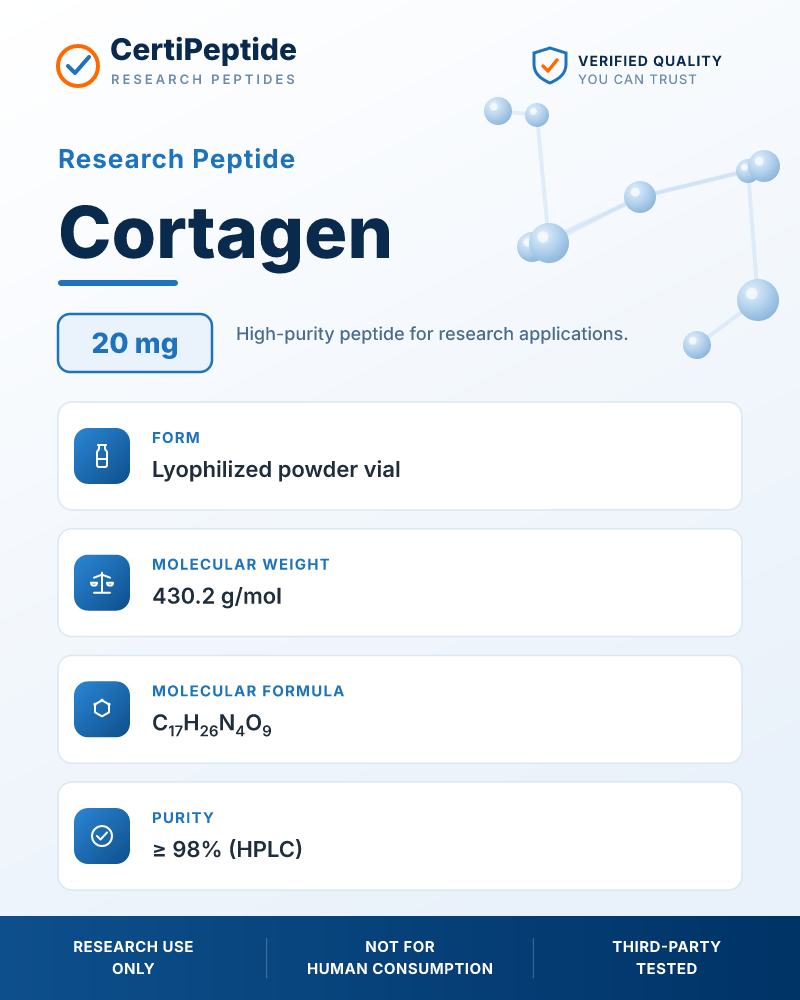
Cortagen is a tetrapeptide (commonly described as Ala-Glu-Asp-Pro). Relative to Thymosin Alpha-1 it is:
- Much shorter, with lower molecular weight and simpler synthesis/purification footprints
- Framed in the bioregulator peptide literature as a cortex-directed sequence
- Studied for effects on gene expression, neuronal stress models, and age-related cortical endpoints in preclinical designs
- Often evaluated with transcriptomic, morphological, or behavioral-proxy assays rather than classic T-cell panels
Because length and physicochemical properties differ sharply, solubility, dosing molarity calculations, and analytical methods are not one-to-one between Thymosin Alpha-1 and Cortagen.
Primary Research Focus Areas
Immune and Host-Response Models (Thymosin Alpha-1)
Published laboratory and translational research programs have used Thymosin Alpha-1 to probe:
- T-cell differentiation and maturation markers
- Innate–adaptive crosstalk and dendritic-cell function
- Viral and bacterial challenge models (immune competence endpoints)
- Combination regimens with other immunomodulators in oncology immunology settings
- Biomarker panels (e.g., lymphocyte subsets, selected cytokines)
These themes make Thymosin Alpha-1 a candidate when the hypothesis centers on immune competence, checkpoint context, or infection immunology—not when the primary target is cortical gene programs.
Cortical and Neurobiological Models (Cortagen)
Cortagen-oriented studies more often emphasize:
- Cerebral cortex tissue cultures or ex vivo preparations
- Neuroprotection and stress-adaptation pathways
- Modulation of gene expression related to neuronal maintenance
- Aging and cognitive-proxy endpoints in animal research designs
- Comparative work among short peptide bioregulators with tissue tropism claims
Labs selecting Cortagen typically need CNS-relevant readouts, histology, or molecular signatures in neural tissue rather than broad peripheral immune phenotyping.
Thymosin Alpha-1 Cortagen Comparison: Key Differences
| Dimension | Thymosin Alpha-1 | Cortagen |
|---|---|---|
| Length | 28 aa | 4 aa (tetrapeptide) |
| Research tradition | Thymic / immune peptide | Short bioregulator / cortex-focused |
| Common model systems | PBMC, lymphoid tissue, infection & tumor immunology models | Cortical cultures, neural stress, aging CNS models |
| Typical endpoints | Immune phenotype, cytokines, host defense | Gene expression, neuronal morphology, cytoprotection |
| Analytical complexity | Longer peptide; full-length purity & impurity profiling | Short peptide; simpler MS confirmation |
Mechanistic non-equivalence. Even where both peptides are discussed under “bioregulation” or “cytoprotection,” pathway-level evidence and cell-type specificity diverge. Substituting one for the other invalidates most historical controls.
Assay selection. Flow cytometry and ELISPOT-style immune assays align more naturally with Thymosin Alpha-1 programs. qPCR panels for neuronal genes, immunohistochemistry of cortex, or related CNS metrics align more with Cortagen.
Concentration space. Molar and mass/volume working ranges used in published methods are peptide-specific. Cross-applying concentrations from a Thymosin Alpha-1 paper to a Cortagen experiment (or vice versa) is not scientifically justified without new titration.
Similarities Relevant to Laboratory Practice
Despite different biology, a Thymosin Alpha-1 or Cortagen decision still shares operational similarities:
- Research-only materials — Both are procured and documented as laboratory reagents for in vitro or approved preclinical protocols.
- Quality attributes — Identity (MS), purity (HPLC), residual solvent/TFA awareness, and certificate-of-analysis review matter for either peptide.
- Handling — Lyophilized solids, cold-chain storage, controlled reconstitution (sterile water, dilute acid, or buffer per method), aliquoting, and light/oxidation precautions are standard good laboratory practice.
- Controls — Vehicle, scrambled or inactive peptide controls (when available), and orthogonal readouts strengthen interpretability for both.
- Documentation — Batch numbers, reconstitution logs, and exposure timing should be recorded identically rigorous for Thymosin Alpha-1 and Cortagen.
These shared process requirements simplify SOPs when a lab works with multiple research peptides, even if scientific endpoints differ.
Experimental Design Considerations
Hypothesis alignment
- Choose Thymosin Alpha-1 when the primary question involves immune cell function, thymic peptide pathways, or host-response modulation.
- Choose Cortagen when the primary question involves cortical tissue biology, short-peptide bioregulator effects, or neural gene-expression programs.
Model system readiness
Confirm that cell lines, primary isolates, or animal models express the pathways you intend to measure. Immune-competent models pair poorly with purely cortical hypotheses, and vice versa.
Endpoint hierarchy
Define primary endpoints before unblinding or analysis. Secondary exploratory omics can compare pathway breadth but should not retroactively redefine the peptide’s research role.
Analytical method validation
Validate quantification (e.g., HPLC for stock verification) and biological assays (precision, specificity) for the chosen peptide. Do not assume a validated Thymosin Alpha-1 cytokine panel transfers to Cortagen neural markers.
Replication and statistics
Short peptides and longer immunomodulatory peptides can show different effect sizes and variance. Power calculations should use pilot data from the same compound class.
Practical Selection Guide: Thymosin Alpha-1 or Cortagen
Use the following decision cues in study planning:
- Immune phenotyping or infection immunology → prioritize Thymosin Alpha-1.
- Cortex-focused molecular or morphological work → prioritize Cortagen.
- Head-to-head exploratory screen → run both arms with separate vehicle controls and non-overlapping endpoint batteries; do not pool data.
- Limited sample volume → match peptide to the single most informative endpoint rather than splitting underpowered dual hypotheses.
- Literature anchoring → cite peptide-specific prior art; avoid generalizing “peptide bioregulator” claims across sequences.
Natural procurement notes for research groups often list Thymosin Alpha-1 alongside other immune-research peptides and Cortagen alongside short neurotropic bioregulators. Catalog adjacency does not imply biological equivalence.
Limitations and Evidence Gaps
Comparative literature that places Thymosin Alpha-1 and Cortagen in identical protocols is sparse. Most papers address one compound class in isolation. Therefore:
- Cross-peptide meta-analyses require caution.
- Mechanistic diagrams should remain compound-specific.
- Translational or clinical inferences are outside the scope of research-supply framing and should not drive lab reagent choice.
Transparency about these gaps improves peer review and reproducibility.
Summary
A rigorous Thymosin Alpha-1 vs Cortagen evaluation separates a long thymic immunomodulatory peptide from a short cortex-oriented tetrapeptide bioregulator. Similarities are largely operational (quality control, storage, research-only use). Differences dominate structure, model systems, and endpoints. For laboratory programs, select Thymosin Alpha-1 when immune mechanisms are central; select Cortagen when cortical or short-peptide neurobiological questions lead. Parallel designs are possible but demand independent controls and validated assays for each compound.
FAQ
See the structured FAQ below for concise answers to common long-tail research questions.
Explore Further
Browse our research peptide catalog and review third-party lab reports & COAs for every batch.
---
Research use only. The information above is provided for educational and laboratory research purposes only. The compounds discussed are not approved for human or veterinary use, diagnosis, treatment, or the prevention of any disease. Nothing here is medical advice.