TL;DR
Sterile Water vs Bacteriostatic Water is a core diluent choice in peptide and compound laboratory work. Sterile water is preservative-free and suited to single-use reconstitution and assays that must avoid additives. Bacteriostatic water contains a bacteriostatic agent (typically 0.9% benzyl alcohol), supporting multi-draw vial use under controlled aseptic technique. Selection depends on study design, open-time, analytical interference risk, and storage protocol—not clinical use.
Why the Sterile Water Bacteriostatic Water Comparison Matters in the Lab
Researchers reconstituting lyophilized materials, preparing stock solutions, or running stability and solubility studies repeatedly face the same decision: Sterile Water or Bacteriostatic Water. Both are sterile aqueous vehicles used to dissolve or dilute research compounds, including peptides supplied for in-vitro and non-clinical experimental work. They are not interchangeable in every protocol.
The Sterile Water vs Bacteriostatic Water distinction affects microbial risk after first puncture, potential matrix effects in chromatography or cell assays, freeze–thaw behavior of stocks, and how long a working vial remains usable under documented lab SOPs. Understanding composition, labeling, and handling limits helps keep methods reproducible and reduces avoidable contamination or analytical noise.
This article focuses on laboratory research differences, similarities, and study design considerations when using Sterile Water and Bacteriostatic Water as diluents.
Composition and How Each Diluent Is Defined
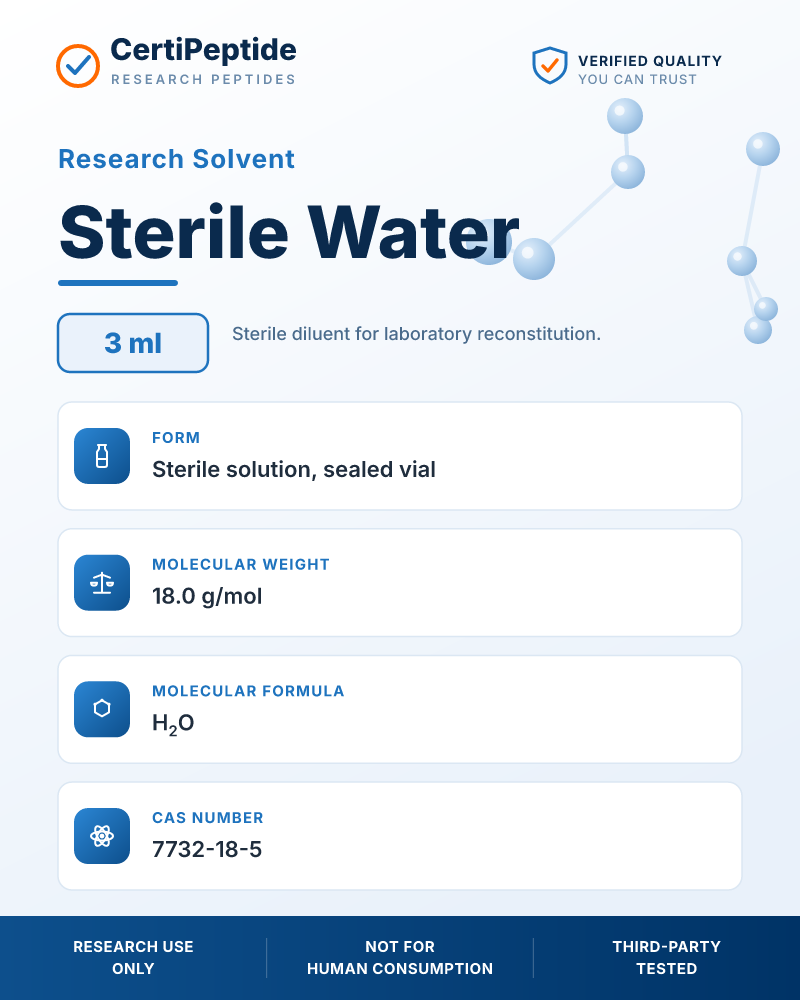
Sterile Water
Sterile water for research is water that has been processed and sterilized to meet low bioburden and particulate expectations appropriate for laboratory reconstitution. It contains no antimicrobial preservative. Once a sealed container is opened or a stopper is punctured, there is no built-in agent to suppress growth of introduced organisms. Many lab SOPs therefore is researched in the context of opened sterile water as single-session or single-use, discarding remainder after the work block or per timed discard rules.
Typical research uses include:
- Initial reconstitution of lyophilized research peptides when preservatives are undesirable
- Preparation of blanks and diluent controls for HPLC, LC-MS, or UV assays
- Cell-culture or sensitive bioassay workflows where benzyl alcohol could confound results (protocol-dependent)
- Short-hold solutions prepared immediately before use
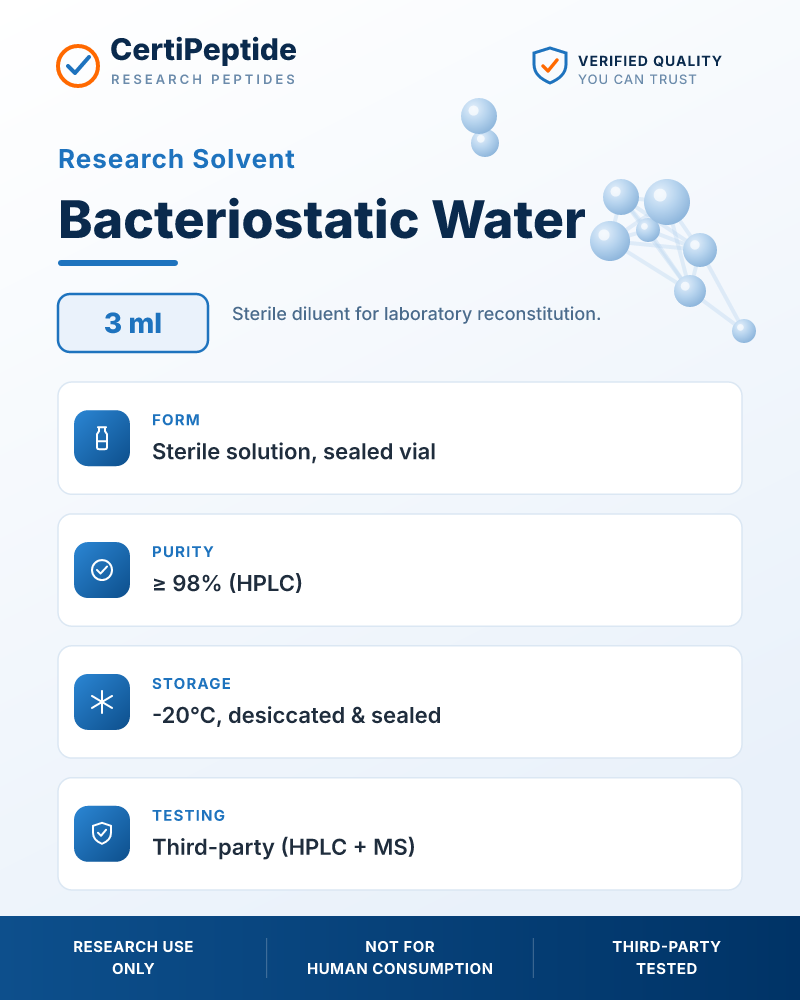
Bacteriostatic Water
Bacteriostatic water is sterile water formulated with a bacteriostatic preservative—most commonly benzyl alcohol at about 0.9% (w/v). The preservative does not “sterilize” a contaminated solution; it inhibits growth of many bacteria under labeled conditions, which is why multi-dose research vials are often preferred when the same container will be accessed more than once under aseptic technique.
Typical research uses include:
- Multi-aliquot reconstitution from a shared research vial over a defined period
- Workflows that require repeated needle entries into the same stopper
- Situations where lab logistics favor fewer open containers, provided assays tolerate the preservative
Always read the supplier certificate of analysis (CoA), concentration of preservative, and storage statements for the specific Bacteriostatic Water lot used in the study.
Sterile Water vs Bacteriostatic Water: Side-by-Side Research Differences
| Factor | Sterile Water | Bacteriostatic Water |
|---|---|---|
| Preservative | None | Usually ~0.9% benzyl alcohol |
| Multi-draw after puncture | Generally discouraged; is researched in the context of as single-use or short hold | Designed to support multi-entry under aseptic lab practice |
| Additive interference risk | Minimal water-only matrix | Possible UV, MS, or cell-assay effects from benzyl alcohol |
| Odor / organoleptics | Neutral | Characteristic benzyl alcohol odor |
| Common research fit | Sensitive analytics, preservative-free needs | Repeated sampling from one vial |
| Discard practice | Often immediate or same-session | Per SOP dating after first puncture |
Microbial control after first access
The central operational difference in the Sterile Water Bacteriostatic Water comparison is post-puncture microbial risk management. Sterile water relies entirely on process control: sterile technique, clean environment, and limited open time. Bacteriostatic water adds a chemical barrier against bacterial proliferation but does not replace aseptic handling, nor does it guarantee activity against all organisms (including many fungi or resistant contaminants).
Analytical and biological assay compatibility
Benzyl alcohol can appear in chromatographic baselines, affect ionization, or influence membrane and cell-based readouts. When the endpoint is high-sensitivity LC-MS quantitation, residual solvent profiling, or primary cell assays, researchers often prefer Sterile Water or verify that bacteriostatic levels are below interference thresholds with method blanks. Conversely, for rugged solubility screens or bulk aliquot preparation where multi-entry convenience dominates and the assay is insensitive to the preservative, Bacteriostatic Water may simplify logistics.
Chemical stability of the diluent itself
Both products are chemically simple. Stability concerns are mainly container integrity, light and temperature storage per label, and—for bacteriostatic water—maintenance of effective preservative concentration and pH over shelf life. Neither diluent “activates” peptides; they are vehicles. Peptide stability after reconstitution depends on sequence, concentration, pH, temperature, freeze–thaw cycles, and sorption—not only which water type was chosen.
Similarities Researchers Sometimes Overlook
Despite frequent framing of Sterile Water or Bacteriostatic Water as opposites, they share important traits:
- Sterility at release — Both are supplied as sterile fluids intended for controlled laboratory reconstitution and dilution, not as substitutes for validated process water systems unless qualified.
- Aqueous vehicle role — Both dissolve hydrophilic research materials and dilute stocks for in-vitro experiments.
- Need for aseptic technique — Preservative presence does not excuse non-sterile needles, repeated non-aseptic handling, or storage outside labeled conditions.
- Documentation burden — Lot numbers, open dates, and discard dates belong in the lab notebook for either product.
- Incompatibility edge cases — Some research compounds show poor solubility in pure water or interact with alcohols; pilot solubility checks remain necessary regardless of brand.
Choosing Sterile Water or Bacteriostatic Water for Study Design
Prefer sterile water when
- The method is additive-sensitive (LC-MS, NMR residual checks, certain cell or enzyme assays).
- Only one draw is planned, or fresh diluent is prepared each session.
- The protocol or quality agreement specifies preservative-free diluent.
- You are generating reference blanks that must match a water-only matrix.
Prefer bacteriostatic water when
- The same research vial will be entered multiple times over days under a written multi-use SOP.
- The assay has been shown (or is reasonably expected) to tolerate low-percent benzyl alcohol.
- Lab throughput benefits from fewer opened containers and documented beyond-use intervals after puncture.
- Training emphasis is on consistent aseptic multi-draw practice rather than single-use discard.
Decision checklist for peptide-related research workflows
- Endpoint sensitivity — Will benzyl alcohol bias the readout?
- Access pattern — One reconstitution vs repeated sampling?
- Hold time — Minutes, hours, or multi-day refrigerated hold of the diluent vial?
- Material compatibility — Any known alcohol sensitivity of the analyte?
- SOP and training — Can staff reliably execute aseptic multi-entry if bacteriostatic water is chosen?
- Controls — Are diluent-only blanks included for whichever product is selected?
Natural pairing in a research supply context often means stocking both Sterile Water for method-critical, preservative-free steps and Bacteriostatic Water for multi-draw convenience where validated as non-interfering.
Practical Handling Notes for Laboratory Use
Shared good practices
- Inspect containers for particulates, cracks, or seal damage before use.
- Record lot, expiry, and first-puncture date/time.
- Use sterile, appropriate-gauge needles and avoid coring stoppers when possible.
- Wipe septa with a suitable sterile alcohol pad and allow to dry when SOPs require.
- Store upright under labeled temperature conditions; protect from unnecessary light and heat.
- Do not pool remainder from different lots or container types.
Sterile water–specific habits
- Plan aliquot maps so one opening covers the session.
- Discard unused portion per single-use or timed policy.
- Prefer smaller fill volumes if waste from single-use practice is high.
Bacteriostatic water–specific habits
- Define a clear beyond-use interval after first puncture in the study SOP.
- Monitor for haze, discoloration, or particulates and quarantine suspect vials.
- Confirm that downstream assays include preservative-matched controls when results will be published or transferred.
Reconstitution workflow (research framing)
For lyophilized research peptides, labs commonly allow the vial to reach ambient temperature, introduce the chosen diluent slowly along the wall, swirl gently without harsh foaming, and document final nominal concentration for subsequent dilution series. Choice of Sterile Water versus Bacteriostatic Water should be locked in the method section so replicates remain comparable across operators and dates.
Common Failure Modes and How Comparison Knowledge Helps
- Unexpected assay drift — Switching from sterile to bacteriostatic water mid-study without re-validating blanks can shift baselines; lock the diluent in the protocol.
- Contamination despite “bacteriostatic” label — Preservative is not a substitute for sterile tools; contaminated multi-dose vials still fail.
- Over-holding sterile water — Treating preservative-free water like a multi-week multi-dose vial increases risk.
- Ignoring solubility — Neither water type fixes a compound that needs co-solvents; screening remains essential.
- Poor labeling — Un-dated punctured bacteriostatic vials create irreproducible hold-time variables.
Summary: Matching Diluent to Research Intent
The Sterile Water vs Bacteriostatic Water decision is a method-design choice. Use Sterile Water when the matrix must stay preservative-free and access is single-session. Use Bacteriostatic Water when controlled multi-draw access is required and the preservative is compatible with analytical or biological endpoints. Both support rigorous laboratory reconstitution and dilution of research materials when handled under aseptic SOPs, fully documented, and paired with appropriate blanks and stability checks. Align the selection with endpoint sensitivity, sampling frequency, and quality documentation so results stay comparable across the life of the study.
FAQ
Short answers to frequent long-tail questions from research buyers comparing these diluents appear in the structured FAQ associated with this article (see JSON faq field for publishable Q&A pairs covering interference, multi-use intervals, peptide reconstitution, and storage).
Explore Further
Browse our research peptide catalog and review third-party lab reports & COAs for every batch.
---
Research use only. The information above is provided for educational and laboratory research purposes only. The compounds discussed are not approved for human or veterinary use, diagnosis, treatment, or the prevention of any disease. Nothing here is medical advice.