TL;DR
PTD-DBM vs AHK-Cu is a common comparison when labs design studies on hair-follicle biology, dermal signaling, and copper-peptide matrix pathways. PTD-DBM is typically framed as a Wnt/β-catenin pathway tool peptide (protein transduction domain fused to a Dishevelled-binding motif) used to probe CXXC5–Dvl interaction and regenerative signaling in controlled models. AHK-Cu is a copper-binding tripeptide complex studied for effects on cultured dermal cells, extracellular-matrix (ECM) markers, and follicle-associated endpoints. They are not interchangeable: one is pathway-interference oriented; the other is a metal–peptide complex with redox and matrix-related research interest. Choice depends on hypothesis, assay type, and whether copper handling is part of the design.
Why Compare PTD-DBM or AHK-Cu in Laboratory Work?
Researchers often search PTD-DBM or AHK-Cu when planning in vitro or ex vivo work on skin and follicle biology. Both compounds appear in literature and supplier catalogs aimed at research-use-only peptide studies, but they address different mechanistic questions.
A structured PTD-DBM AHK-Cu comparison helps teams avoid mismatched endpoints: using a transduction-domain pathway disruptor when the question is copper-dependent fibroblast behavior—or the reverse. This article summarizes research-oriented differences, overlaps, and practical study-design notes without clinical claims.
What Is PTD-DBM in Research Contexts?
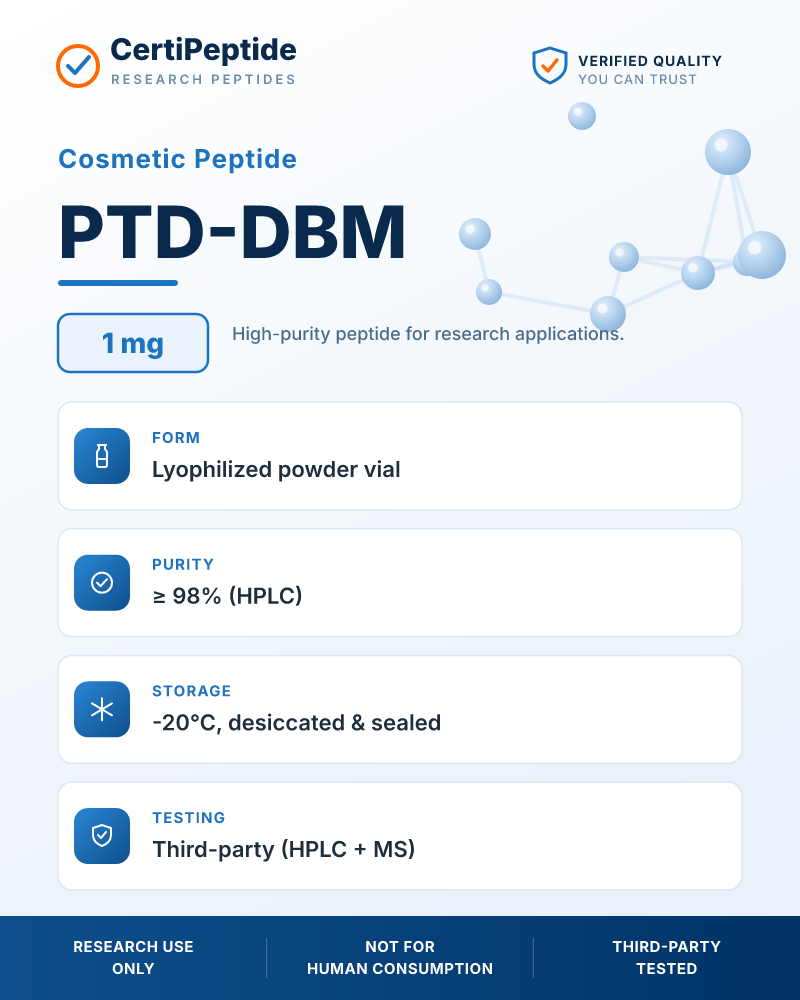
PTD-DBM (Protein Transduction Domain–Dishevelled Binding Motif) is a engineered peptide construct. The PTD segment is intended to improve cellular entry in experimental systems; the DBM portion is designed to interact with Dishevelled (Dvl) and thereby modulate the CXXC5–Dvl interaction that can restrain Wnt/β-catenin signaling in certain models.
Typical research framing for PTD-DBM
- Pathway focus: Wnt/β-catenin, Dvl, CXXC5-related readouts
- Common model types: keratinocyte or follicle-associated cell cultures; tissue explants; molecular assays for β-catenin targets
- Why investigators use it: to test whether relieving a specific inhibitory protein–protein interaction changes regenerative or proliferative markers in controlled lab settings
- Material considerations: sequence integrity, purity, vehicle compatibility, and consistent handling for transduction-domain peptides
PTD-DBM is best treated as a mechanistic probe for a defined interaction node, not as a generic “hair peptide.” Study designs usually include pathway reporters, target-gene expression, and appropriate negative controls (scrambled or inactive analogs when available).
What Is AHK-Cu in Research Contexts?
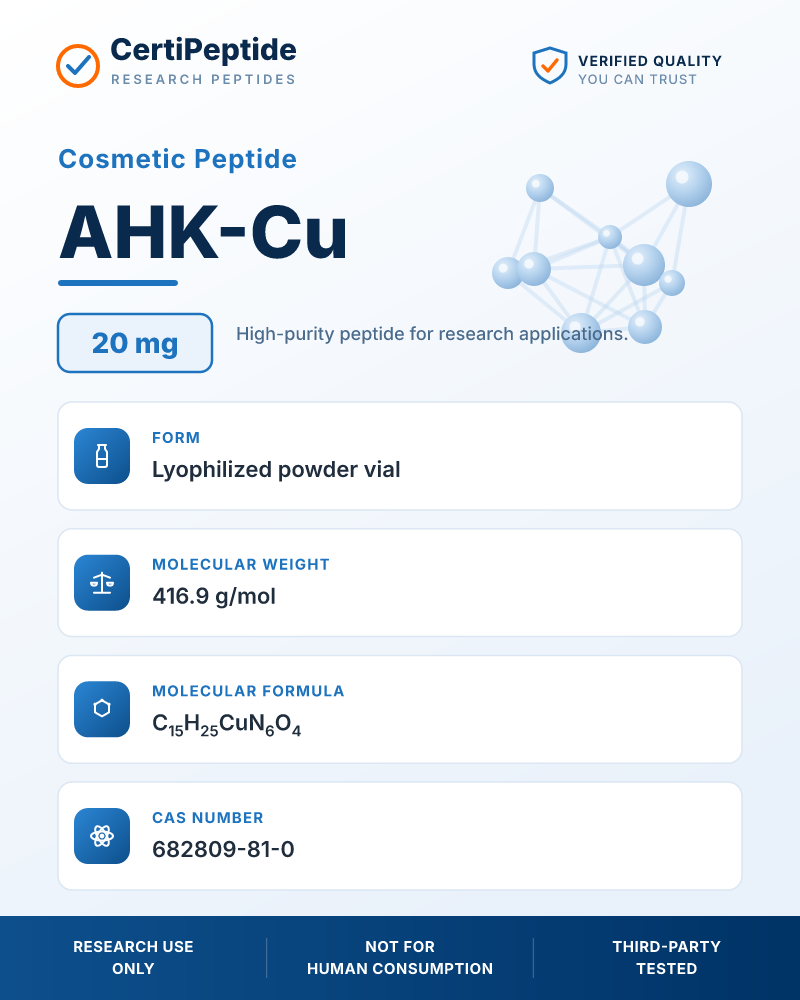
AHK-Cu refers to the copper(II) complex of the tripeptide AHK (alanine–histidine–lysine). Copper peptides are widely examined in dermal and connective-tissue research because copper ions participate in enzymatic and redox processes linked to ECM remodeling in vitro.
Typical research framing for AHK-Cu
- Complex focus: peptide ligand plus coordinated copper
- Common model types: dermal fibroblasts, co-cultures, wound-assay scratch models, follicle organ culture where copper peptides are endpoints of interest
- Why investigators use it: to explore copper delivery, local peptide–metal effects on collagen/ECM markers, antioxidant-related assays, and cell-migration or viability panels under defined media conditions
- Material considerations: copper stoichiometry, free vs bound copper, buffer choice, and avoiding unintended precipitation or media interactions
AHK-Cu studies often emphasize metal–peptide chemistry and matrix biology more than a single intracellular protein–protein interaction.
PTD-DBM vs AHK-Cu: Core Mechanistic Differences
| Dimension | PTD-DBM | AHK-Cu |
|---|---|---|
| Chemical class | Engineered PTD fusion peptide | Cu(II)–tripeptide complex |
| Primary research “hook” | CXXC5–Dvl / Wnt–β-catenin node | Copper–peptide and ECM/dermal cell responses |
| Entry / delivery narrative | PTD-assisted cellular access in models | Complex stability, local Cu availability |
| Typical readouts | Pathway reporters, β-catenin targets, follicle morphometrics in explants | ECM genes/proteins, migration, redox/copper assays |
| Control logic | Inactive motif or non-transducing controls | Apo-peptide (AHK without Cu), Cu salts alone, chelator controls |
Pathway specificity vs metal–ligand biology
In a PTD-DBM vs AHK-Cu design choice, ask: Is the hypothesis about a discrete Dvl-binding interaction, or about copper-dependent dermal biology? PTD-DBM aligns with the former; AHK-Cu with the latter. Combining them without clear factorial design can confound interpretation (pathway shift plus altered copper load).
Analytical and handling differences
- PTD-DBM: longer sequence; purity, identity (MS/HPLC), and aggregation risk matter; vehicle and serum can affect uptake assays.
- AHK-Cu: verify copper content and complex integrity; control for free Cu²⁺ toxicity artifacts in sensitive cultures; pH and amino-acid-rich media can change speciation.
Similarities Relevant to Study Design
Despite different mechanisms, PTD-DBM and AHK-Cu share practical overlaps in laboratory workflows:
- Dermal / follicle-adjacent research niches — Both appear in papers and protocols touching hair-follicle biology, scalp skin models, or regenerative signaling themes. That shared niche drives many “PTD-DBM or AHK-Cu” searches, even though endpoints differ.
- Peptide-centric quality controls — Identity, purity, lot documentation, storage temperature, and light/oxidation protection (especially for copper complexes) are standard good laboratory practice.
- Need for rigorous controls — Vehicle-only arms, concentration–response curves (for in vitro systems), and orthogonal assays reduce false positives from osmolarity, pH, or metal contamination.
- Ex vivo and in vitro preference in many labs — Both are frequently evaluated in cell culture or organ-culture frameworks before any broader animal work, depending on institutional protocols.
- Research-use positioning — Supplied and discussed as tools for controlled experiments, not as approved therapeutics or consumer actives in this context.
PTD-DBM AHK-Cu Comparison: Choosing by Hypothesis
Choose PTD-DBM-oriented designs when
- The question centers on Wnt/β-catenin tone and CXXC5–Dvl interaction.
- You can measure pathway outputs (e.g., reporter activity, selected target transcripts/proteins).
- You need a peptide tool rather than a metal complex.
- Control peptides without functional DBM or without PTD are feasible.
Choose AHK-Cu-oriented designs when
- The question centers on copper–peptide effects on fibroblasts, ECM markers, or redox-related endpoints.
- You can separate peptide ligand effects from copper-only effects.
- Media copper background and chelation status are characterized.
- Analytical confirmation of the complex is part of QC.
When labs evaluate both
Some groups run parallel arms (not mixed ambiguous doses) to map which pathway class moves a shared phenotypic readout (for example, hair-shaft elongation in organ culture or keratinocyte proliferation indices). Parallelism only works if:
- Endpoints are pre-registered in the lab notebook or protocol.
- Copper contamination of PTD-DBM stocks is ruled out.
- Statistical power accounts for multiple comparisons.
- Each arm has its own mechanism-appropriate positive/negative controls.
Experimental Readouts Commonly Paired With Each Compound
PTD-DBM-aligned assays
- β-catenin stabilization or nuclear localization imaging in fixed cells
- qPCR/protein panels for Wnt target genes relevant to the tissue model
- Follicle staging or morphometrics in explant systems where Wnt tone is hypothesized to matter
- Co-IP or proximity assays if CXXC5–Dvl disruption is directly tested
AHK-Cu-aligned assays
- Collagen and other ECM transcript/protein quantification
- Scratch or Boyden migration assays in dermal fibroblasts
- Copper uptake or metallothionein-related markers where justified
- ROS/antioxidant capacity panels interpreted cautiously (copper can be pro- or antioxidant depending on conditions)
Shared phenotypic screens (interpret with care)
Cell viability, cytotoxicity (LDH), and basic proliferation (EdU/Ki-67) are common gatekeepers for both. Phenotype-only screens cannot distinguish PTD-DBM pathway action from AHK-Cu metal–ligand action without mechanistic follow-up.
Practical Lab Considerations (Non-Clinical)
Documentation: Record lot numbers, certificates of analysis, solvent, filtration steps, and freeze–thaw counts for both PTD-DBM and AHK-Cu.
Solubility and vehicles: Use vehicles validated for cell compatibility; avoid assuming water solubility equals bioassay compatibility.
Concentration exploration: In research settings, map wide ranges with cytotoxicity guards; report molarity clearly (especially for AHK-Cu, state whether concentrations refer to peptide ligand or copper).
Interference: Copper can affect some fluorescence and enzymatic assays; PTD peptides can show non-specific membrane effects at high levels—include counterscreens.
Storage: Follow supplier guidance; protect copper peptides from conditions that promote ligand exchange or oxidation; aliquot transduction peptides to reduce freeze–thaw damage.
How Suppliers and Catalog Listings Fit Research Workflows
From a procurement perspective, labs often stock PTD-DBM for pathway-dissection projects and AHK-Cu for copper-peptide matrix studies. Clear labeling, research-only designations, and batch analytics matter more than marketing comparisons. When building a cart for a comparison study, align certificates (HPLC/MS, copper content where applicable) with the assays you will run.
Summary Table: Quick Decision Guide
- Need Dvl/CXXC5–Wnt tool peptide? → Prioritize PTD-DBM designs.
- Need Cu–tripeptide complex for ECM/dermal panels? → Prioritize AHK-Cu designs.
- Shared follicle-related phenotype only? → Run parallel, controlled arms; do not is researched in the context of the compounds as mechanistic substitutes.
- Unclear hypothesis? → Define molecular endpoint first; the PTD-DBM vs AHK-Cu choice usually becomes obvious.
Conclusion
A careful PTD-DBM AHK-Cu comparison shows complementary—not redundant—research roles. PTD-DBM is positioned in studies as a transduction-enabled probe around Dishevelled-related Wnt regulation. AHK-Cu is positioned as a copper–peptide complex for dermal cell and ECM-oriented experiments. Similarities lie in quality-control discipline, dermal/follicle model popularity, and the need for mechanism-matched controls. For investigators deciding PTD-DBM or AHK-Cu, let the primary molecular question drive compound selection, assay battery, and control strategy in laboratory research.
FAQ
Explore Further
Browse our research peptide catalog and review third-party lab reports & COAs for every batch.
---
Research use only. The information above is provided for educational and laboratory research purposes only. The compounds discussed are not approved for human or veterinary use, diagnosis, treatment, or the prevention of any disease. Nothing here is medical advice.