TL;DR
MIC(LC216) is a research peptide used in controlled laboratory settings to explore structure–activity relationships, signaling readouts, and assay design. This article summarizes what MIC(LC216) is in a research context, how investigators frame MIC(LC216) mechanism hypotheses, and the experimental approaches commonly used in MIC(LC216) research. All discussion below is limited to in vitro, ex vivo, and non-clinical laboratory investigation.
What Is MIC(LC216)?
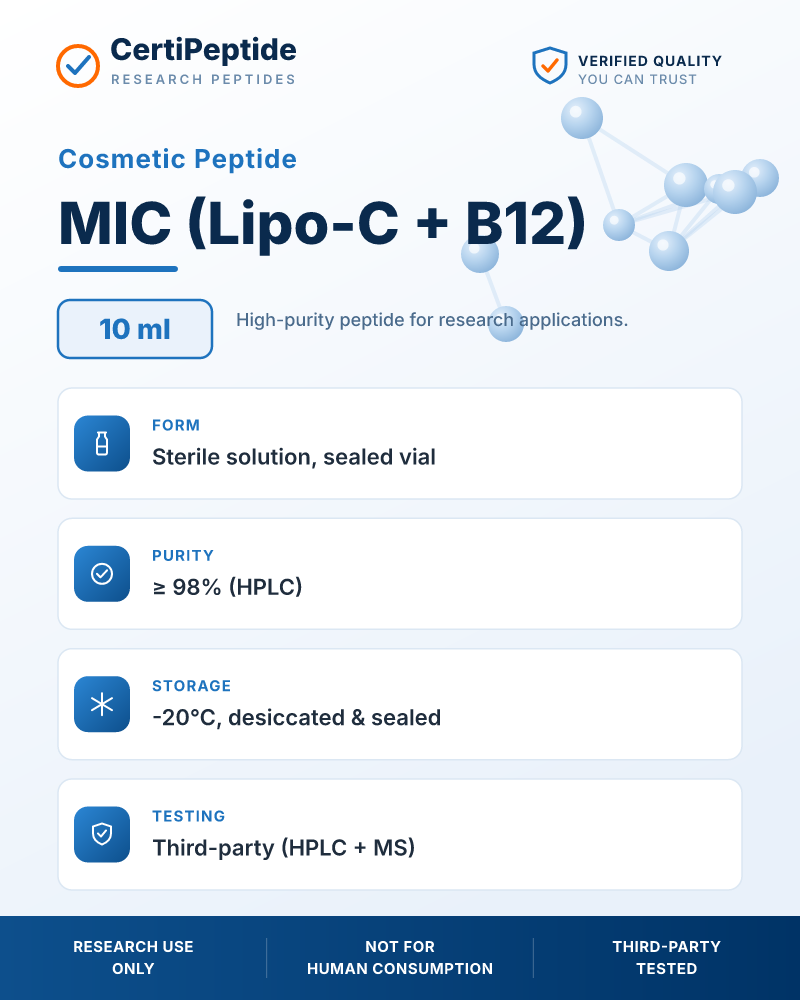
What is MIC(LC216) in practical lab terms? MIC(LC216) is supplied as a discrete research peptide (catalog-style designation LC216) intended for experimental use only. Researchers typically is researched in the context of it as a defined molecular tool: a sequence-characterized peptide stock that can be reconstituted, quantified, and applied in model systems to generate measurable biochemical or cellular endpoints.
In catalog and methods language, the MIC(LC216) peptide is handled like other research peptides: identity and purity are verified analytically, working solutions are prepared under documented conditions, and exposure is limited to systems designed for mechanistic or methodological study. It is not framed here as a therapeutic, diagnostic, or consumer product.
Key practical attributes investigators usually document when onboarding MIC(LC216) include:
- Peptide identity (sequence confirmation where applicable)
- Purity profile (e.g., HPLC) and mass confirmation (e.g., MS)
- Solubility and vehicle compatibility for the intended assay matrix
- Storage stability of lyophilized material versus working aliquots
- Lot-to-lot consistency for multi-experiment campaigns
These basics matter because mechanistic conclusions are only as strong as the characterization of the test article.
Why MIC(LC216) Appears in Research Workflows
Interest in MIC(LC216) research generally tracks three laboratory needs:
- Tool-compound exploration — testing whether a defined peptide produces concentration-dependent changes in a chosen pathway or phenotype in cells or isolated preparations.
- Assay development — using a consistent peptide standard while optimizing buffers, time points, controls, and detection methods.
- Comparative peptide studies — placing MIC(LC216) alongside structural analogs to map which residues or motifs drive observed readouts.
Because peptide tools can be sensitive to aggregation, adsorption to plastics, and proteolytic turnover, well-run studies emphasize pre-analytical controls as much as the biological endpoint itself.
MIC(LC216) Mechanism: How Hypotheses Are Framed
Discussions of MIC(LC216) mechanism in the literature and lab notebooks are hypothesis-driven. Researchers typically do not assume a single fixed “mode of action” without orthogonal evidence. Instead, they build a chain of inference:
1. Target-engagement hypotheses
Investigators may ask whether MIC(LC216) interacts with a candidate receptor, enzyme, transporter, or protein–protein interface. Early work often starts with binding or competition formats (where a validated probe exists), pull-down/enrichment designs, or biophysical methods compatible with peptides.
2. Pathway-level readouts
If target engagement is plausible, teams measure downstream messengers or reporter activity—second messengers, phosphorylation events, transcriptional reporters, or secreted factors—under vehicle-controlled conditions. Time-course and concentration–response designs help distinguish primary responses from secondary adaptation.
3. Specificity and off-target checks
Mechanism claims strengthen when experiments include scrambled or inactive analogs, receptor/pathway blockade (pharmacological or genetic), and counterscreens in related pathways. For any MIC(LC216) peptide study, specificity controls reduce the risk of interpreting formulation or stress artifacts as biology.
4. Context dependence
Peptide effects can depend on cell type, differentiation state, serum content, extracellular matrix, and incubation time. Mechanism language should stay tied to the model system actually used (e.g., a particular cell line, primary culture, or cell-free assay), not generalized beyond the data.
In short, MIC(LC216) mechanism work is iterative: map exposure → engagement → pathway shift → phenotype, then stress-test each link.
Laboratory Approaches Used to Study MIC(LC216)
Analytical characterization before biology
Prior to cell work, many groups confirm that the material matches expectations:
- Reverse-phase HPLC for purity
- Mass spectrometry for molecular ion confirmation
- Optional amino-acid analysis or peptide mapping for deeper identity work
- Endotoxin and sterility checks when downstream models are contamination-sensitive
Documenting solvent, pH, and filtration steps is essential, because apparent “activity” sometimes tracks with preparation variables rather than the peptide backbone.
In vitro cellular models
Common designs in MIC(LC216) research include:
- Concentration–response curves across a pre-specified range with independent replicates
- Time-course sampling to capture transient versus sustained signals
- Vehicle and comparator arms (inactive analog, known pathway probe)
- Viability/cytotoxicity panels run in parallel so pathway changes are not confounded by overt cell stress
Readouts vary by hypothesis: qPCR or RNA-seq for transcriptional programs; Western blot or phospho-flow for signaling nodes; ELISA/multiplex for secreted factors; high-content imaging for morphological endpoints.
Biochemical and biophysical assays
When the question is molecular rather than cellular, researchers may use:
- Surface plasmon resonance or related binding kinetics (if a purified partner protein is available)
- Fluorescence polarization or TR-FRET competition assays
- Protease-stability incubations in defined matrices
- Circular dichroism or related methods if folding/structure under assay conditions is relevant
These formats help separate direct molecular interactions from emergent cell-level responses.
Ex vivo and tissue-preparation studies
Some programs extend from immortalized lines to primary cells or precision-cut tissue preparations. Those models add physiological context but also variability. Successful designs pre-define inclusion criteria, randomization where applicable, and blinded analysis for subjective endpoints.
Experimental Design Considerations
Rigorous MIC(LC216) studies usually specify:
- Stock handling: aliquot strategy, freeze–thaw limits, protection from light/moisture if relevant
- Adsorption control: low-binding plastics, carrier proteins only when justified and controlled
- Proteolysis awareness: protease inhibitors or serum-free windows when degradation is a confounder
- Osmolality and pH: matched vehicles so “peptide effects” are not vehicle effects
- Statistics plan: sample size rationale, primary endpoint selection, and correction for multiple comparisons
Reporting negative controls and failed conditions is as useful as reporting positive curves; it clarifies the operating envelope of the MIC(LC216) peptide in a given matrix.
Data Interpretation and Reproducibility
When interpreting datasets, experienced groups separate:
- Pharmacodynamic-style assay behavior (EC50-like metrics inside one model)
- Molecular mechanism (evidence of a discrete target or step)
- Broader biological inference ( whichtypically requires multiple models and orthogonal assays)
Replication across lots of MIC(LC216), across operators, and across detection platforms is the practical standard for trusting a signal. If a result collapses after switching plastics, serum lots, or dissolution methods, the finding may be methodological rather than mechanistic.
Practical Notes for Research Teams Sourcing MIC(LC216)
For laboratories planning new MIC(LC216) research:
- Align certificate-of-analysis data (purity, identity) with the sensitivity of your endpoint.
- Pilot solubility and stability in the exact assay buffer before large factorial experiments.
- Pre-register or at least pre-specify primary endpoints to reduce analytical flexibility.
- Archive raw chromatograms, spectra, and plate-level files alongside notebook summaries.
Used this way, MIC(LC216) functions as a traceable experimental input rather than an undefined additive.
Summary
MIC(LC216) is a research peptide applied in laboratory investigation of peptide behavior, assay performance, and potential pathway modulation. Credible MIC(LC216) mechanism statements rest on analytical identity, controlled exposure, orthogonal readouts, and explicit model limits—not on single unblinded assays. Researchers studying the MIC(LC216) peptide benefit most from careful formulation controls, concentration–response and time-course designs, and reproducibility checks across lots and methods.
FAQ
Explore Further
Browse our research peptide catalog and review third-party lab reports & COAs for every batch.
---
Research use only. The information above is provided for educational and laboratory research purposes only. The compounds discussed are not approved for human or veterinary use, diagnosis, treatment, or the prevention of any disease. Nothing here is medical advice.