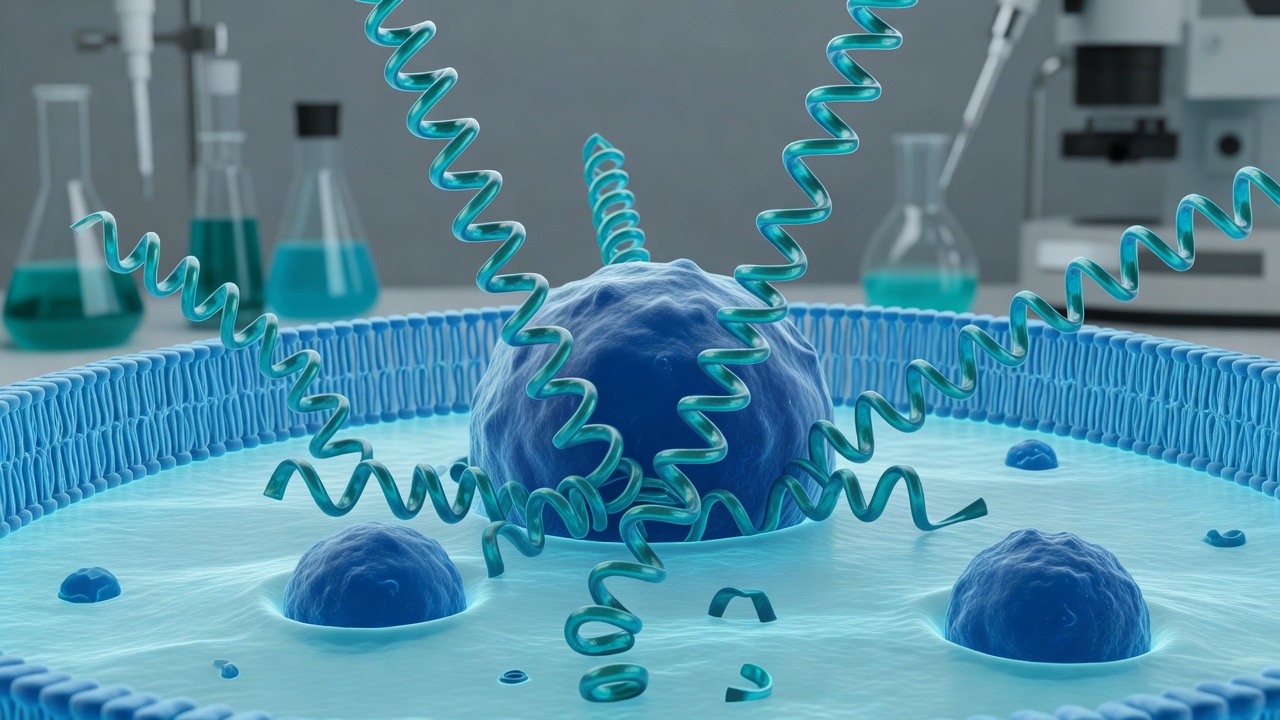
As of 1 October 2026, the indexed records from 24 and 25 September 2026 that address intracellular peptide delivery are review abstracts, not primary experiments that isolate surface binding, vesicular uptake, and cytosolic access with orthogonal controls. Both treat plasma-membrane crossing and endosomal escape as sequential problems rather than a single uptake score. The usable claim is chemical and physiological: different amino acids are assigned to different barriers, and peptide CRISPR delivery in tissue is described as facing more than those two steps.
Residue maps are not compartment assays
Akinsola and Narayanan, in a 25 September 2026 review in Journal of drug targeting, state that cell-penetrating peptide (CPP) delivery efficiency is much lower than that of other non-viral systems because of several cellular barriers: the plasma membrane, endosomal acidification, cytosolic degradation, and nuclear entry. The plasma membrane is described as a significant extracellular barrier that regulates biomolecule entry. Peptides containing functional groups such as basic amino acids are presented as a way to address that step.
After internalization, the abstract states that CPPs must still cross further barriers, and that their ability to do so depends mainly on the specific amino acids in the peptide. Histidine is cited as helping with endosomal escape. A nuclear localization signal is said to increase the likelihood of nuclear entry. Overcoming the listed barriers is attributed to both the presence and the position of specific residues. The authors also discuss some CPPs that have advanced to clinical trials and highlight their strengths; the abstract does not name those peptides or report trial results.
That mapping is the insight for this week's question. If basic residues are invoked for membrane engagement and histidine for leaving acidifying vesicles, a cell-associated signal after incubation cannot, by itself, identify which barrier was crossed. Surface-bound peptide, endosome-trapped peptide, and cytosolic peptide would all register as cell-associated unless later steps are scored independently. The abstract does not describe the assays that would make that separation.
Dish editing is not cytosolic proof in tissue
Ressnerova and Wilson, in a 24 September 2026 review in Current opinion in chemical biology, place the same two steps in a CRISPR-delivery context. Peptide platforms are described as chemically defined, modular, small enough to penetrate dense tissues, inexpensive to synthesize, and redesignable residue by residue. In cell culture, the abstract states that peptide platforms compete effectively against standard electroporation, delivering high editing efficiency in primary human cells while significantly improving cell viability. Editing is a functional cytosolic and nuclear readout in principle, but the abstract does not specify how surface-bound or endosomal cargo was excluded, nor does it report numerical efficiencies.
The in vivo contrast is stated directly: when peptide-delivered CRISPR editors are introduced by tissue injection, they must tackle more barriers than mere cell entry and endosomal escape they had to face in the dish. Typical editing efficiencies are described as modest, which the authors note could still yield a therapeutic benefit. For systemic delivery, more fragile but transient ribonucleoprotein complexes face hepatic clearance, phagocytic capture, and protein corona interference, obstacles the review says are driving a shift toward engineered nanoassemblies and mRNA/DNA cargo alternatives.
The authors argue that peptide-mediated delivery must reconcile conservative clinical translation with chemical innovation, and that the field must transition past qualitative readouts and integrate isolated advancements into a single cohesive vehicle engineered for robust in vivo efficacy. That is a methodological warning as much as a delivery claim: qualitative uptake images do not establish cytosolic editor access, and even functional editing in a dish does not forecast the extra barriers of injection or bloodstream exposure.
An adjacent 8 September 2026 review of mRNA-lipid nanoparticle medicines for the ageing brain lists efficient endosomal escape in aged neurons among major remaining hurdles and mentions peptide-functionalized shells among emerging chemistries (Belaidi et al.). That paper is not a peptide-cargo study; it is useful here only as a reminder that endosomal escape is treated as a distinct failure mode across delivery modalities.
What these abstracts do and do not support
| Step | Assigned in the September 2026 abstracts | Not reported in the retrieved abstracts |
|---|---|---|
| Plasma-membrane entry | Basic amino acids and related functional groups in CPPs; peptide platforms that compete with electroporation in primary human cells | Binding-versus-uptake controls or quantitative association data |
| Endosomal escape | Histidine as a residue that helps escape; escape listed as a dish-stage barrier still required in vivo | pH-dependent assays or cytosolic-versus-vesicular measurements |
| Downstream access | Nuclear localization signals for nuclear entry; CRISPR editing as a functional endpoint; modest editing after tissue injection | Orthogonal cytosolic sensors, sample sizes, or named peptide sequences |
These are review abstracts retrieved without full text. They do not substitute for primary delivery experiments, and they do not validate any supplier peptide as a research or clinical reagent.
Checklist for reading this week's records:
- Treat membrane entry, endosomal escape, and later in vivo barriers as separate claims.
- Do not read cell-associated peptide from these abstracts as cytosolic delivery.
- Do not transfer dish editing statements to tissue injection or systemic ribonucleoprotein delivery.
- Do not treat unnamed CPPs said to have reached clinical trials as identified products or efficacy results.
A specific remaining question, given only these records, is whether histidine's assigned role in endosomal escape can be measured in the same experiment as basic-residue-dependent membrane association, so that increased cell-associated peptide is not mistaken for increased cytosolic peptide. The CRISPR review's call to move past qualitative readouts points at that gap without filling it.
As of 1 October 2026, the week's indexed literature restates a design split among membrane entry, vesicular escape, and later physiological barriers rather than delivering a new control set that separates those compartments experimentally.
Frequently Asked Questions
Do these papers report new assays that separate surface binding from cytosolic access?
No. The 24 and 25 September 2026 records are reviews. Their retrieved abstracts do not describe new primary experiments or named controls that isolate surface binding, vesicular uptake, and cytosolic access.
Can these reviews be used to choose a CPP sequence for cytosolic delivery?
No. The abstracts do not name sequences, report numerical efficiencies, or describe assays that confirm cytosolic access. They map residue classes to barriers and warn against relying on qualitative readouts.
Explore Further
Browse our research peptide catalog and review third-party lab reports & COAs for published batches.
---
Research use only. The information above is provided for educational and laboratory research purposes only. The compounds discussed are not approved for human or veterinary use, diagnosis, treatment, or the prevention of any disease. Nothing here is medical advice.