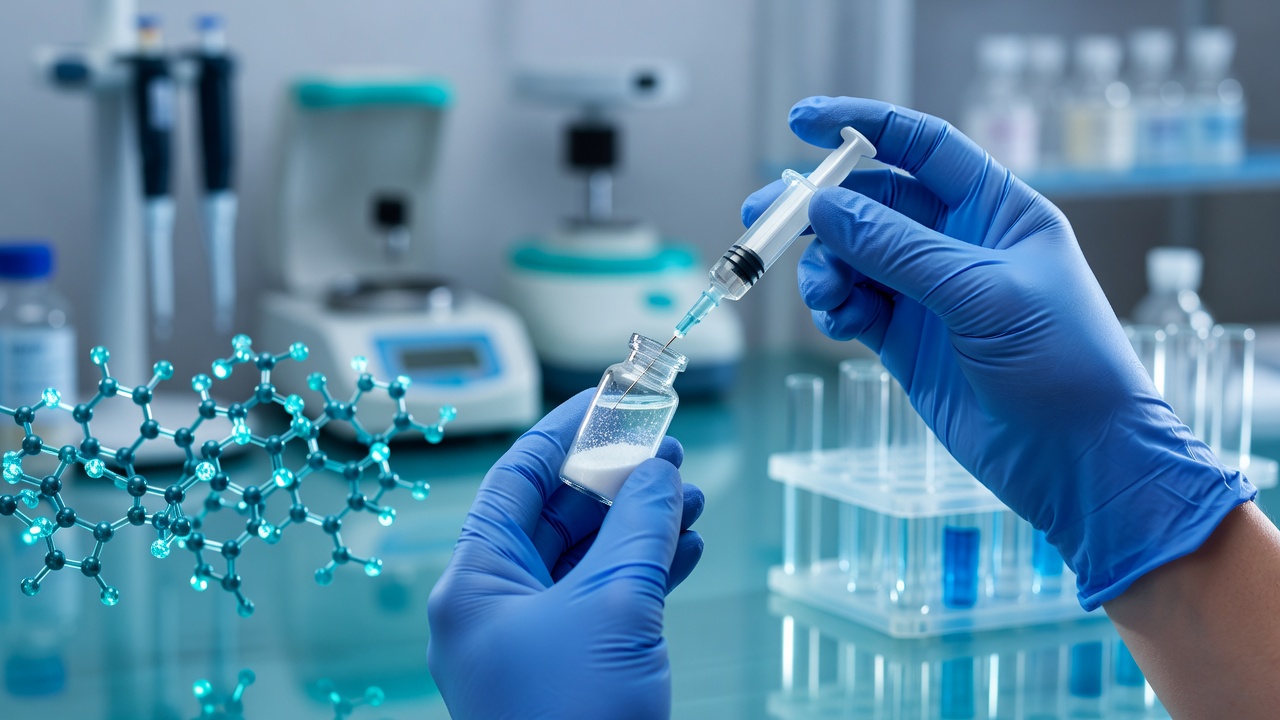
Lyophilized research peptides have to be reconstituted with a diluent before they can be used in a research protocol. The Peptide Reconstitution Basics guide is site editorial guidance, not independent scientific evidence. It describes bacteriostatic water as a commonly chosen diluent, explains how to add it, and defines concentration as peptide mass divided by diluent volume. The notes below collect that sequence, the public Bacteriostatic Water pack sizes, two published certificates of analysis for named lots, and the site's storage notes.
Listed bacteriostatic water SKUs
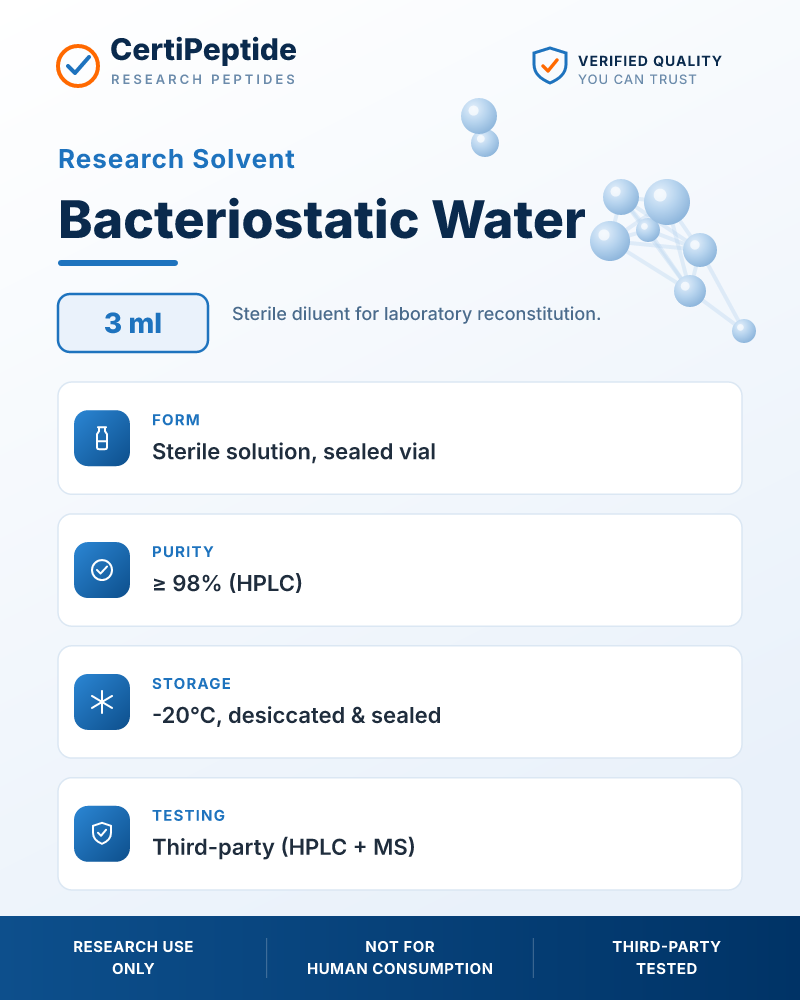
The public listing records two variants (public listed variants only; at most 40, not a claim that the list is exhaustive). Bacteriostatic Water SKU BA3 is 3 ml per vial with 10 vials per pack. SKU BA10 is 10 ml per vial with 10 vials per pack. CAS number, molecular formula, and molecular weight are marked unknown on that listing.
Those millilitre figures are nominal catalog sizes. Measured fill on a tested lot is reported only on that lot's certificate, in millilitres, and can differ from the nominal size.
Editorial reconstitution steps
The Peptide Reconstitution Basics page states a short handling sequence:
- Lyophilized (freeze-dried) peptides must be reconstituted before use in research protocols.
- Bacteriostatic water is commonly used because the benzyl alcohol content limits microbial growth across multiple draws.
- Direct the stream against the vial wall rather than onto the powder.
- Let the peptide dissolve without vigorous shaking.
- Concentration is peptide mass divided by diluent volume. Use the reconstitution calculator on that page to convert to the exact volume to draw for a target amount.
No peptide identity, milligram amount, or target draw appears in the sources, so there is no worked calculator example here. Equipment, wipe-downs, needle gauges, and wait times are not specified on those pages.
Checklist aligned to the published notes
- Confirm the peptide is lyophilized and intended for the research protocol.
- If using bacteriostatic water, match a listed SKU (BA3 or BA10) and, when available, the batch certificate for that vial.
- Add diluent against the vial wall, not onto the powder, as the reconstitution guide describes.
- Allow dissolution without vigorous shaking.
- Record concentration as mass divided by volume; use the reconstitution calculator mentioned on the basics page only to convert that concentration to a draw volume for a chosen target amount.
- Apply the site's lyophilized versus reconstituted storage notes in the following section.
Batch certificates (named lots only)
Published recorded results apply to the named batch and SKU only. They are not evidence of clinical suitability or of every batch. Provider verification links were not independently fetched.
BA3 batch DUXP0YTJQ74Z
Certificate QC-2026-3XVHCE5E37 for batch DUXP0YTJQ74Z covers SKU BA3 (listed 3 ml). The laboratory name is Stand Science & Technology Pharmaceutical (Qingdao) Co., Ltd. (Stand Group). The test date is 2026-09-05.
| Item | Method | Specification | Result | Unit | Determination |
|---|---|---|---|---|---|
| Appearance | Visual | Clear, colorless liquid | Clear colorless liquid | Pass | |
| Identity | HPLC | Benzyl alcohol present | Conforms | Pass | |
| Assay | HPLC | 0.85-0.95 % w/v | 0.92 | % w/v | Pass |
| pH | Potentiometry | 4.5-7.0 | 5.9 | Pass | |
| Actual fill | Volumetric | 3 ml | 3.20 | ml | Pass |
| Sterility | Membrane filtration (USP <71>) | No growth | Sterile | Pass | |
| Bacterial endotoxins | LAL (gel-clot) | NMT 0.5 EU/mL | <0.25 | EU/mL | Pass |
The same record's summary fields report purity 0.92 % w/v, identity Conforms, weight 3.20 ml, sterility Sterile, and endotoxin <0.25 EU/mL.
BA10 batch 6D2FT9KF53OI
Certificate QC-2026-NETBEFM8HY for batch 6D2FT9KF53OI covers SKU BA10 (listed 10 ml), from the same laboratory on the same test date.
| Item | Method | Specification | Result | Unit | Determination |
|---|---|---|---|---|---|
| Appearance | Visual | Clear, colorless liquid | Clear colorless liquid | Pass | |
| Identity | HPLC | Benzyl alcohol present | Conforms | Pass | |
| Assay | HPLC | 0.85-0.95 % w/v | 0.91 | % w/v | Pass |
| pH | Potentiometry | 4.5-7.0 | 5.4 | Pass | |
| Actual fill | Volumetric | 10 ml | 10.16 | ml | Pass |
| Sterility | Membrane filtration (USP <71>) | No growth | Sterile | Pass | |
| Bacterial endotoxins | LAL (gel-clot) | NMT 0.5 EU/mL | <0.25 | EU/mL | Pass |
Summary fields report purity 0.91 % w/v, identity Conforms, weight 10.16 ml, sterility Sterile, and endotoxin <0.25 EU/mL.
A sterility or endotoxin determination on these two certificates describes those lots. It does not show that an unlisted lot is sterile, that reconstitution in a given laboratory remains sterile, or that the diluent is appropriate for administration.
Storage notes after the powder is in solution
Storage and Cold Chain for Research Peptides is editorial guidance. For lyophilized powder it says to store sealed vials frozen (-20°C) and protected from light for long-term stability. After reconstitution it says to refrigerate (2–8°C) and use within the timeframe appropriate to the peptide, and to avoid repeated freeze-thaw cycles. That page does not state a number of days, so no in-use expiry is given here.
Evidence gaps
These sources do not compare peptides, mechanisms, or clinical outcomes. They do not list a reconstitution volume for any named peptide, and they do not document a calculator output. Identity and assay lines on the two water certificates are batch measurements; they are not a full composition monograph for every SKU. If a protocol needs a step that is not written on the reconstitution, storage, product, or COA pages cited above, that step is outside this article.
Frequently Asked Questions
Which bacteriostatic water pack sizes are listed?
The public listing shows SKU BA3 at 3 ml per vial (10 vials per pack) and SKU BA10 at 10 ml per vial (10 vials per pack). CAS number, molecular formula, and molecular weight are recorded as unknown.
How does the reconstitution basics page say to add diluent?
Direct the stream against the vial wall rather than onto the powder, and let the peptide dissolve without vigorous shaking.
How is concentration described?
Concentration is peptide mass divided by diluent volume. The same page refers to its reconstitution calculator to convert that value to the volume to draw for a target amount. No peptide-specific masses or volumes are given in the sources used here.
What assay was recorded for bacteriostatic water batch DUXP0YTJQ74Z?
For SKU BA3 batch DUXP0YTJQ74Z, assay by HPLC was 0.92 % w/v against a specification of 0.85-0.95 % w/v, determination Pass (certificate QC-2026-3XVHCE5E37, test date 2026-09-05).
What storage does the site guide give after reconstitution?
Refrigerate (2–8°C) and use within the timeframe appropriate to the peptide. Avoid repeated freeze-thaw cycles. No numeric in-use period in days is stated on that page.
Explore Further
Browse our research peptide catalog and review third-party lab reports & COAs for published batches.
---
Research use only. The information above is provided for educational and laboratory research purposes only. The compounds discussed are not approved for human or veterinary use, diagnosis, treatment, or the prevention of any disease. Nothing here is medical advice.