TL;DR
HCG vs Gonadorelin comparisons center on where each ligand acts in the hypothalamic–pituitary–gonadal (HPG) axis. In laboratory models, human chorionic gonadotropin (HCG) is studied as an LH-receptor agonist that can drive gonadal steroidogenesis and related endpoints directly. Gonadorelin (synthetic GnRH) is studied as a pituitary GnRH-receptor agonist that stimulates endogenous LH and FSH release. Both appear in reproductive endocrinology, receptor-pharmacology, and assay-development work, but they are not interchangeable: half-life, receptor target, feedback dynamics, and readout timing differ. Choosing HCG or Gonadorelin depends on whether the protocol needs direct LH-mimetic stimulation or upstream pulse-driven gonadotropin release.
Why Researchers Compare HCG and Gonadorelin
Investigators searching for an HCG Gonadorelin comparison usually need to align ligand choice with a specific node of the HPG axis. HCG and Gonadorelin both influence gonadotropin signaling cascades in experimental systems, yet they do so at different anatomical and molecular levels. Clear differentiation reduces confounding when interpreting LH/FSH output, sex-steroid production, receptor desensitization, or downstream gene-expression changes in cell, tissue, or animal models.
This article summarizes research-oriented similarities and differences so laboratory teams can design cleaner controls, select appropriate assays, and document rationale when protocols reference HCG, Gonadorelin, or both.
Molecular Identity and Structural Notes
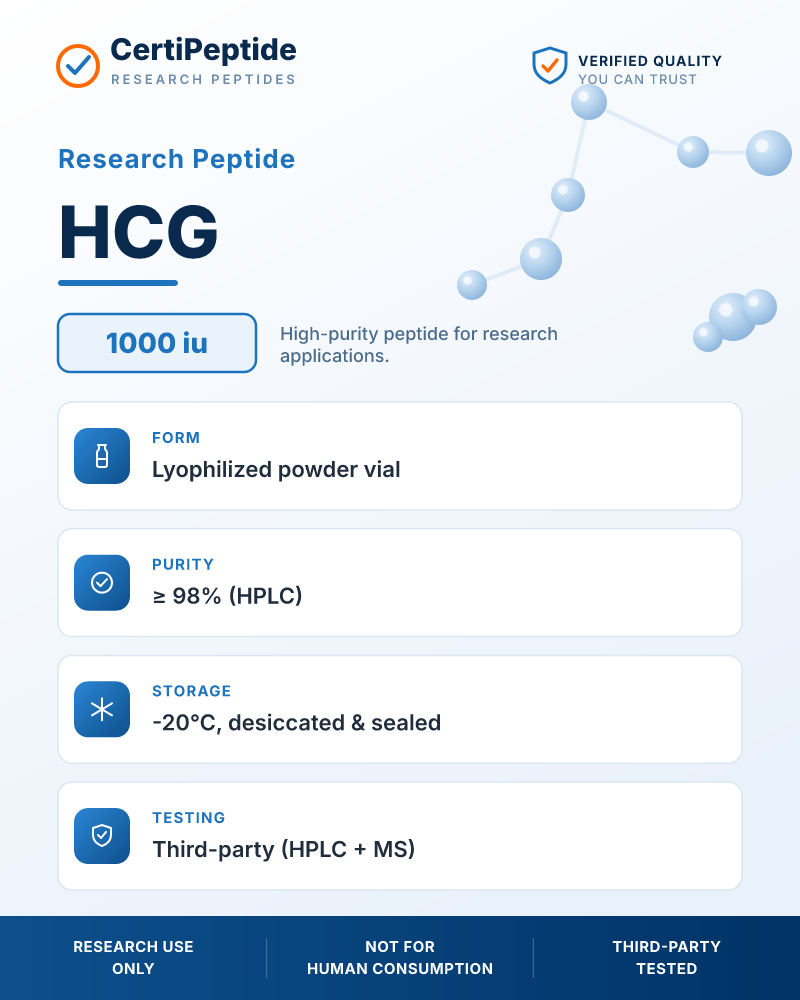
HCG in research reagents
HCG is a heterodimeric glycoprotein hormone in the same family as LH, FSH, and TSH. Research preparations are characterized by alpha and beta subunits; the beta subunit confers receptor specificity overlapping with LH. In vitro and in vivo laboratory work often tracks cAMP accumulation, steroidogenic enzyme induction, and gonadal cell responses after LH/hCG receptor (LHCGR) engagement. Glycosylation state can affect potency and clearance in model systems, so lot documentation and bioactivity units matter for reproducibility.
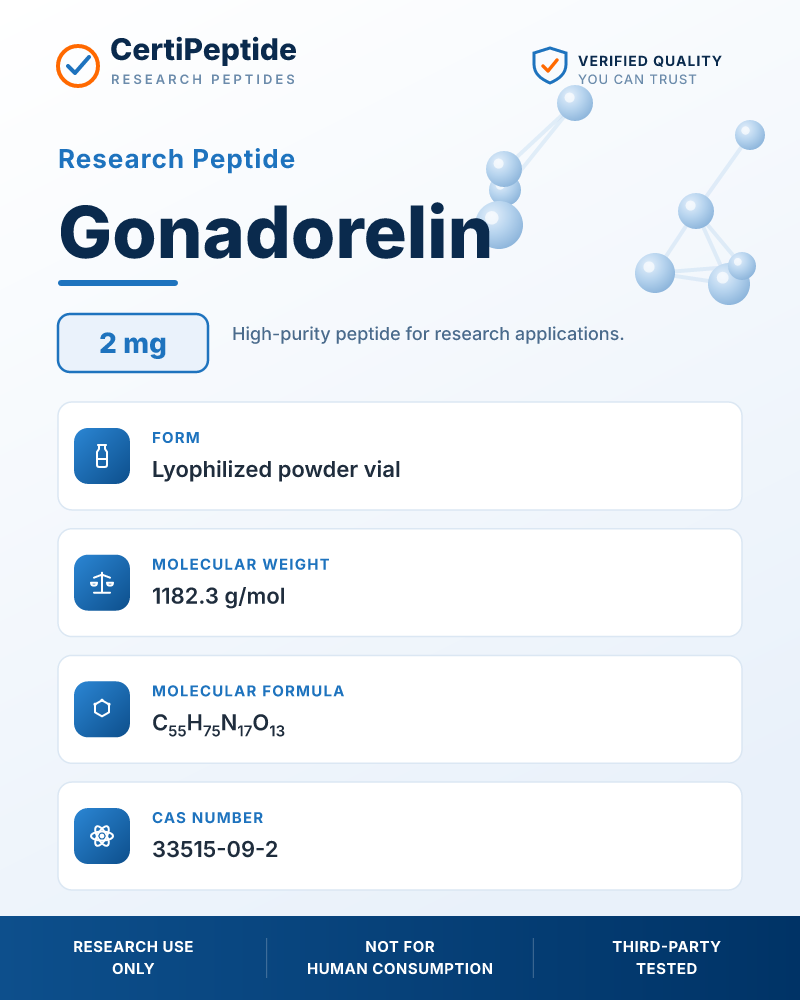
Gonadorelin in research reagents
Gonadorelin is a synthetic decapeptide corresponding to endogenous gonadotropin-releasing hormone (GnRH). It binds G-protein–coupled GnRH receptors on pituitary gonadotrophs (and in some extrapituitary experimental models). Typical research endpoints include timed LH and FSH secretion, calcium flux, IP3/DAG signaling, and pulse-frequency experiments that mimic physiologic GnRH patterns. Peptide stability, solvent, and adsorption to labware are practical handling variables in quantitative work.
Structural takeaway for HCG vs Gonadorelin designs: HCG is a large glycoprotein ligand for LHCGR; Gonadorelin is a small peptide ligand for the GnRH receptor. Cross-reactivity, antibody assays, and mass-spectrometric identification strategies therefore diverge.
Mechanism of Action: HCG vs Gonadorelin
Direct LH-mimetic pathway (HCG)
In experimental systems expressing LHCGR—commonly Leydig- or theca-lineage models—HCG is used to activate Gs-cAMP-PKA pathways linked to acute steroidogenesis (e.g., androgen or progesterone output depending on the model). Because HCG acts downstream of the pituitary, studies can isolate gonadal responsiveness without requiring intact hypothalamic–pituitary connectivity. Prolonged receptor occupancy and slower clearance relative to native LH are frequently discussed when interpreting desensitization, internalization, or sustained steroid output curves.
Upstream GnRH-receptor pathway (Gonadorelin)
Gonadorelin challenges are used when the scientific question involves pituitary competence, GnRH-receptor sensitivity, or the fidelity of pulsatile drive. A single bolus versus pulsed exposure can produce different LH/FSH profiles in animal or perfusion models, reflecting physiologic encoding of pulse amplitude and frequency. Feedback from sex steroids and inhibins remains relevant in intact organisms, so factorial designs often include endocrine status as a covariate.
Cascade position summary
| Research focus | More direct fit |
|---|---|
| LHCGR signaling, gonadal steroidogenesis | HCG |
| Pituitary GnRH-R, LH/FSH pulse dynamics | Gonadorelin |
| Full-axis integration and feedback | Either or sequential use |
| Assay calibration for LH-like activity | HCG (with method validation) |
| Peptide GPCR kinetics / pulse protocols | Gonadorelin |
Similarities in Laboratory Study Design
Despite different primary targets, HCG and Gonadorelin share several research-use patterns:
- HPG-axis relevance: Both are standard tools when mapping reproductive endocrine circuitry or validating disruption by experimental variables (genetic models, receptor antagonists, metabolic stress paradigms).
- Quantifiable endocrine readouts: LH, FSH, testosterone, estradiol, progesterone, and related transcripts/proteins are common dependent variables; multiplex immunoassays and LC-MS steroid panels are widely paired with either ligand.
- Receptor pharmacology themes: Dose–response curves, time-course sampling, antagonist co-administration, and desensitization protocols appear in both literatures.
- Need for rigorous controls: Vehicle controls, time-matched sampling, and confirmation of reagent identity/purity support interpretability whether the test article is HCG or Gonadorelin.
- Combination and sequence experiments: Some study designs use Gonadorelin to probe pituitary output and HCG to probe gonadal reserve within the same research program, enabling segmental assessment of the axis.
These overlaps explain why product catalogs and methods sections often mention both reagents even when only one is primary in a given arm.
Key Research Differences Investigators Should Document
- Site of action: Gonadal LHCGR (HCG) versus pituitary GnRH receptor (Gonadorelin) in classic models.
- Endogenous gonadotropin dependence: Gonadorelin protocols typically rely on a responsive pituitary; HCG protocols can bypass pituitary LH secretion for gonadal endpoints.
- Kinetics: Gonadorelin-related LH pulses are often short-lived relative to the more prolonged LH-mimetic exposure profiles associated with HCG in many experimental reports—sampling windows must match the ligand.
- Feedback and desensitization: Continuous versus pulsatile GnRH-receptor stimulation is a major design variable for Gonadorelin; LHCGR downregulation and prolonged cAMP drive are recurring themes for HCG.
- Analyte interference: High HCG can complicate some LH immunoassays through cross-reactivity; method validation is essential. Gonadorelin measurements require sensitive peptide assays if exposure confirmation is needed.
- Model requirements: Dispersed gonadal cells or LHCGR-expressing lines suit HCG mechanistic work; primary pituitary cells, hypothalamic–pituitary explants, or intact animals better showcase Gonadorelin pulse biology.
HCG or Gonadorelin: Aligning Ligand With Study Aims
Use an HCG or Gonadorelin decision framework tied to the hypothesis:
- Choose HCG-focused designs when the question is LHCGR efficacy, gonadal steroidogenic capacity, downstream enzyme regulation, or LH-mimetic reference activity in bioassays.
- Choose Gonadorelin-focused designs when the question is GnRH-receptor activation, pituitary LH/FSH releasability, pulse-frequency encoding, or upstream axis stimulation before gonadal readouts.
- Consider sequential or parallel arms when mapping where a perturbation acts (pituitary versus gonad). For example, blunted response to Gonadorelin with preserved response to HCG in the same model can localize reduced pituitary responsiveness—interpretation still requires appropriate statistics and controls.
- Match matrices and timing: Serum/plasma schedules, perfusion fractions, or cell-culture supernatant collections should reflect expected peak windows for each ligand’s cascade position.
Natural mention of catalog materials: laboratories often source research-grade HCG for LHCGR bioactivity curves and research-grade Gonadorelin for GnRH-receptor challenge tests, keeping certificates of analysis with the study record.
Practical Experimental Considerations
Analytical chemistry and identity
Confirm identity with orthogonal methods appropriate to class (e.g., peptide mapping or HPLC for Gonadorelin; subunit-aware immunoactivity or validated physicochemical panels for HCG). Record specific activity where suppliers provide biological unitage.
Matrix effects and sample handling
Peptide adsorption, freeze–thaw cycles, and protease activity can alter Gonadorelin recovery. Glycoprotein stability, aggregation, and assay hook effects are more often discussed for HCG. Pre-analytical SOPs should be ligand-specific.
Readout panels
Combine pituitary hormones, gonadal steroids, and molecular markers (LHCGR, Gnrhr, Star, Cyp11a1, etc., as relevant to species and tissue) to avoid single-analyte bias. When comparing HCG vs Gonadorelin arms, standardize animal strain, cell passage, photoperiod, and sampling Zeitgeber time where applicable.
Statistics and replication
Power calculations should incorporate the higher temporal variability of pulse-driven LH series (Gonadorelin) versus sometimes smoother steroidogenic plateaus (HCG). Report effect sizes and assay CVs alongside p-values.
Summary for Study Teams
An accurate HCG Gonadorelin comparison for research use is less about which molecule is “stronger” and more about cascade level, kinetics, and the biological compartment under test. HCG primarily enables controlled LH-receptor pathway interrogation at the gonad; Gonadorelin enables controlled GnRH-receptor interrogation at the pituitary with downstream LH/FSH dynamics. Similar endocrine endpoints create superficial overlap, but mechanism, model choice, and sampling design differ enough that substituting one for the other without redesign risks invalid inference. Document ligand identity, receptor target, and timing explicitly in methods to keep HPG-axis studies reproducible and interpretable.
Frequently Asked Questions
Short answers to common long-tail questions appear in structured FAQ data accompanying this article; key themes include receptor targets, when dual-ligand designs help, assay cross-reactivity, and why pulse protocols matter more for Gonadorelin than for HCG in many laboratory settings.
Explore Further
Browse our research peptide catalog and review third-party lab reports & COAs for every batch.
---
Research use only. The information above is provided for educational and laboratory research purposes only. The compounds discussed are not approved for human or veterinary use, diagnosis, treatment, or the prevention of any disease. Nothing here is medical advice.