TL;DR
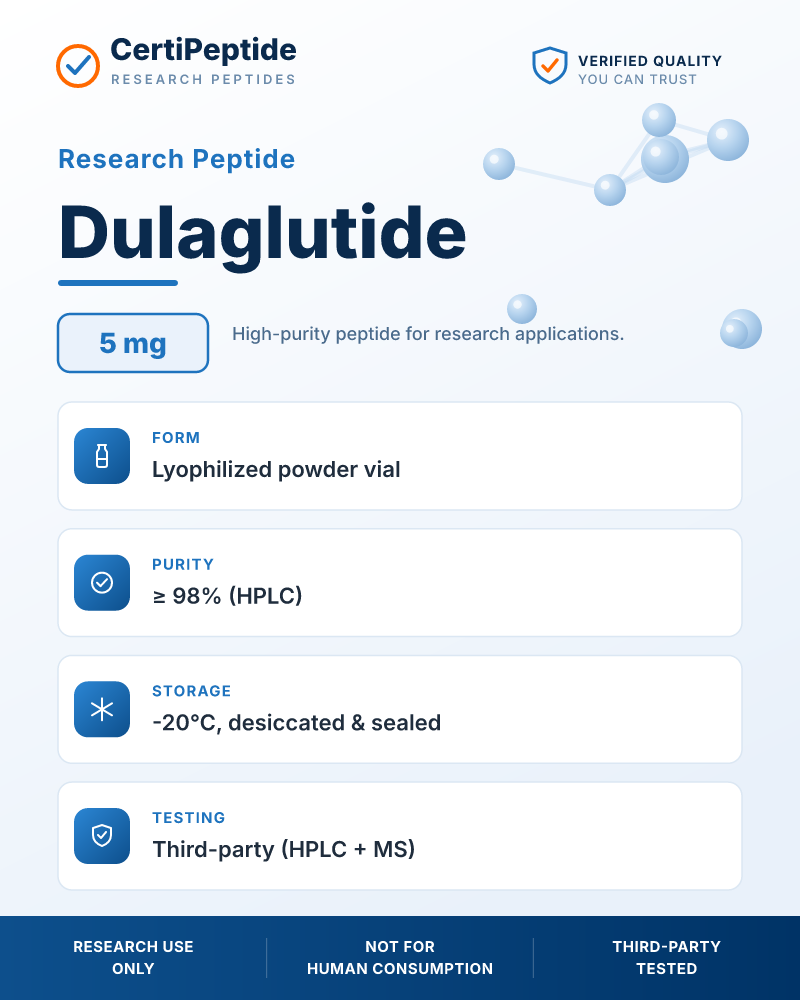
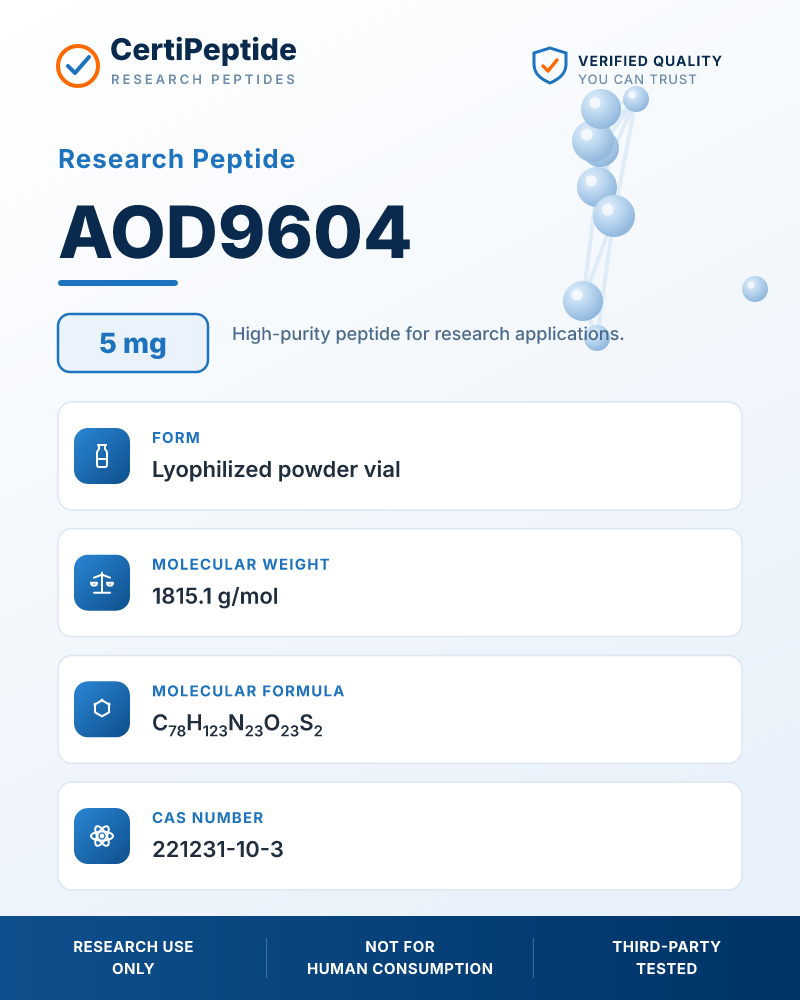
Dulaglutide vs AOD9604 contrasts two research peptides with distinct origins and pathways. Dulaglutide is a long-acting GLP-1 receptor agonist analog used in metabolic and incretin-pathway studies. AOD9604 is a C-terminal fragment of growth hormone (hGH 176–191) examined mainly in lipid-metabolism and adipose-tissue models. Neither is interchangeable in study design: choose Dulaglutide when the endpoint centers on GLP-1R signaling, insulinotropic readouts, or gastric-emptying proxies; choose AOD9604 when the focus is lipolytic or GH-fragment–related metabolic markers without full somatotropic activity. This article outlines structural, mechanistic, and practical differences for laboratory planning only.
Dulaglutide vs AOD9604: Core Research Framing
Researchers comparing Dulaglutide or AOD9604 typically start from divergent hypotheses. Dulaglutide was engineered as a GLP-1 receptor agonist fused to an IgG4 Fc domain to extend half-life, making it suitable for chronic or multi-dose incretin studies in vitro and in vivo. AOD9604 (also described as hGH fragment 176–191) retains a modified lipolytic region of growth hormone and is used when investigators want to probe fat-metabolism pathways with limited growth-promoting signaling relative to full-length GH.
A clear Dulaglutide AOD9604 comparison therefore rests on receptor target, half-life engineering, and primary assay endpoints—not on “which is better,” but on which molecular tool matches the experimental question.
What Is Dulaglutide in Laboratory Context?
Dulaglutide is a recombinant fusion protein: a DPP-4–resistant GLP-1 analog linked to a modified human IgG4 Fc fragment. In research settings it is characterized by:
- High affinity for the GLP-1 receptor (GLP-1R)
- Resistance to dipeptidyl peptidase-4 cleavage
- Extended circulating half-life relative to native GLP-1, supporting less frequent sampling or dosing schedules in animal models
- Utility in assays of cAMP accumulation, insulin secretion in beta-cell lines or islets, appetite-related neuropeptide expression, and gastric motility proxies
Typical laboratory applications include receptor pharmacology, metabolic phenotyping in diet-induced models, and comparative incretin biology versus shorter GLP-1 analogs. Material handling usually follows protein-peptide SOPs (cold-chain storage, avoidance of repeated freeze–thaw, validated reconstitution buffers).
What Is AOD9604 in Laboratory Context?
AOD9604 is a synthetic peptide corresponding to the C-terminal region of human growth hormone (residues 176–191), often with a Tyr-Tyr or related N-terminal modification in research grades. It is investigated for:
- Effects on lipolysis and lipid oxidation markers in adipocytes and animal adipose depots
- Limited activation of the full GH receptor–IGF-1 growth axis compared with intact GH
- Downstream readouts such as hormone-sensitive lipase activity, glycerol release, and selected metabolic gene expression panels
AOD9604 is therefore positioned in studies of fragment-selective GH biology and energy-balance biochemistry rather than classical incretin or glycemic-control pathways.
Mechanism of Action: Side-by-Side
Dulaglutide pathway
Dulaglutide binds GLP-1R, a class B GPCR, raising intracellular cAMP via Gs, enhancing glucose-dependent insulin secretion in responsive beta-cell systems, modulating glucagon in alpha-cell models, and influencing central and peripheral circuits tied to satiety and gut motility in vivo. Extended Fc fusion slows clearance, so pharmacokinetic (PK) and pharmacodynamic (PD) sampling windows differ from native GLP-1 or short liraglutide-like peptides.
AOD9604 pathway
AOD9604 is studied for GH-fragment–associated metabolic effects, historically linked to lipolytic signaling in adipose tissue. Research literature emphasizes lipid mobilization and related enzymatic markers more than robust IGF-1 elevation or linear growth endpoints. Mechanistic work often pairs AOD9604 with adipocyte culture, ex vivo fat pads, or body-composition imaging in rodents, alongside controls for full-length GH or GHRH analogs.
Direct contrast
| Feature | Dulaglutide | AOD9604 |
|---|---|---|
| Structural class | GLP-1 analog–Fc fusion | hGH 176–191 fragment |
| Primary target focus | GLP-1 receptor | GH-fragment / lipolytic pathways |
| Half-life design | Extended (Fc) | Short peptide kinetics |
| Common endpoints | cAMP, insulin, incretin PD | Lipolysis, adipose gene panels |
| Growth-axis involvement | Minimal direct GH/IGF-1 | Limited vs full GH |
This table is a planning aid only; exact binding, potency, and off-target profiles must be verified with lot-specific certificates of analysis and primary literature for the model used.
Similarities Relevant to Study Design
Despite different origins, Dulaglutide and AOD9604 share several operational similarities in the lab:
- Research-peptide handling — Both require controlled storage, documented reconstitution, and identity/purity checks (HPLC, MS) before critical experiments.
- Metabolic research umbrella — Both appear in broader energy-balance and body-composition research programs, though via non-overlapping primary receptors.
- Need for vehicle and positive controls — Parallel arms with known GLP-1 agonists (for Dulaglutide studies) or GH/lipolytic references (for AOD9604 studies) strengthen interpretation.
- Species and model caveats — GLP-1R homology, Fc recycling (FcRn), and adipose biology differ across rodents, non-human primates, and human cell systems; translation assumptions should be explicit.
- Analytical burden — Both benefit from PK sampling, anti-drug antibody awareness (especially Fc fusions), and orthogonal PD biomarkers rather than single endpoints.
Key Differences That Drive Peptide Choice
When deciding Dulaglutide or AOD9604, align the molecule to the hypothesis:
- Receptor and pathway fidelity — Dulaglutide is inappropriate as a pure lipolysis probe if GLP-1R activation confounds the readout; AOD9604 is a poor surrogate for incretin-axis questions.
- Kinetics — Extended exposure with Dulaglutide suits multi-day metabolic cages or weekly phenotyping; AOD9604’s shorter peptide profile may require more frequent administration schedules and denser sampling in PK/PD work.
- Immunogenicity and matrix effects — Fc-containing biologics can differ from small synthetic peptides in assay interference, anti-drug responses, and bioanalytical method development.
- Endpoint batteries — Pair Dulaglutide with glucose tolerance tests, insulin/C-peptide, GLP-1R occupancy or cAMP biosensors, and gut-brain markers. Pair AOD9604 with glycerol/FFA flux, adipose histology, selected lipolytic enzyme assays, and carefully interpreted body-composition metrics.
- Comparator sets — Dulaglutide studies often include other GLP-1R agonists; AOD9604 studies often include GH fragments, beta-adrenergic lipolytic agents, or diet-only controls.
Practical Considerations for Laboratory Use
Formulation and stability
Document buffer composition, pH, and light/temperature exposure for each lot of Dulaglutide and AOD9604. Fc-fusion proteins and short synthetic peptides degrade via different pathways (aggregation vs oxidation/hydrolysis); stability-indicating methods should match the chemistry.
Dose ranging in animals (research only)
Any in vivo work should follow institutional animal-care protocols. Establish dose–response curves against predefined PD markers rather than extrapolating from unrelated compounds. Report mg/kg or molar exposure, route, and vehicle fully so others can replicate.
Assay interference
GLP-1R reporter cells, ELISA kits for incretins, and mass-spec panels for lipids each have different interference risks. Spike-recovery experiments with the actual research material reduce false conclusions when running a Dulaglutide AOD9604 comparison side by side in the same facility.
Ethical and regulatory scope
Both compounds are discussed here strictly as tools for non-clinical investigation. Study protocols should define research-only use, chain of custody, and disposal in line with institutional chemical-safety rules.
Designing a Head-to-Head or Parallel Program
A rigorous program that includes both peptides might:
- Keep separate primary hypotheses (incretin vs GH-fragment lipolysis) even if secondary metabolic outcomes overlap (e.g., weight trajectory in diet-induced models).
- Standardize housing, diet, circadian timing, and blind outcome assessment.
- Pre-register endpoints and analysis plans to avoid post-hoc “winner” narratives between unrelated mechanisms.
- Use factorial designs only when interaction terms are scientifically meaningful (usually they are not, given pathway distance).
- Publish negative and null PD results; pathway mismatch is informative.
Summary for Researchers
Dulaglutide vs AOD9604 is a comparison of an extended-action GLP-1 receptor agonist fusion protein against a synthetic C-terminal growth-hormone fragment used in lipid-metabolism research. Similarities are largely operational (peptide handling, metabolic study context). Differences dominate at the level of target biology, kinetics, and valid endpoints. Select Dulaglutide for GLP-1R and incretin-axis questions; select AOD9604 for fragment-selective adipose and lipolytic questions. Parallel use is feasible only with clear, non-overlapping primary aims and robust analytical controls.
FAQ
Explore Further
Browse our research peptide catalog and review third-party lab reports & COAs for every batch.
---
Research use only. The information above is provided for educational and laboratory research purposes only. The compounds discussed are not approved for human or veterinary use, diagnosis, treatment, or the prevention of any disease. Nothing here is medical advice.