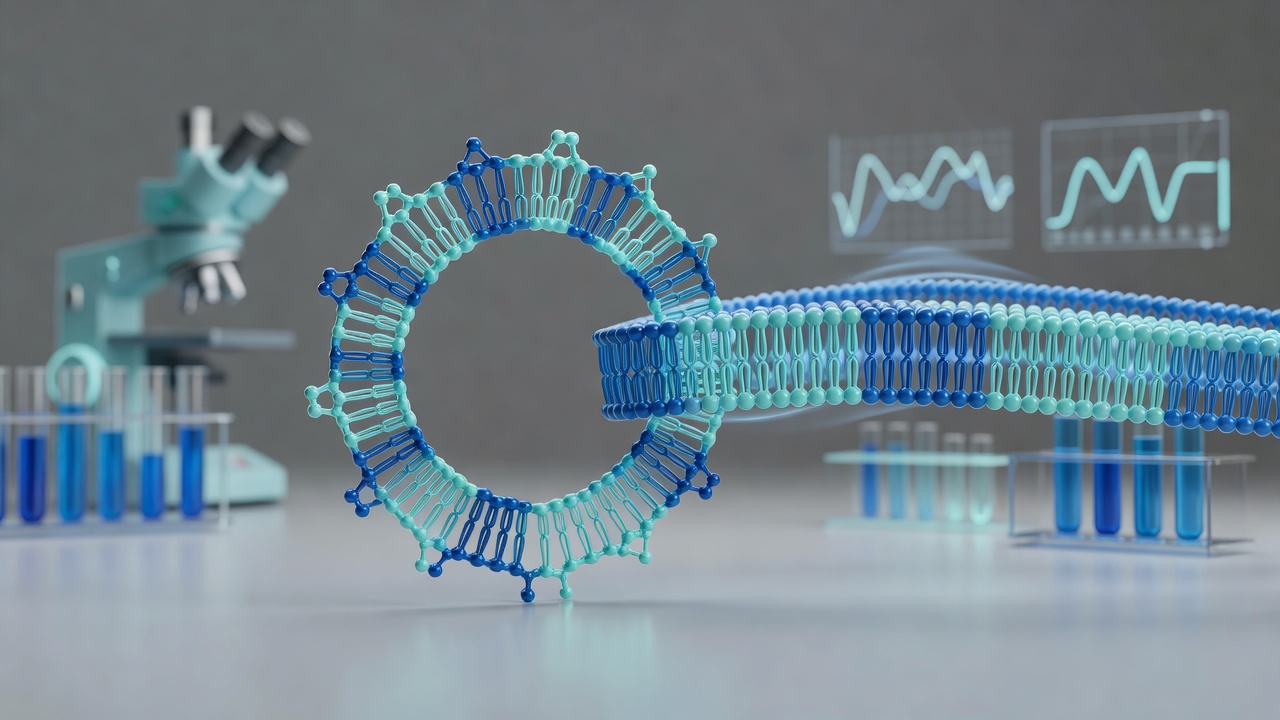
As of 27 September 2026, retrieved abstracts do not supply head-to-head permeability coefficients that would rank cyclic peptides across programs. They do make a design tension concrete: cyclization is used to rigidify binders and to improve protease resistance, yet membrane crossing remains a bottleneck, and the same word “permeability” is applied to tissue penetration, cell-membrane models, and in vitro pharmacokinetic screens that are not interchangeable. Cell uptake or tissue homing should not be read as oral efficacy.
Assay systems behind recent permeability claims
The most method-focused paper in this window is a cheminformatics study with first publication date 4 August 2026. Amirahmadi and colleagues treat cyclic peptides as candidates for intracellular sites and identify cell-membrane permeability as a key bottleneck, worsened by limited public data and the need for well-calibrated uncertainty. They propose monomer-aware decoupled global alignment kernels (MD-GAK and a position-aware variant, PMD-GAK) inside Gaussian-process models. The authors report improved discrimination, probabilistic calibration, and scaffold-level robustness versus order-agnostic fingerprints, standard global-alignment kernels, and graph and language-model baselines on leakage-controlled cyclic-peptide permeability benchmarks. The abstract does not publish experimental apparent-permeability values or animal absorption data.
That computational framing should not be conflated with experimental pharmacokinetic profiling. On 1 August 2026, Fuchs and co-workers reported disulfide-constrained cyclic peptides against triggering receptor expressed on myeloid cells 2 (TREM2), isolated from a phage-display library. TREM2-6 and TREM2-12 exhibited micromolar affinity and both modulated microglial responses in a human iPSC-derived model of amyloid stress and in neuron-microglia cocultures. In vitro pharmacokinetic profiling revealed favorable plasma and intestinal stability but limited permeability, described as consistent with cyclic peptide scaffolds. Molecular-dynamics simulations supported peptide–TREM2 interactions, with TREM2-12 in a more constrained binding mode. Limited permeability here is an in vitro pharmacokinetic observation, not a demonstration of oral delivery and not a ranked membrane-flux comparison against the computational set.
A 25 August 2026 review of macrocyclic peptides and peptidomimetics (MPPs) as protein–protein interaction (PPI) modulators states the textbook trade-off without new numbers. Parmar et al. note that traditional small molecules lack surface area for large, flat PPI interfaces, while linear peptides suffer rapid proteolytic degradation and poor cell permeability. Cyclic architecture is credited with conformational rigidity, reduced entropic penalties, higher binding affinity and selectivity, metabolic robustness, protease resistance, and enhanced cellular permeability. The abstract does not name Caco-2, PAMPA, or MDCK assays, so those permeability statements remain review-level rather than a new measured dataset.
Tissue access is a different physical problem. In a review with first publication date 16 September 2026, Ma and colleagues contrast antibody–drug conjugates (about 150 kDa) that struggle to cross blood vessels and collagen-rich stroma with smaller tumor-homing peptides (THPs) that they say allow improved tissue permeability, low immunogenicity, and rapid systemic clearance. Internalization routes discussed include neuropilin-1–dependent C-end Rule (CendR) and the sortilin (SORT1) scavenger receptor. The reviewers’ early-2026 translational snapshot includes the FDA withdrawal of the lipophilic peptide-conjugated melphalan flufenamide (Pepaxto) and, as they state, clinical success of the cyclic peptide certepetide for pancreatic adenocarcinoma plus ongoing studies of chemically constrained bicyclic peptides. Improved interstitial penetration versus a large ADC is not evidence of passive membrane crossing or oral bioavailability.
Selectivity versus access
Placed side by side, the abstracts describe complementary halves of the same trade-off rather than a single ranked permeability series.
On the selectivity side, the TREM2 cyclic peptides were advanced because they bind a defined immune receptor and change microglial behavior under amyloid stress, at micromolar affinity. The MPP review argues that pre-organization from cyclization can raise affinity and selectivity at historically difficult PPI surfaces. THP work instead pursues spatial selectivity: homing and receptor-gated internalization to improve intratumoral retention of cytotoxic or immunomodulatory agents and limit off-target exposure.
On the access side, the computational paper treats membrane permeability as the rate-limiting property for intracellular cyclic peptides and invests in calibrated prediction because experimental labels are scarce. The TREM2 study is the only experimental abstract in this set that reports a permeability outcome, and that outcome is limited permeability despite favorable plasma and intestinal stability. The THP review relocates permeability to deep tissue penetration after systemic administration, a setting in which rapid clearance is listed as a feature, not a membrane-flux measurement.
A cyclic peptide can therefore look permeable in a tissue-homing narrative, poorly permeable in an in vitro pharmacokinetic screen, and only predicted-permeable in a Gaussian-process kernel without contradiction, because the assays answer different questions. None of these abstracts report oral bioavailability.
How to read a permeability claim
| Abstract (first publication date) | What permeability refers to | Selectivity or function reported | Not supported by the abstract |
|---|---|---|---|
| Amirahmadi et al., 4 Aug 2026 | Predicted cell-membrane permeability (Gaussian processes with alignment kernels) | Not a target-engagement study | Experimental flux values; oral absorption |
| Fuchs et al., 1 Aug 2026 | Limited in vitro pharmacokinetic permeability; plasma and intestinal stability | Micromolar TREM2 binding; microglial modulation in iPSC and coculture models | Oral efficacy; high membrane flux |
| Parmar et al., 25 Aug 2026 | Review-level cellular permeability of MPPs versus linear peptides | PPI modulation via rigid macrocycles | New measured permeability coefficients |
| Ma et al., 16 Sep 2026 | Tissue permeability of THPs versus ~150 kDa ADCs | Receptor-gated tumor homing (CendR/NRP-1, SORT1); cyclic certepetide cited as a clinical example | Passive membrane permeability or oral dosing success |
When a cyclic-peptide paper mentions permeability:
- Name the assay class: computational membrane model, in vitro pharmacokinetic permeability, cell uptake, or tissue penetration.
- Record whether a number was actually measured; unknown is not zero and is not evidence of absence.
- Keep affinity and selectivity readouts, such as micromolar TREM2 binding, separate from access readouts.
- Do not promote intestinal stability or tissue homing into oral efficacy.
- Note the evidence stage: computational benchmark, cell or coculture work, or a review of translational programs.
One specific question left open is whether the limited in vitro permeability of TREM2-6 and TREM2-12 can be redesigned with monomer-aware permeability models of the kind in Amirahmadi et al. without eroding micromolar TREM2 engagement, and whether membrane-trained kernels transfer to the stromal tissue-penetration problem that Ma et al. pose for tumor-homing cyclic peptides. The abstracts do not test that transfer. This briefing is scoped to the four retrieved records as of 27 September 2026 and is not a complete review of cyclic-peptide permeability.
Frequently Asked Questions
Does favorable intestinal stability mean a cyclic peptide is orally bioavailable?
Not on the evidence here. Fuchs et al. (1 August 2026) reported favorable plasma and intestinal stability together with limited permeability for TREM2-binding cyclic peptides, so stability and permeability are separate readouts.
Are tumor-homing peptides the same as membrane-permeable cyclic peptides?
No. Ma et al. (16 September 2026) discuss tissue permeability of smaller tumor-homing peptides versus antibody–drug conjugates of about 150 kDa. That is vascular and interstitial access, not the cell-membrane permeability bottleneck modeled by Amirahmadi et al.
Explore Further
Browse our research peptide catalog and review third-party lab reports & COAs for published batches.
---
Research use only. The information above is provided for educational and laboratory research purposes only. The compounds discussed are not approved for human or veterinary use, diagnosis, treatment, or the prevention of any disease. Nothing here is medical advice.