TL;DR
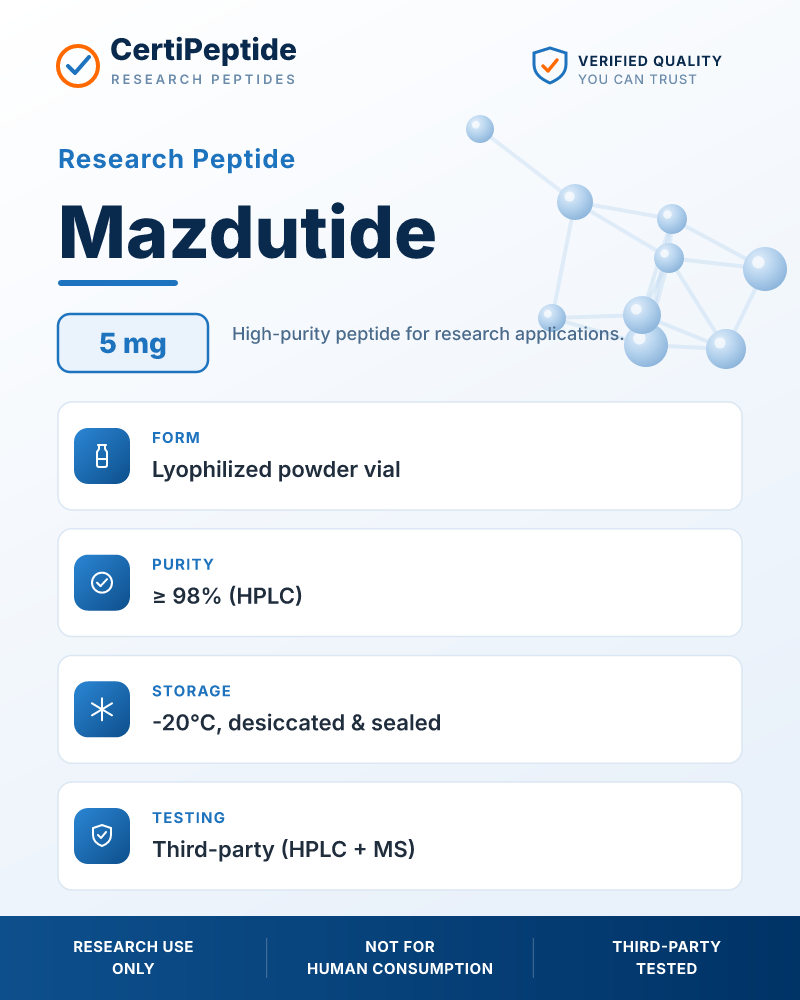
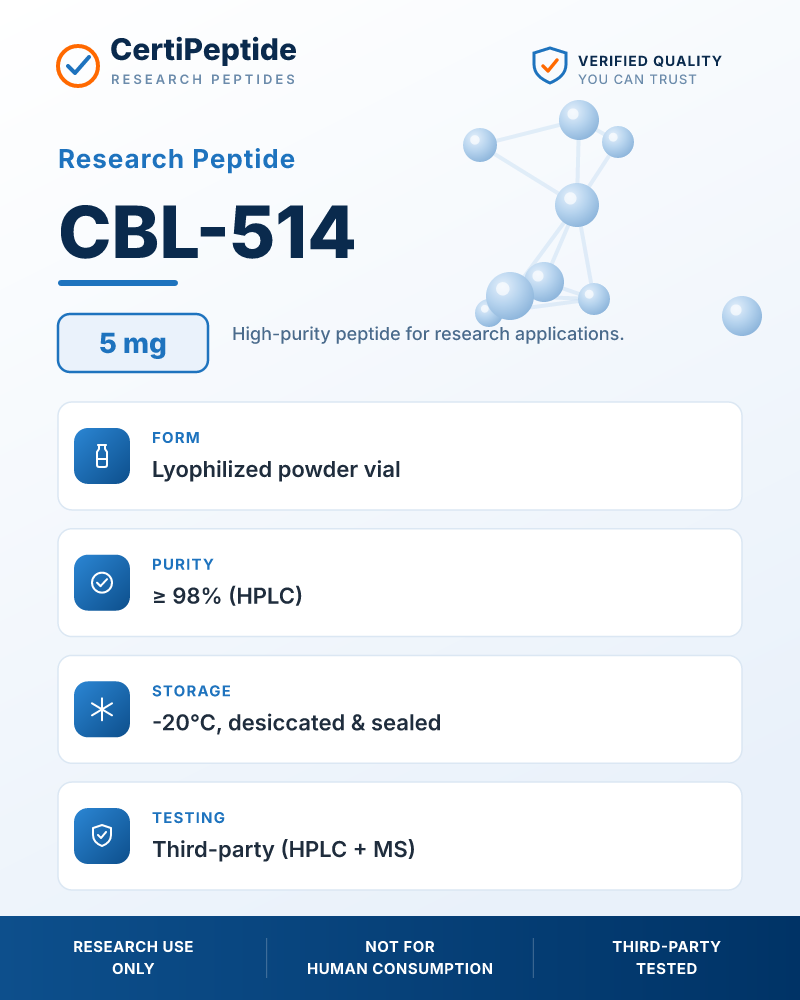
CBL-514 vs Mazdutide is a comparison between two distinct research tools rather than interchangeable analogs. In published and early-stage study contexts, CBL-514 is investigated mainly as a localized adipose-tissue modulation agent (often framed around subcutaneous fat reduction models), while Mazdutide is studied as a dual GLP-1/glucagon receptor agonist in systemic metabolic and body-composition research. Choosing CBL-514 or Mazdutide depends on whether the protocol targets local tissue endpoints or whole-organism metabolic pathways, receptor pharmacology, and readout windows.
Why Compare CBL-514 vs Mazdutide in Laboratory Work?
Researchers increasingly search for a CBL-514 Mazdutide comparison when designing adipose, metabolic, or body-composition studies. The compounds are not structural twins and are not typically positioned as drop-in substitutes. A structured comparison helps labs align molecule selection with hypothesis, assay type, animal model, and analytical endpoints—without conflating local tissue interventions with systemic incretin/glucagon pathway work.
Both molecules appear in modern metabolic and adiposity research conversations, but they answer different experimental questions:
- CBL-514: commonly discussed in the context of localized subcutaneous adipose research models and tissue-level outcomes.
- Mazdutide: dual GLP-1R/GCGR agonist pharmacology used in systemic metabolic, glycemic, and energy-balance research frameworks.
Understanding those differences reduces protocol noise, improves control selection, and clarifies what a “positive” signal would mean in vitro, ex vivo, or in vivo.
Quick Snapshot: CBL-514 Mazdutide Comparison
| Dimension | CBL-514 (research context) | Mazdutide (research context) |
|---|---|---|
| Primary research framing | Localized adipose / subcutaneous tissue modulation models | Systemic metabolic pathway research (GLP-1R + GCGR) |
| Typical experimental scope | Regional tissue endpoints, histology, local composition readouts | Whole-animal metabolic panels, body weight/composition trends, glycemic markers |
| Pharmacologic class emphasis | Investigational local adipose-targeting research compound | Dual incretin/glucagon receptor agonist peptide research tool |
| Route considerations in studies | Often framed around local administration paradigms in research literature | Typically studied with systemic peptide administration paradigms |
| Best-fit hypothesis type | Local tissue remodeling / regional adiposity questions | Energy homeostasis, dual-receptor engagement, metabolic phenotype questions |
This table is a planning aid for study design discussions, not a clinical recommendation matrix.
Mechanism and Target Biology
CBL-514 in research models
In research discussions, CBL-514 is associated with localized effects on subcutaneous adipose tissue biology. Study narratives often emphasize regional fat-pad or subcutaneous depot endpoints rather than broad endocrine dual-agonist signaling. Investigators interested in tissue architecture, adipocyte populations, inflammatory or remodeling markers in a defined anatomic field may therefore evaluate CBL-514 as a local-intervention research variable.
Because published mechanistic depth can vary by source and study phase, rigorous labs should anchor claims to primary literature, certificate-of-analysis identity data, and their own assay validation. is researched in the context of mechanism language as hypothesis-generating until confirmed in the specific model system.
Mazdutide in research models
Mazdutide is characterized in research literature as a dual agonist at glucagon-like peptide-1 receptor (GLP-1R) and glucagon receptor (GCGR). That dual engagement is central to why laboratories use it when the scientific question involves coordinated effects on appetite-related pathways, energy expenditure proxies, glycemic regulation markers, and systemic body-composition metrics in controlled experimental settings.
For receptor-pathway work, Mazdutide is therefore closer to other multi-agonist metabolic peptides than to a localized adipose-injection research paradigm.
Similarities Relevant to Study Design
Despite different primary framings, a careful CBL-514 vs Mazdutide review shows several operational similarities that matter in the lab:
- Research-only peptide/compound handling culture
Both are handled as investigational research materials: identity confirmation, purity documentation, cold-chain or stability SOPs, and contamination controls matter equally.
- Adiposity and body-composition adjacent endpoints
Both may appear in protocols that ultimately quantify fat mass, lean mass, or tissue morphology—though one may do so regionally and the other systemically.
- Need for tight controls
Vehicle controls, sham procedures (if local administration is used), pair-feeding or food-intake monitoring (for systemic metabolic work), and blinded outcome assessment improve interpretability for either molecule.
- Multi-modal readouts
Histology, imaging (e.g., DEXA/MRI where available), circulating metabolic panels, and molecular markers (qPCR, immunoassays) are commonly layered onto either type of study.
- Translation caution
Both require explicit separation between laboratory observations and any human therapeutic narrative. Research endpoints are model-bound.
Key Differences That Drive Molecule Choice
1) Local tissue question vs systemic pathway question
Choose the comparison axis first:
- If the hypothesis is about a defined subcutaneous region, depot-specific remodeling, or local histologic change, CBL-514 is the more thematically aligned research candidate in many protocols.
- If the hypothesis is about GLP-1R/GCGR dual signaling, systemic energy balance, or integrated metabolic phenotypes, Mazdutide is the clearer pharmacologic fit.
This is the core of most CBL-514 or Mazdutide decisions.
2) Pharmacodynamic “shape” of the experiment
Local adipose-focused designs often emphasize spatial resolution: injection field mapping, contralateral controls, depth of tissue sampling, and regional imaging. Dual-agonist metabolic designs emphasize temporal resolution: dosing schedule relative to dark/light cycles, cumulative intake, glucose excursion tests, and longitudinal weight/composition curves.
3) Confounders differ
- Local paradigms: trauma, volume effects, inflammatory artifacts from administration, sampling bias across the depot.
- Systemic dual-agonist paradigms: food intake changes, gastrointestinal-related behavioral confounds in animals, hydration/weight interactions, and receptor desensitization questions over chronic dosing schedules used in research.
4) Analytical panels are not interchangeable
A histology-heavy CBL-514 study may under-instrument metabolic cages and OGTT-style assays. A Mazdutide study that only reports scale weight without body composition or receptor-pathway markers may miss the dual-agonist rationale. Align assays to mechanism.
5) Comparator arms differ
For Mazdutide, rational research comparators may include selective GLP-1R agonists or other dual/triple agonists depending on the question. For CBL-514, comparators are more often vehicle, sham, or other local adipose-research interventions—not necessarily incretin dual agonists—unless the lab is explicitly cross-comparing modalities.
Practical Study-Design Notes (Laboratory Framing)
Defining endpoints before picking CBL-514 or Mazdutide
Write the primary endpoint in one sentence:
- Example local endpoint language: “Change in designated subcutaneous depot cross-sectional adipocyte metrics at day X versus contralateral control.”
- Example systemic endpoint language: “Change in total fat mass and fasting metabolic markers after dual GLP-1R/GCGR agonist exposure versus vehicle.”
If the sentence naturally includes “regional depot,” CBL-514 is usually the comparison anchor. If it naturally includes “dual receptor agonist” or “systemic metabolic phenotype,” Mazdutide is usually the anchor.
Model selection
- Diet-induced obesity rodent models are common for systemic metabolic peptide research including Mazdutide-class questions.
- Local adipose studies may use specific fat-pad models, large-animal subcutaneous models, or explant systems depending on institutional capability and ethical approvals.
- In vitro adipocyte or explant work can support mechanistic side experiments for either, but receptor-engagement assays are more central to Mazdutide characterization.
Measurement stack suggestions (non-prescriptive)
For CBL-514-oriented research questions
- Standardized tissue harvest maps
- Histomorphometry / immunohistochemistry panels relevant to adipocytes and remodeling
- High-frequency local imaging if available
- Local inflammatory marker controls to separate pharmacology from procedure effects
For Mazdutide-oriented research questions
- Body weight trajectories plus composition (fat/lean)
- Food intake and, where relevant, energy-expenditure proxies
- Glycemic and lipid panels appropriate to the species model
- Optional receptor-pathway biomarkers or pharmacodynamic markers tied to GLP-1R/GCGR biology
Quality and identity controls for both research materials
Regardless of CBL-514 vs Mazdutide selection, laboratories typically document:
- Supplier COA (identity, purity, appearance)
- Lot tracking and storage conditions
- Reconstitution vehicle compatibility tests
- Stability time windows after preparation
- Blinded aliquot labeling to reduce bias
These controls matter as much as the biological hypothesis.
How to Read “Head-to-Head” Claims Critically
Direct head-to-head publications may be limited because the molecules are optimized for different experimental jobs. When comparing secondary sources:
- Check whether endpoints were matched (local vs systemic).
- Check species, sex, diet, and duration.
- Separate pharmacologic dual-agonist potency discussions (more relevant to Mazdutide) from procedural local-administration outcomes (more relevant to CBL-514).
- Avoid marketing language that collapses both into a single “fat loss compound” category; that erases the scientific distinction investigators need.
A responsible CBL-514 Mazdutide comparison is modality-aware, endpoint-aware, and literature-anchored.
Which Research Tool Fits Which Protocol?
Consider CBL-514 when the protocol needs:
- Regional subcutaneous adipose questions
- Spatial controls (treated vs untreated regions)
- Histology- and imaging-forward local outcomes
Consider Mazdutide when the protocol needs:
- Dual GLP-1R/GCGR hypothesis testing
- Systemic metabolic and body-composition distributions
- Comparators within the incretin/glucagon agonist research space
Consider a dual-arm exploratory design only when justified:
Some advanced labs may run parallel arms to contrast local-modality effects against systemic dual-agonist effects on overlapping composition metrics. That is a methods paper design, not a default substitution. Power calculations, ethical load, and divergent confounds must be explicit.
SEO-Style Research Takeaway for Protocol Authors
If your notes literally say “CBL-514 vs Mazdutide,” reframe the decision tree as:
- Is the independent variable a local tissue intervention or a systemic dual-receptor agonist?
- Which primary endpoint will convince a skeptical reviewer?
- Which confounds dominate—procedural local effects or whole-animal metabolic behavior?
- Do you need receptor pharmacology assays or depot histomorphometry as the centerpiece?
Answering those four questions usually resolves CBL-514 or Mazdutide without forced equivalence.
Conclusion
CBL-514 vs Mazdutide is best treated as a comparison of research roles. CBL-514 aligns with localized subcutaneous adipose research questions; Mazdutide aligns with systemic dual GLP-1R/GCGR metabolic research questions. They can appear in the same broad field—adiposity and metabolic science—yet they are not mechanistic clones. For clean study design, match the molecule to the hypothesis, build endpoint-appropriate assays, and keep interpretation inside laboratory model limits. Natural next steps for many groups are literature mapping, model selection, and COA-driven material qualification for CBL-514 and Mazdutide before any in vivo work.
FAQ
Explore Further
Browse our research peptide catalog and review third-party lab reports & COAs for every batch.
---
Research use only. The information above is provided for educational and laboratory research purposes only. The compounds discussed are not approved for human or veterinary use, diagnosis, treatment, or the prevention of any disease. Nothing here is medical advice.