TL;DR
Cardiogen research examines a synthetic peptide in controlled lab settings. This article covers key study areas, proposed mechanisms, and standard research protocols using Cardiogen.
What Is Cardiogen
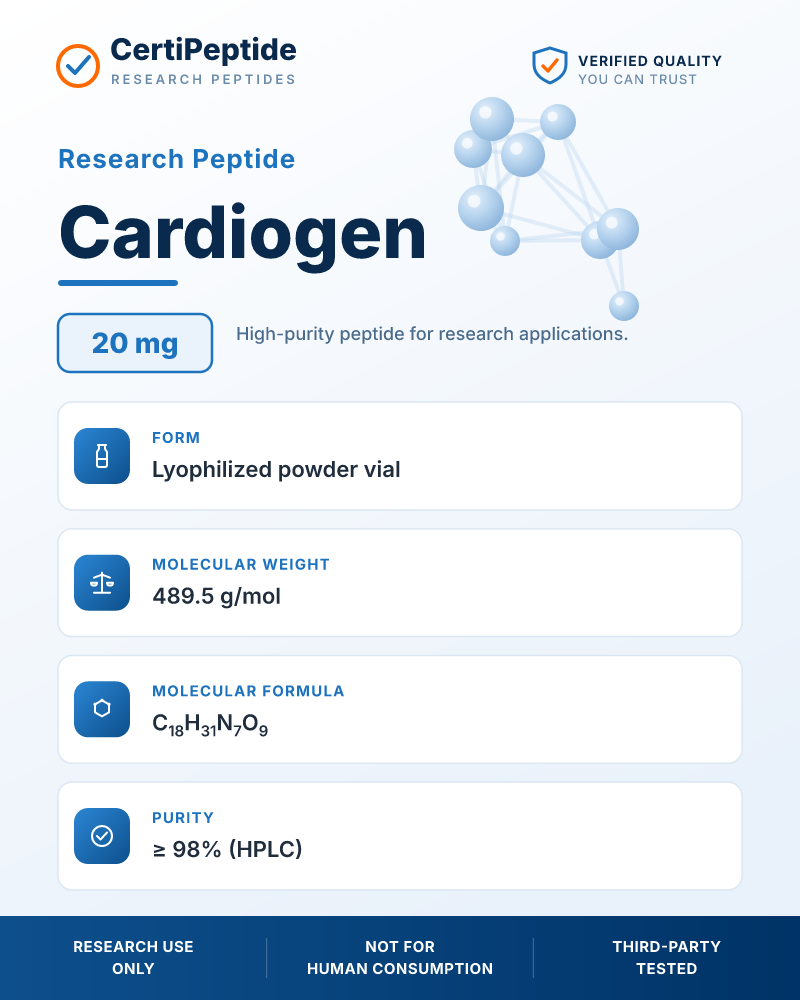
Cardiogen is a research peptide supplied for laboratory investigation only. Researchers explore its interactions with cellular pathways in vitro and in animal models. Early Cardiogen research focuses on cardiac tissue cultures and gene expression patterns.
Cardiogen Research Overview
Cardiogen research spans multiple decades of peptide bioregulator studies. Investigators examine dose-response relationships, stability profiles, and tissue-specific binding in non-human systems. Publications frequently address Cardiogen peptide effects on protein synthesis markers within controlled environments. Recent work incorporates advanced techniques such as RNA sequencing to map potential regulatory networks.
Cardiogen Mechanism of Action
Proposed mechanisms in Cardiogen research involve modulation of transcription factors linked to cellular repair processes. Laboratory data suggest interactions with chromatin remodeling complexes, though exact binding affinities remain under active investigation. Studies using Cardiogen typically track downstream signaling cascades in isolated cardiomyocytes or endothelial cell lines. These findings derive exclusively from bench research and do not extend to clinical interpretations.
How Researchers Study Cardiogen
Standard protocols for Cardiogen research include:
- Cell culture assays measuring viability and proliferation
- Western blot and ELISA quantification of target proteins
- Animal model histology following controlled administration
- Mass spectrometry for peptide stability assessments
Researchers source Cardiogen from verified suppliers to maintain batch consistency across experiments. Flow cytometry and fluorescence microscopy further support visualization of intracellular localization.
Key Areas in Current Cardiogen Studies
Ongoing Cardiogen research explores oxidative stress markers and extracellular matrix remodeling in vitro. Comparative studies evaluate Cardiogen alongside related bioregulator peptides to identify unique activity profiles. Data analysis often employs bioinformatics tools to correlate gene expression changes with observed phenotypic shifts in research models.
Sourcing and Handling Cardiogen
Laboratories obtain Cardiogen in lyophilized form for reconstitution under sterile conditions. Proper storage at controlled temperatures preserves activity during extended research timelines. Documentation of lot numbers and certificates of analysis supports reproducibility requirements common in peer-reviewed work.
Frequently Asked Questions
What is Cardiogen used for in laboratory research?
Cardiogen serves as a tool compound in studies examining peptide interactions with cardiac cell cultures and gene regulation pathways.
How do researchers investigate Cardiogen mechanism?
Common approaches include cell-based assays, protein quantification, and transcriptomic analysis to map potential activity in non-human models.
Is Cardiogen studied in animal models?
Yes, controlled animal studies form part of Cardiogen research protocols to assess tissue responses and biodistribution patterns.
What techniques are used in Cardiogen peptide studies?
Researchers apply Western blotting, RNA sequencing, mass spectrometry, and microscopy to evaluate Cardiogen in laboratory settings.
Explore Further
Browse our research peptide catalog and review third-party lab reports & COAs for every batch.
---
Research use only. The information above is provided for educational and laboratory research purposes only. The compounds discussed are not approved for human or veterinary use, diagnosis, treatment, or the prevention of any disease. Nothing here is medical advice.