TL;DR
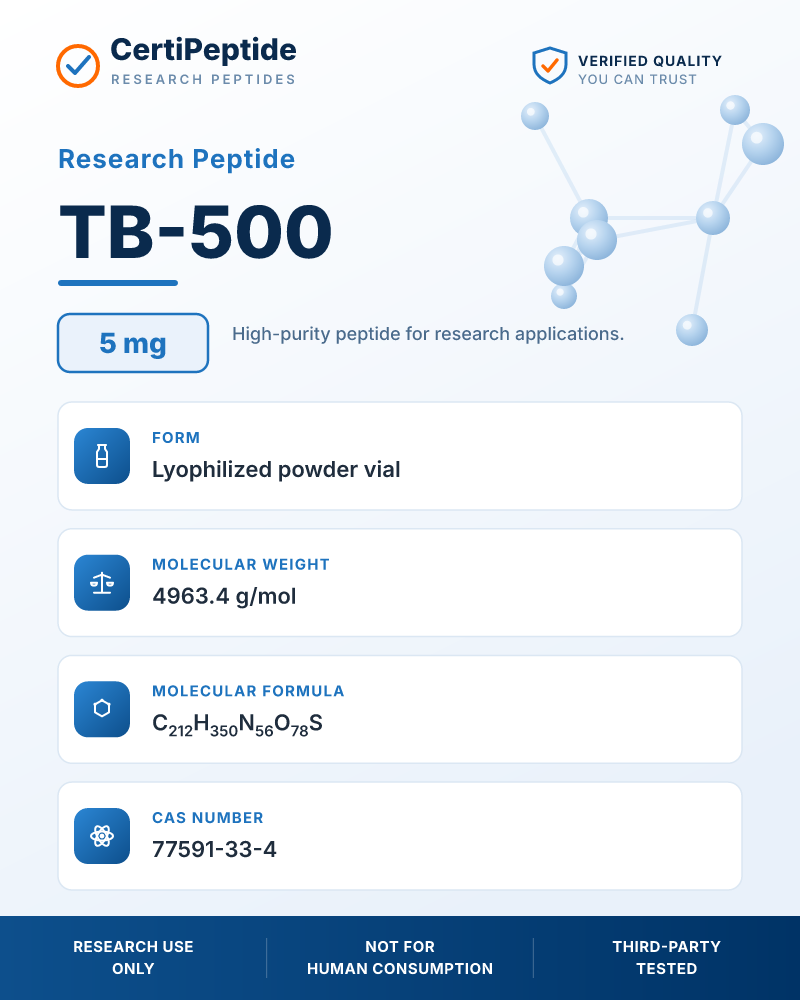
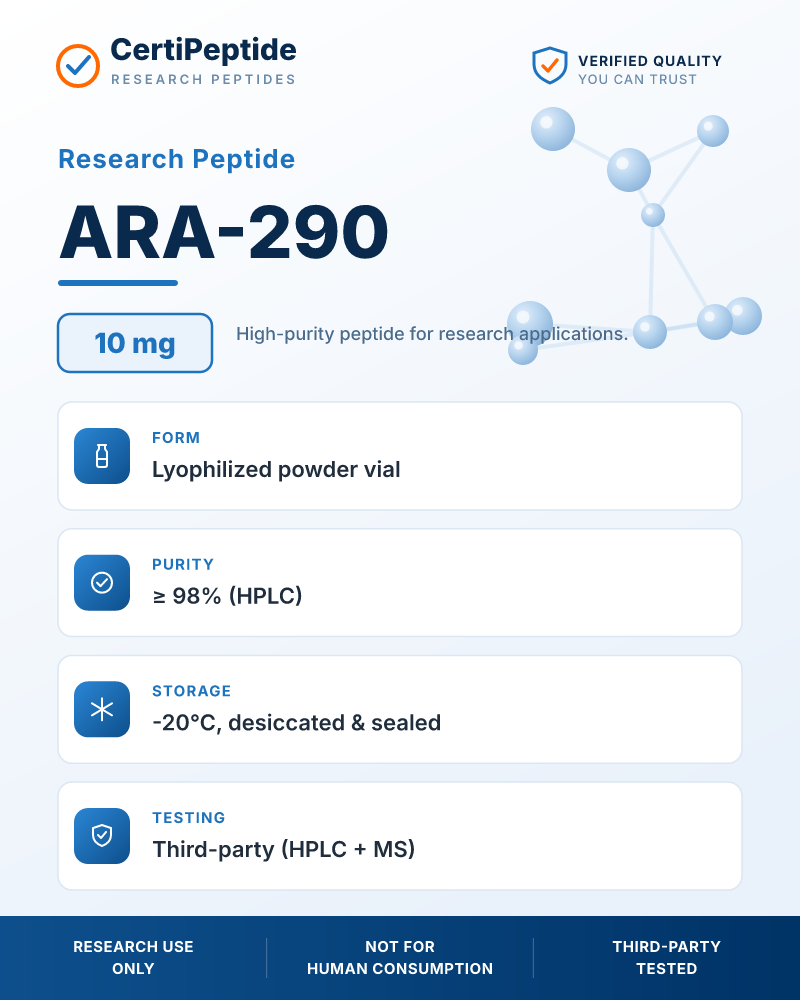
ARA-290 vs TB-500 is a frequent comparison in peptide research because both compounds appear in tissue-repair and inflammation-related study designs, yet they differ sharply in origin, molecular targets, and typical experimental readouts. ARA-290 (cibinetide) is a non-erythropoietic EPO-derived peptide studied mainly for innate repair receptor (IRR) signaling and neuroprotective or anti-inflammatory models. TB-500 is a synthetic fragment related to thymosin beta-4, investigated for actin sequestration, cell migration, and wound-healing pathways. Choosing ARA-290 or TB-500 depends on whether the protocol prioritizes IRR/EPO-pathway endpoints or cytoskeletal and angiogenesis-oriented assays. This ARA-290 TB-500 comparison summarizes structural traits, mechanisms, overlapping research themes, and practical study-design considerations for laboratory use only.
What Are ARA-290 and TB-500 in Research?
ARA-290 and TB-500 are synthetic research peptides used in non-clinical and preclinical investigations. They are not interchangeable tool compounds; each maps to a distinct literature base and set of molecular hypotheses.
ARA-290 is an 11-amino-acid peptide designed from the helix-B surface of erythropoietin (EPO). Research interest centers on selective engagement of the innate repair receptor complex (EPOR/CD131) without stimulating classical erythropoiesis. Published work has examined ARA-290 in models of neuropathic pain signaling, metabolic stress, endothelial dysfunction, and inflammatory cascade modulation. Investigators often track IRR-dependent downstream markers, cytokine profiles, and tissue histology rather than red-cell mass.
TB-500 refers to a synthetic peptide sequence associated with thymosin beta-4 (Tβ4), a ubiquitous G-actin–binding protein. In laboratory settings, TB-500 is studied for effects on actin dynamics, cell motility, matrix remodeling, and angiogenic gene expression. Experimental systems frequently include scratch-wound assays, endothelial tube formation, cardiac or musculoskeletal injury models, and quantification of regenerative markers.
Both peptides are handled as research reagents under controlled laboratory conditions. Protocol design, purity verification, vehicle selection, and endpoint selection should follow institutional and regulatory requirements for investigational compounds.
ARA-290 vs TB-500: Structure and Primary Mechanisms
A clear ARA-290 vs TB-500 contrast starts at the molecular level.
Structural profile
- ARA-290: Short linear peptide (commonly described as pyroglutamate-capped EPO helix-B fragment). Compact size supports receptor-focused signaling studies and relatively straightforward analytical characterization (HPLC, mass spectrometry).
- TB-500: Synthetic sequence modeled on the active region of thymosin beta-4 (often discussed around the LKKTETQ motif and related Tβ4 fragments). Research framing emphasizes actin-binding biology and extracellular matrix interactions rather than EPO-mimetic receptor selectivity.
Mechanistic focus
| Dimension | ARA-290 (research framing) | TB-500 (research framing) |
|---|---|---|
| Primary literature anchor | EPO helix-B / IRR (EPOR–βc) pathway | Thymosin β4 / G-actin sequestration |
| Typical pathway readouts | IRR signaling, inflammation mediators, neural or endothelial stress markers | Actin polymerization state, migration, VEGF-related and repair-gene panels |
| Erythropoietic activity (classic EPO) | Designed to avoid it in study narratives | Not an EPO pathway tool |
| Common model themes | Neuropathy, ischemia-reperfusion stress, inflammatory tone | Wound closure kinetics, tissue remodeling, angiogenesis assays |
In short, ARA-290 research usually asks whether IRR-selective signaling alters injury or inflammatory trajectories, while TB-500 research usually asks how Tβ4-pathway biology shapes cytoskeletal behavior and tissue architecture after insult.
Similarities Observed Across Study Designs
Despite different origins, an ARA-290 TB-500 comparison shows several overlapping experimental themes:
- Tissue integrity endpoints – Both appear in protocols that quantify histological damage, barrier function, or functional recovery scores after controlled injury.
- Inflammation-adjacent readouts – Investigators may measure cytokines, macrophage phenotypes, or oxidative-stress markers even when the primary hypothesized target differs.
- Endothelial and microvascular interest – ARA-290 work often probes protective endothelial signaling; TB-500 work often probes angiogenic and migratory endothelial behavior. The biology is not identical, but vascular beds are shared experimental terrain.
- Peptide logistics – Both require cold-chain handling considerations, validated identity/purity documentation, and careful vehicle/stability planning for in vitro and in vivo laboratory models.
- Non-clinical positioning – Neither compound is framed here as a therapeutic product; both are discussed strictly as research tools for hypothesis testing.
These similarities explain why search interest in ARA-290 or TB-500 is high among groups running repair-biology screens—yet mechanistic alignment should drive selection, not surface-level “repair peptide” labeling.
ARA-290 or TB-500: How Investigators Choose
Selecting ARA-290 or TB-500 is a study-design decision tied to the primary scientific question.
Prefer ARA-290-oriented designs when
- The hypothesis centers on innate repair receptor / EPO-derived non-hematopoietic signaling.
- Endpoints include neuropathic signaling markers, IRR pathway phosphorylation events, or inflammation resolution signatures linked to EPOR–CD131 literature.
- The team needs a compact peptide tool positioned away from classical erythropoietic EPO activity in the experimental narrative.
- Comparative arms may include EPO, soluble receptor reagents, or IRR pathway inhibitors/antibodies as mechanistic controls.
Prefer TB-500-oriented designs when
- The hypothesis centers on actin dynamics, cell migration, or Tβ4-pathway tissue remodeling.
- Assays include scratch wounds, Transwell migration, angiogenesis matrices, or musculoskeletal/cardiac injury histology focused on structural repair.
- Gene/protein panels emphasize cytoskeletal regulators, proteases/MMPs, and angiogenic factors more than IRR complexes.
- Controls may include full-length Tβ4 references, actin-modulating agents, or migration inhibitors.
When dual-arm or sequential designs make sense
Some exploratory programs run parallel cohorts—ARA-290 in an inflammation/neural-stress arm and TB-500 in a migration/remodeling arm—to map which pathway better explains a phenotype. That approach is comparative research, not a recommendation to combine compounds for any applied outcome. Orthogonal readouts (receptor signaling vs actin/migration) reduce interpretive confounds.
Laboratory Applications and Endpoint Mapping
In vitro systems
- ARA-290: Neuronal or glial cultures under metabolic/inflammatory stress; endothelial monolayers; cytokine challenge models; IRR pathway reporter assays where validated.
- TB-500: Keratinocyte or fibroblast migration; endothelial tube formation; actin staining (phalloidin) and live-cell motility tracking; matrix-invasion setups.
In vivo and ex vivo models (research only)
- ARA-290: Controlled nerve injury, ischemia-reperfusion, or systemic inflammatory challenge models with behavioral, electrophysiological, or histological batteries aligned to IRR hypotheses.
- TB-500: Excisional wound, tendon/muscle injury, or vascular remodeling models with planimetry, biomechanics, and angiogenesis indices.
Analytical and quality considerations
For either peptide, laboratories typically document:
- Certificate of analysis (identity, purity, residual solvents as applicable)
- Reconstitution solvent compatibility and aliquot stability
- Dose-ranging within the animal or cell model solely for concentration–response curves (not human use)
- Blinding and vehicle controls to separate peptide effects from handling artifacts
Natural mention of research materials: investigators sourcing ARA-290 for IRR-pathway work or TB-500 for Tβ4-related cytoskeletal studies should match lot documentation to the assay’s sensitivity and the institution’s reagent policies.
Key Differences That Affect Data Interpretation
- Receptor vs cytoskeleton primacy – Positive ARA-290 signals are often interpreted through IRR biology; positive TB-500 signals through actin/migration biology. Cross-claiming mechanisms without pathway evidence weakens manuscripts.
- Hematopoietic confounding – ARA-290 literature emphasizes separation from erythropoietic EPO effects; study designs still monitor hematologic parameters when EPO-pathway tools are used. TB-500 designs rarely frame this confound the same way.
- Time-course expectations – Migration and wound-closure assays (TB-500–type) may show early kinetic differences; IRR-linked inflammatory or neuropathic models (ARA-290–type) may require longer behavioral or histological windows.
- Biomarker panels – Align omics and immunoassays to the chosen mechanism. A generic “inflammation panel” alone rarely distinguishes the two tools.
- Combination claims – Without factorial designs and interaction statistics, co-administration data cannot support synergy conclusions.
Practical Checklist for an ARA-290 TB-500 Comparison Study
- Define a single primary endpoint tied to one dominant mechanism.
- Pre-register or pre-specify secondary endpoints (cytokines, histology scores, migration indices).
- Include pathway-appropriate positive/negative controls.
- Standardize injury severity and timing across arms.
- Report peptide identity, purity, and vehicle in methods for reproducibility.
- Use adequate sample size and blinding for in vivo behavioral or planimetric measures.
- Discuss limitations: model species, peptide stability, and off-target possibilities.
Summary
The ARA-290 vs TB-500 decision is mechanistic, not cosmetic. ARA-290 is positioned in research as an EPO helix-B–derived probe of innate repair receptor signaling and related inflammatory or neural-stress phenotypes. TB-500 is positioned as a thymosin beta-4–related tool for actin-linked migration, remodeling, and angiogenesis-oriented questions. Similarities exist in broad “tissue integrity” experimental spaces, but structure, targets, and best-fit endpoints diverge. Laboratories comparing ARA-290 or TB-500 should anchor protocols to validated pathway readouts, rigorous controls, and transparent reagent characterization—keeping all work within controlled research contexts.
FAQ Preview
Common long-tail questions—mechanism differences, model selection, and whether the peptides are interchangeable—are addressed in the FAQ block accompanying this article for quick reference during protocol planning.
Explore Further
Browse our research peptide catalog and review third-party lab reports & COAs for every batch.
---
Research use only. The information above is provided for educational and laboratory research purposes only. The compounds discussed are not approved for human or veterinary use, diagnosis, treatment, or the prevention of any disease. Nothing here is medical advice.