TL;DR
AOD9604 vs 5-Amino-1MQ comparisons help researchers choose tools for metabolic, adipose, and energy-balance studies. AOD9604 is a synthetic C-terminal fragment analog of human growth hormone (hGH 177–191) examined mainly for lipolytic and adipose-related endpoints. 5-Amino-1MQ is a small-molecule nicotinamide N-methyltransferase (NNMT) inhibitor explored for NAD+-linked metabolism and adiposity models. They share interest in body-composition research but differ in structure, primary targets, and typical experimental readouts. This article outlines research differences, similarities, and practical study-use considerations for laboratory settings only.
Why Compare AOD9604 and 5-Amino-1MQ in Studies?
Laboratories investigating energy homeostasis, adipose tissue biology, or metabolic enzyme pathways often evaluate multiple research compounds. An AOD9604 5-Amino-1MQ comparison clarifies which molecule better matches a given hypothesis, assay type, and model system.
AOD9604 is frequently positioned in peptide and fragment-hormone research. 5-Amino-1MQ sits in the chemical biology space around methyltransferase inhibition and cellular NAD+ economy. Side-by-side evaluation reduces protocol mismatch and supports clearer interpretation of in vitro and in vivo data.
Both materials appear in catalogs aimed at qualified research use. Selecting AOD9604 or 5-Amino-1MQ depends on whether the study prioritizes GH-fragment signaling readouts or NNMT/NAD+ pathway modulation.
Molecular Identity and Structure
AOD9604
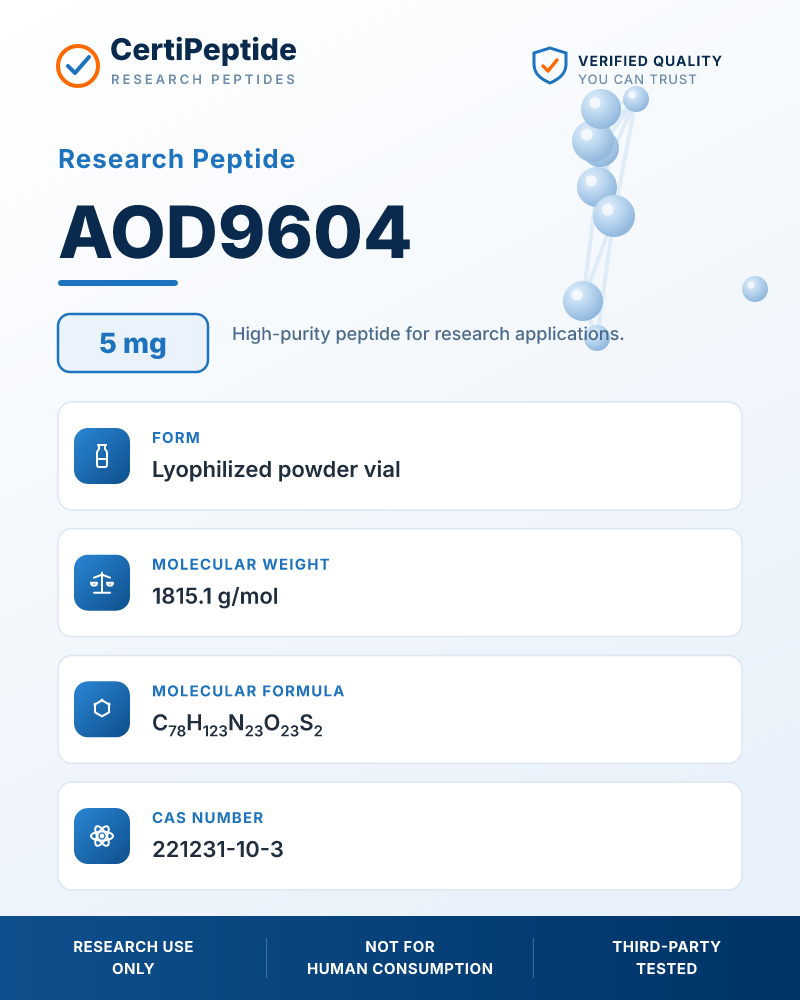
AOD9604 is a modified peptide corresponding to the C-terminal region of hGH (residues 177–191), typically described with a Tyr-hGH(177–191) design and stabilizing modifications used in research lots. It is handled as a research peptide: sequence-defined, often supplied lyophilized, and characterized by HPLC/MS identity and purity assays.
In published and preclinical literature, interest centers on fragments that retain certain metabolic associations of hGH while being studied separately from full-length growth-promoting activity. Experimental work has examined lipolysis markers, adipose explants, and related biochemical endpoints rather than classical somatotropic growth panels.
5-Amino-1MQ
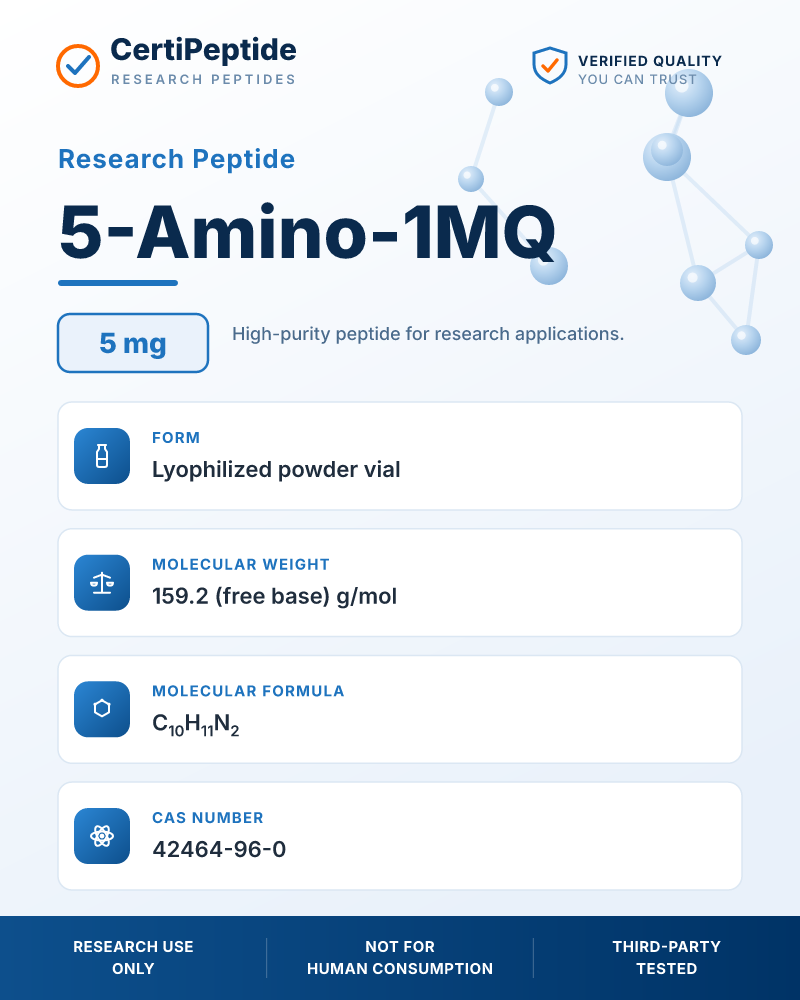
5-Amino-1MQ (5-amino-1-methylquinolinium) is a low-molecular-weight quinolinium derivative, not a peptide. It is studied as an inhibitor of nicotinamide N-methyltransferase (NNMT), an enzyme that methylates nicotinamide and influences the salvage pathway for NAD+. Research lots are typically salt forms suitable for cell culture or animal-model administration under institutional protocols.
Structural simplicity favors membrane permeability discussions and enzyme-kinetic assays, contrasting with the receptor- or pathway-context work more common for peptide fragments such as AOD9604.
Mechanisms Under Investigation
AOD9604: Adipose and Lipolytic Research Angles
Research narratives around AOD9604 emphasize:
- Exploration of lipolytic signaling and free fatty acid release in adipocyte or tissue models
- Comparison against full-length hGH or other fragments for pathway selectivity
- Cartilage and connective-tissue exploratory work in some non-clinical models
- Downstream markers sometimes linked to beta-adrenergic or cAMP-associated lipolysis cascades (model-dependent)
Investigators usually design experiments around adipose gene expression, glycerol release, lipid droplet dynamics, or body-composition imaging in animals—always within controlled research frameworks.
5-Amino-1MQ: NNMT Inhibition and Metabolic Flux
5-Amino-1MQ research focuses on:
- NNMT catalytic inhibition and effects on nicotinamide methylation
- Consequences for intracellular NAD+ availability and sirtuin-related biology in cell systems
- Adipose tissue mass, energy expenditure proxies, and metabolic gene programs in rodent diet-induced models
- Intersection with one-carbon metabolism and methyl-donor balance
Assays often include NNMT activity, NAD+/NADH ratios, oxygen consumption, and transcriptomic panels for oxidative metabolism.
Overlap and Divergence
Both compounds appear in metabolic phenotype literature, yet primary molecular handles differ: fragment-hormone biology versus methyltransferase inhibition. An AOD9604 vs 5-Amino-1MQ mechanism table in a lab notebook would list distinct upstream targets and partially overlapping downstream phenotypes (e.g., adiposity-related endpoints).
Similarities in Research Use
Despite chemical dissimilarity, several practical similarities matter for study design:
- Metabolic and body-composition themes – Both are cited in work touching fat mass, energy balance, or related biomarkers.
- Preclinical and in vitro emphasis – Literature and supplier contexts center on cells, tissues, and animal models—not clinical use.
- Need for analytical verification – Identity, purity, and stability testing (HPLC, LC-MS, NMR as appropriate) remain essential before assays.
- Formulation considerations – Solubility, vehicle choice, and storage affect reproducibility for both AOD9604 (peptide handling, freeze-thaw limits) and 5-Amino-1MQ (solvent and salt form).
- Endpoint flexibility – Either can pair with shared readouts: DEXA/EchoMRI in animals, adipokine panels, respirometry, or histomorphometry of adipose depots.
These parallels explain why search interest in AOD9604 or 5-Amino-1MQ often co-occurs in metabolic research planning.
Key Differences for Experimental Design
| Dimension | AOD9604 | 5-Amino-1MQ |
|---|---|---|
| Chemical class | Modified peptide fragment | Small-molecule quinolinium |
| Primary research handle | hGH C-terminal fragment biology | NNMT inhibition / NAD+ pathway |
| Typical assays | Lipolysis, adipose explants, peptide stability | Enzyme kinetics, NAD+ metabolomics |
| Handling | Lyophilized peptide SOPs | Small-molecule stock solutions |
| Off-target framing | Peptide receptor/pathway context | Methylation and redox cofactor networks |
Model Selection
- Prefer AOD9604 when the hypothesis is anchored in growth-hormone fragment literature, comparative fragment studies, or classical lipolysis workflows.
- Prefer 5-Amino-1MQ when NNMT expression, nicotinamide flux, or NAD+-dependent enzymes are central.
- Dual-arm designs are feasible when the goal is to contrast peptide-fragment versus NNMT-inhibitor routes to similar phenotypic endpoints.
Analytical and QC Notes
Peptide lots of AOD9604 require sequence confirmation and careful control of oxidation or aggregation. 5-Amino-1MQ characterization leans on purity of the quinolinium species and consistent counter-ion identity. Cross-contamination controls matter if both are used in the same facility.
Use in Studies: Practical Research Framing
In Vitro
- AOD9604: differentiated adipocytes, primary adipose stromal cells, glycerol/NEFA release, hormone-sensitive lipase phosphorylation panels.
- 5-Amino-1MQ: NNMT-overexpressing lines, hepatocytes or adipocytes for NAD+ metabolomics, Seahorse-style bioenergetics, methyltransferase activity assays.
Ex Vivo / Tissue
Tissue baths or explants can test acute lipolytic responses (AOD9604-focused) versus longer enzyme-inhibition and cofactor shifts (5-Amino-1MQ-focused).
In Vivo (Institutional Animal Protocols)
Rodent diet-induced obesity or genetic models may track weight trajectory, fat pad weights, glucose handling tests, and indirect calorimetry. Attribution of effects must stay tied to the distinct mechanisms; combination studies need factorial design and adequate power.
No human dosing, therapeutic claims, or clinical protocols belong in research-use documentation for these materials.
AOD9604 vs 5-Amino-1MQ: Choosing for a Protocol
Decision checklist for principal investigators:
- Hypothesis fit – GH-fragment lipolysis narrative vs NNMT/NAD+ narrative.
- Available assays – peptide bioactivity suite vs enzymology/metabolomics suite.
- Compound logistics – cold-chain peptide stability vs small-molecule stock management.
- Literature anchors – depth of prior fragment-hGH papers vs NNMT inhibitor papers in your exact model.
- Controls – vehicle, scrambled or inactive peptide controls for AOD9604; structurally related non-inhibitors or genetic NNMT knockdown for 5-Amino-1MQ.
When catalogs list both AOD9604 and 5-Amino-1MQ, is researched in the context of them as complementary research tools rather than interchangeable reagents.
Limitations and Reporting Standards
Comparative claims should stay within the evidence of the specific model. Batch variability, incomplete dose–response curves, and unblinded phenotyping weaken both peptide and small-molecule studies. Report:
- Full chemical identity and purity
- Vehicle and stability data
- Exact exposure conditions in vitro or administration details under approved animal protocols
- Negative and pathway-positive controls
Avoid extrapolating laboratory observations to human health, performance, or medical outcomes.
Summary
An AOD9604 vs 5-Amino-1MQ research comparison shows two distinct chemical strategies aimed at overlapping metabolic questions. AOD9604 supports peptide-fragment and adipose-lipolysis lines of inquiry; 5-Amino-1MQ supports NNMT-centric and NAD+-linked metabolic flux work. Similarities include metabolic endpoint families and rigorous QC needs; differences dominate at the level of structure, target, and core assays. For study design, map the molecule to the mechanism first, then align models and analytics. Both AOD9604 and 5-Amino-1MQ remain research-use materials for controlled laboratory investigation only.
FAQ
Explore Further
Browse our research peptide catalog and review third-party lab reports & COAs for every batch.
---
Research use only. The information above is provided for educational and laboratory research purposes only. The compounds discussed are not approved for human or veterinary use, diagnosis, treatment, or the prevention of any disease. Nothing here is medical advice.