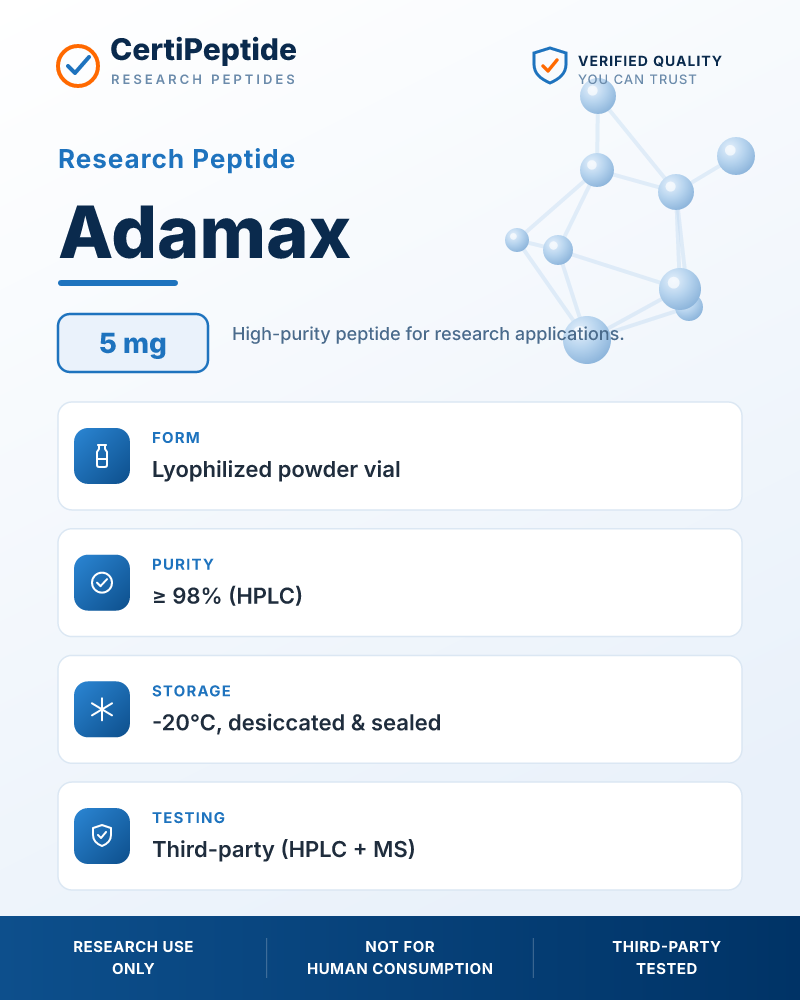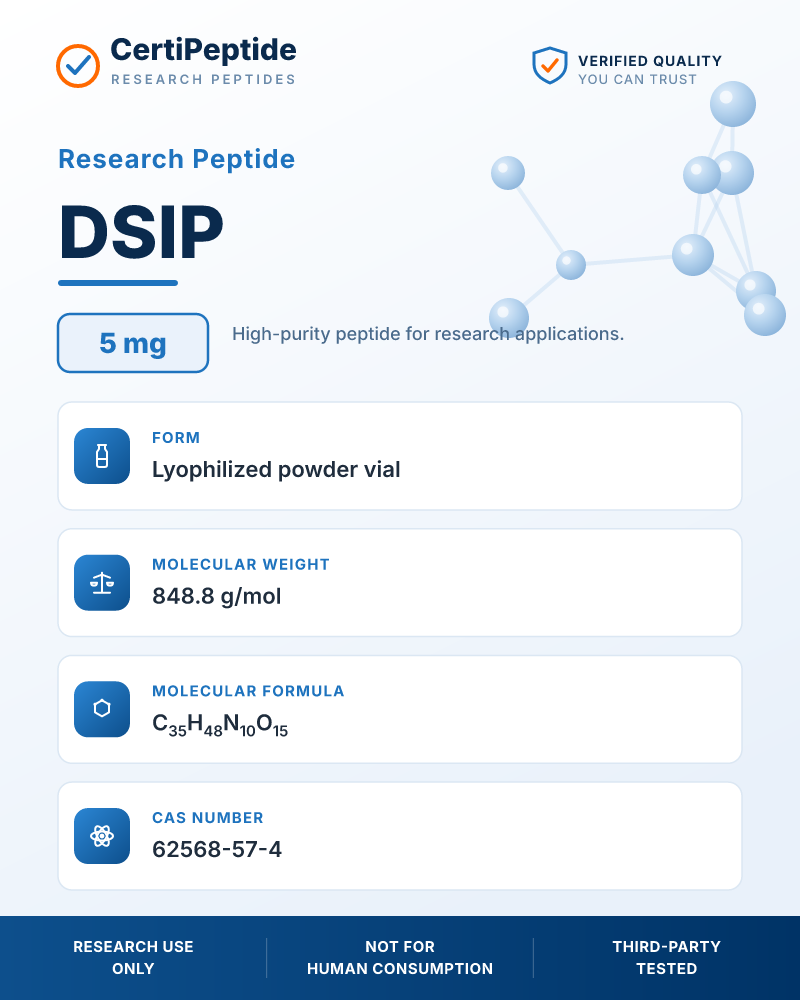
TL;DR: An Adamax vs DSIP decision is a hypothesis choice, not a catalog swap. Adamax is a synthetic Semax analog explored mainly in neurotrophic and cognitive laboratory models. DSIP is an endogenous nonapeptide studied for sleep architecture, stress physiology, and selected endocrine endpoints. Investigators pick Adamax or DSIP from the assay battery they need and from the much deeper published record attached to DSIP.
Why Researchers Compare Adamax vs DSIP
Neuroscience groups that source research peptides often evaluate neighboring catalog items when a new protocol is drafted. An Adamax DSIP comparison shows up frequently for a simple reason: both compounds appear in the same procurement lists, yet they occupy different experimental niches. Treating them as interchangeable would scramble endpoints, vehicle notes, and literature controls.
An Adamax or DSIP (peptide) is a short amino-acid chain used as a biochemical tool. Published effects are model-specific. Animal or cell dose-ranging does not transfer to people, and neither material is discussed here as an approved clinical product. The useful question is which structure matches which measurement.
Structural and Biochemical Differences
DSIP (delta sleep-inducing peptide) is a defined nonapeptide, typically given as Trp-Ala-Gly-Gly-Asp-Ala-Ser-Gly-Glu. Labs can pull formula, identifiers, and related records from PubChem compound data and other public chemical sources. Because the sequence has been stable in the literature since the 1970s, synthetic lots can be checked against a clear reference, and older papers remain interpretable.
Adamax is described in research-chemical sources as an adamantane-modified analog of Semax (an ACTH(4–10)-related heptapeptide). The adamantane group is a design choice meant to change lipophilicity and proteolytic stability relative to unmodified Semax. Unlike DSIP, Adamax does not have a long, independently curated monograph trail. When a laboratory first brings Adamax online, lot documentation, HPLC/MS identity, and an in-house reference standard matter more than brochure language.
Those structural facts create practical differences:
- Size and polarity. DSIP is a small acidic nonapeptide. Adamax is a modified heptapeptide analog carrying a bulky hydrophobic group.
- Origin. DSIP was isolated from mammalian cerebral venous blood and later synthesized. Adamax is a purpose-built analog.
- Natural comparators. DSIP studies often include scrambled peptides or other sleep-related transmitters. Work that names Adamax, when it exists, is more coherently compared with Semax, Selank, or other ACTH-fragment analogs—not with DSIP.
Research Domains and Experimental Endpoints
Where DSIP appears in studies
DSIP has been examined in animal and in vitro systems for electroencephalographic (EEG) measures and slow-wave activity; stress-axis markers in immobilization or novelty-stress paradigms; selected endocrine readouts in historical pituitary work; thermoregulation, nociception, and withdrawal-related rodent models; and circadian or recovery-sleep designs.
Results across decades are mixed. Some groups reported changes in delta activity or stress-related markers; others found weak or context-dependent effects. That inconsistency is methodologically useful. It tells a careful team to pre-specify endpoints, control circadian phase, and avoid reading too much into a single snapshot.
Where Adamax is discussed
Adamax is usually grouped with nootropic and neurotrophic research tools. Experimental questions that might justify including Adamax—or, more often, better-documented Semax—include expression of neurotrophic factors such as BDNF or NGF in neuronal or glial cultures; rodent batteries that probe exploration, attention, or memory consolidation; oxidative-stress or ischemia-related cell models already used for ACTH-fragment analogs; and stability comparisons in plasma or brain homogenate assays.
Primary papers that name Adamax specifically are sparse. A rigorous group will is researched in the context of vendor narratives as hypotheses and build the assay around measurable molecular or behavioral endpoints rather than assumed cognitive outcomes.
Literature Depth: Adamax or DSIP?
On a simple literature-volume test, DSIP is the better-documented tool. The peptide has a long tail of preclinical papers and secondary summaries. Searching bibliographic indexes and the ClinicalTrials.gov registry will surface far more historical DSIP-related records than Adamax-specific entries. Volume is not the same as a therapeutic claim. It means failed replications, method notes, and control conditions exist for other investigators to inspect.
Adamax sits on a thinner evidence layer. Many mechanistic inferences are borrowed from Semax and related ACTH fragments, a literature that is unevenly available in English full text. For an Adamax vs DSIP methods paragraph, honest wording is: DSIP has a characterized, if contested, experimental history; Adamax requires more in-house validation before it can carry a primary claim.
Public starting points include DSIP research studies indexed on PubMed, Semax-analog papers, and chemical records—not marketing copy.
Selecting Adamax or DSIP for Study Design
A practical Adamax DSIP comparison for protocol design looks like this:
| Decision factor | Favors DSIP | Favors Adamax |
|---|---|---|
| Sleep/EEG or circadian hypothesis | Yes | Rarely |
| Stress-axis or endocrine panels | Often | Unlikely first choice |
| Neurotrophic or Semax-analog questions | No | Possible, with Semax as a control |
| Need for historical animal dose-ranging papers | Stronger | Weak |
| Sequence consensus and identity standards | High | Laboratory must verify |
| Factorial or combination designs | Only if hypotheses are independent | Same caveat |
If the scientific question is sleep architecture or exploratory DSIP binding/physiology work, DSIP is the coherent reagent. If the question is how adamantane modification changes Semax-like activity in a cell or rodent assay, Adamax may be justified—ideally with Semax and vehicle arms, not DSIP, as the comparator.
Putting Adamax and DSIP into the same animal is only defensible when the hypothesis is explicitly about interaction, for example whether a neurotrophic analog changes a DSIP-linked EEG readout. Otherwise attribution collapses.
Laboratory Handling Notes (Non-Clinical)
Both materials are peptides and share generic quality-control themes used across research peptide work:
- Confirm identity and purity (HPLC, MS) against the certificate of analysis.
- Protect stocks from repeated freeze–thaw; aliquot early.
- Document solvent, pH, and adsorption to plastic. DSIP’s acidic residues and Adamax’s hydrophobic modification can behave differently on surfaces.
- Use endotoxin-aware practices for any in vivo animal work required by the institutional protocol.
- Store lyophilized material dry and cold according to the supplier’s research-chemical guidance.
These points are documentation and integrity steps for laboratory material. They are not instructions for human administration.
Summary for Investigators
An Adamax vs DSIP choice is a hypothesis choice. DSIP is the historically studied sleep- and stress-related nonapeptide with a large, mixed literature. Adamax is a less-documented Semax analog aimed at neurotrophic and cognitive-model research. They are not structural analogs of each other, they do not share a primary endpoint family, and substituting one for the other will usually invalidate the study’s literature controls. Match the peptide to the assay, cite primary chemistry sources, and keep human therapeutic language out of the protocol.
Frequently Asked Questions
Is Adamax a DSIP analog? No. DSIP is a tryptophan-containing nonapeptide. Adamax is discussed as an adamantane-modified Semax analog. Shared catalog placement does not imply shared sequence or mechanism.
Which compound has stronger published backing? DSIP has decades of preclinical papers and mixed replications. Adamax has a much thinner primary literature, so labs should validate identity and endpoints in-house.
Can one study include both peptides? Only when the protocol is written to test an interaction. Otherwise a single-peptide design with proper vehicle and analog controls is cleaner.
Explore Further
Browse our research peptide catalog and review third-party lab reports & COAs for every batch.
---
Research use only. The information above is provided for educational and laboratory research purposes only. The compounds discussed are not approved for human or veterinary use, diagnosis, treatment, or the prevention of any disease. Nothing here is medical advice.