TL;DR
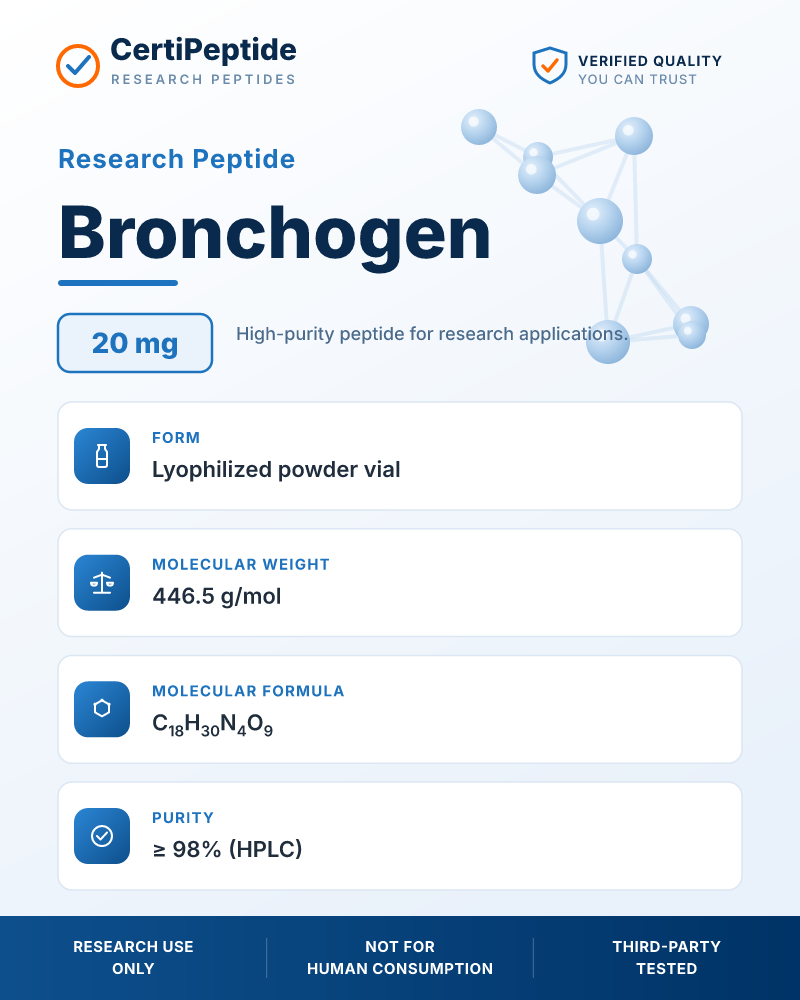
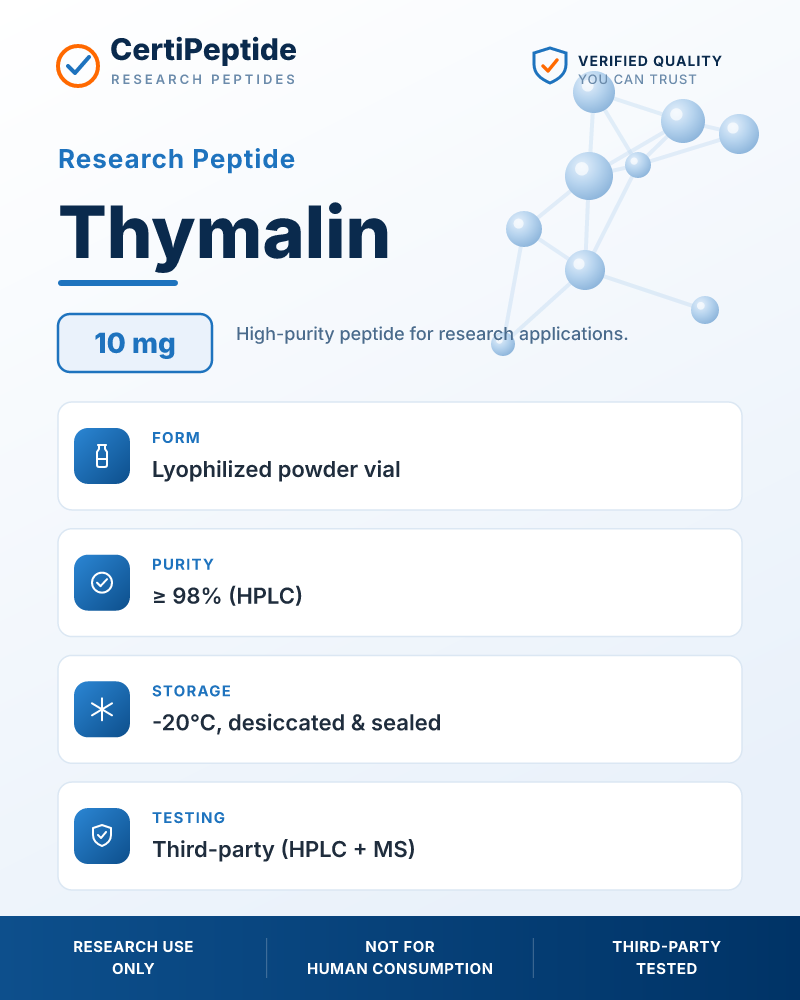
**Thymalin vs Bronchogen** is a comparison of two distinct peptide bioregulators used in laboratory research. Thymalin is a thymic polypeptide complex studied mainly for immune-cell differentiation and thymic signaling models. Bronchogen is a short peptide complex associated with bronchial and respiratory epithelial research. They share bioregulator framing and multi-peptide composition but differ in tissue orientation, primary endpoints, and typical assay panels. Choice depends on whether a study prioritizes immune/thymic readouts or airway/epithelial models—not interchangeable “general” peptides.
Why Compare Thymalin vs Bronchogen in Research?
Investigators often search **Thymalin vs Bronchogen**, **Thymalin or Bronchogen**, or **Thymalin Bronchogen comparison** when designing protocols that touch immune competence, mucosal barriers, or aging-related tissue models. Both compounds appear in the peptide-bioregulator literature and are supplied for research use only. They are not the same molecule, do not target identical pathways, and should not be treated as drop-in substitutes without clear endpoint alignment.
This article summarizes compositional context, overlapping methods, divergent study aims, and practical selection criteria for lab work—without clinical claims or human-use guidance.
What Is Thymalin in Laboratory Context?
Thymalin is a polypeptide complex historically prepared from thymic tissue and later characterized in research settings as a mixture of low-molecular-weight peptides. In experimental literature it is linked to:
- Models of T-cell maturation and thymic microenvironment signaling
- In vitro assays of lymphocyte proliferation, surface marker expression, and cytokine patterns
- Animal studies exploring immune organ indices, stress or age-associated immune decline, and recovery after cytostatic or radiation challenge (as research stressors)
- Broader “peptide bioregulator” work on gene expression and protein synthesis in immune-relevant tissues
Material used in modern labs is typically standardized for research (identity, peptide content, purity documentation) rather than crude extracts. Investigators is researched in the context of Thymalin as an **immune/thymic-oriented** tool, not a single defined sequence like many synthetic research peptides.
What Is Bronchogen in Laboratory Context?
Bronchogen is a short peptide complex developed within the same bioregulator research tradition but oriented toward **bronchial and respiratory epithelial** systems. Published and vendor research framing commonly associates it with:
- Airway mucosa and bronchial tissue models
- Epithelial barrier integrity, secretory function, and local inflammatory marker panels in vitro or ex vivo
- Animal respiratory challenge or aging-lung models where bronchial structure/function is the primary readout
- Gene-expression or proteomic studies focused on lung-associated peptide regulation
Unlike single-chain synthetic peptides with one primary sequence, Bronchogen is discussed as a multi-component short-peptide preparation. Its research niche is tissue-specific (respiratory), which is the main contrast in any **Thymalin Bronchogen comparison**.
Composition and Classification: Core Differences
| Dimension | Thymalin (research framing) | Bronchogen (research framing) |
|-----------|-----------------------------|--------------------------------|
| Tissue orientation | Thymus / immune system | Bronchial / respiratory mucosa |
| Typical description | Thymic polypeptide complex | Short peptide bioregulator complex |
| Primary research axis | Lymphoid differentiation, immune indices | Airway epithelium, local bronchial markers |
| Interchangeability | Not a substitute for bronchial models | Not a substitute for thymic/immune models |
| Form factor in labs | Lyophilized research material | Lyophilized research material |
**Differences that matter for study design**
1. **Endpoint fit** — Thymalin aligns with thymic output, T-cell subsets, and systemic immune panels. Bronchogen aligns with bronchial histology, epithelial cytokines, mucin-related markers, or lung function proxies in animals.
2. **Tissue selectivity hypothesis** — Bioregulator research often assumes preferential action on tissues matching the peptide complex’s origin or design. That hypothesis drives separate inclusion criteria, not a shared “one peptide fits all” design.
3. **Assay battery** — Flow cytometry and lymphoid organ weights are more natural for Thymalin arms; BAL (bronchoalveolar lavage) cytology, epithelial tight-junction proteins, or airway remodeling scores fit Bronchogen arms better.
4. **Literature silos** — Citations cluster by organ system. Meta-comparisons across immune vs respiratory papers require careful normalization of dose units (research concentrations), species, and outcome definitions.
Similarities Relevant to Protocol Design
Despite different tissue focuses, **Thymalin vs Bronchogen** comparisons reveal shared practical traits useful for lab operations:
- **Bioregulator class** — Both are discussed as complexes of short peptides rather than classical single-target small molecules or monoclonals.
- **Research-use supply chain** — Both appear as lyophilized materials intended for controlled laboratory experiments, with emphasis on identity and purity documentation.
- **Multi-endpoint culture** — Studies often combine molecular (mRNA/protein), cellular, and tissue-level readouts instead of one binary assay.
- **Combination exploratory designs** — Some groups explore sequential or parallel arms (immune + mucosal) when modeling multi-organ stress; that does not imply synergy claims—only that designs can include both reagents if justified.
- **Handling norms** — Cold-chain storage, reconstitution in suitable research vehicles, aliquotting to limit freeze–thaw, and vehicle controls are standard for both.
- **Need for controls** — Blinded scoring, sham/vehicle groups, and validated antibodies or primers remain essential regardless of which complex is used.
These similarities simplify SOPs (shared reconstitution and QC habits) but do not erase biological non-equivalence.
Research Use Cases: When Studies Use Thymalin
Typical laboratory scenarios for Thymalin include:
- **Immune aging models** — Aged rodents or senescent cell co-cultures with thymic and peripheral immune endpoints.
- **Lymphopoiesis / differentiation assays** — Bone marrow or thymic explants, thymocyte subset analysis, and related cytokine profiling.
- **Stress or cytotoxic challenge recovery** — Research models where chemotherapy analogs, irradiation, or severe stress are applied solely as experimental insults, then immune recovery kinetics are measured.
- **Gene-expression screens** — Transcriptomic or targeted PCR panels on thymus, spleen, or purified lymphocytes after exposure in vitro or in vivo (animal).
Investigators select Thymalin when the **primary scientific question is immune or thymic**, not when the question is purely airway remodeling.
Research Use Cases: When Studies Use Bronchogen
Bronchogen-oriented work more often includes:
- **Airway epithelial cultures** — Primary bronchial epithelial cells or cell lines under inflammatory or oxidative challenge.
- **Mucosal barrier studies** — Tight-junction proteins, permeability dyes, and secretory marker quantification.
- **Animal respiratory models** — Controlled inhalation or systemic challenge models with bronchial histology and lavage endpoints (research-only).
- **Tissue-specific peptide regulation** — Experiments testing whether short peptide complexes alter expression patterns preferentially in lung-associated tissues versus off-target organs.
Here the decision **Thymalin or Bronchogen** resolves toward Bronchogen when bronchial epithelium is the dependent variable of interest.
Head-to-Head: Designing a Fair Comparison Study
If a lab explicitly wants a **Thymalin Bronchogen comparison** under one protocol, good practice includes:
1. **Separate primary endpoints** — Pre-register immune primary endpoints for Thymalin-relevant arms and respiratory primaries for Bronchogen arms; secondary cross-readouts are optional.
2. **Matched exposure metrics** — Harmonize molarity or mass/volume conventions, exposure duration, and sampling times so differences are not artifacts of unequal contact.
3. **Tissue panel breadth** — Sample both lymphoid and lung tissues in all groups to test specificity hypotheses rather than assuming them.
4. **Orthogonal methods** — Pair histology with qPCR/protein assays and, where feasible, functional tests (e.g., lymphocyte proliferation vs epithelial barrier TEER).
5. **Vehicle and scrambled/irrelevant peptide controls** — Strengthen attribution when using multi-component preparations.
6. **Statistics powered for two domains** — Avoid underpowered “fishing” across dozens of markers without correction.
Such designs answer whether effects are tissue-biased—an actual scientific question—rather than which product is “better” in a marketing sense.
Practical Selection Guide for Investigators
**Lean toward Thymalin when:**
- Hypotheses center on thymic signaling, T-cell subsets, or systemic immune indices.
- Core facilities and kits already optimized for immunology panels.
- Prior pilot data show signal in lymphoid tissues.
**Lean toward Bronchogen when:**
- Hypotheses center on bronchial epithelium, airway inflammation markers, or lung tissue structure.
- Models are inhalation, epithelial injury, or mucosal barrier focused.
- Histopathology and lavage workflows are already validated in the lab.
**Consider parallel arms when:**
- Multi-organ aging or multi-hit stress models require both immune and mucosal readouts.
- The goal is comparative tissue specificity, not a single therapeutic narrative.
Always document lot numbers, COAs, reconstitution solvent, and storage for reproducibility. Frame conclusions strictly within the species, model, and assay limits used.
Methodological Caveats Shared by Both
- **Complex mixtures** — Multi-peptide preparations complicate single-target mechanistic claims; fractionation or synthetic single-sequence follow-ups may be needed for mechanism papers.
- **Batch documentation** — Demand analytical data appropriate to research peptides (appearance, solubility, peptide content, impurity profile as available).
- **Model validity** — In vitro concentrations and animal models do not translate to human use; keep language and ethics board scopes research-only.
- **Publication clarity** — Specify “Thymalin” or “Bronchogen” preparation source and characterization so readers can interpret **Thymalin vs Bronchogen** results across labs.
Summary
A rigorous **Thymalin vs Bronchogen** comparison shows complementary—not identical—research tools. Thymalin maps to thymic and broader immune experimental questions; Bronchogen maps to bronchial and respiratory epithelial questions. They share bioregulator classification, handling practices, and multi-endpoint study culture, but differ in tissue orientation, typical assays, and literature context. Selecting **Thymalin or Bronchogen** should follow the dependent variables of the protocol. Parallel use is justifiable only when the science requires dual-domain readouts and controls are strong. All work remains confined to laboratory and preclinical research settings.
FAQ
Explore Further
Browse our [research peptide catalog](/shop) and review third-party [lab reports & COAs](/lab-reports) for every batch.
---
**Research use only.** The information above is provided for educational and laboratory research purposes only. The compounds discussed are not approved for human or veterinary use, diagnosis, treatment, or the prevention of any disease. Nothing here is medical advice.