TL;DR **Selank vs Pinealon** comparisons help researchers match peptide tools to experimental questions. Selank is a synthetic tuftsin-derived heptapeptide often examined in stress-response, GABAergic, and cognitive-behavior models. Pinealon is a short Glu-Asp-Arg bioregulator peptide studied mainly in neuronal resilience, oxidative stress, and age-related CNS models. Both appear in neuro-oriented in vitro and in vivo work, yet they differ in size, proposed pathways, and typical endpoints. This guide outlines structural contrasts, shared themes, and study-design considerations for laboratory use of Selank and Pinealon.
Why Compare Selank vs Pinealon in Research? Investigators searching for a **Selank Pinealon comparison** usually need clarity on which compound better fits a given protocol. Neither peptide is interchangeable with the other on a one-to-one basis. Selection depends on hypothesis, model system, readout, and prior literature. Framing the choice as **Selank or Pinealon** forces explicit alignment between molecular properties and experimental aims—essential for reproducible, hypothesis-driven work.
Primary keyword usage and product context matter for catalog clarity: laboratories source research-grade **Selank** when exploring anxiolytic-like or nootropic-related pathways in controlled models, and research-grade **Pinealon** when probing cytoprotection, gene-expression shifts, or senescence-linked neuronal endpoints. The sections below summarize peer-oriented differences without clinical claims.
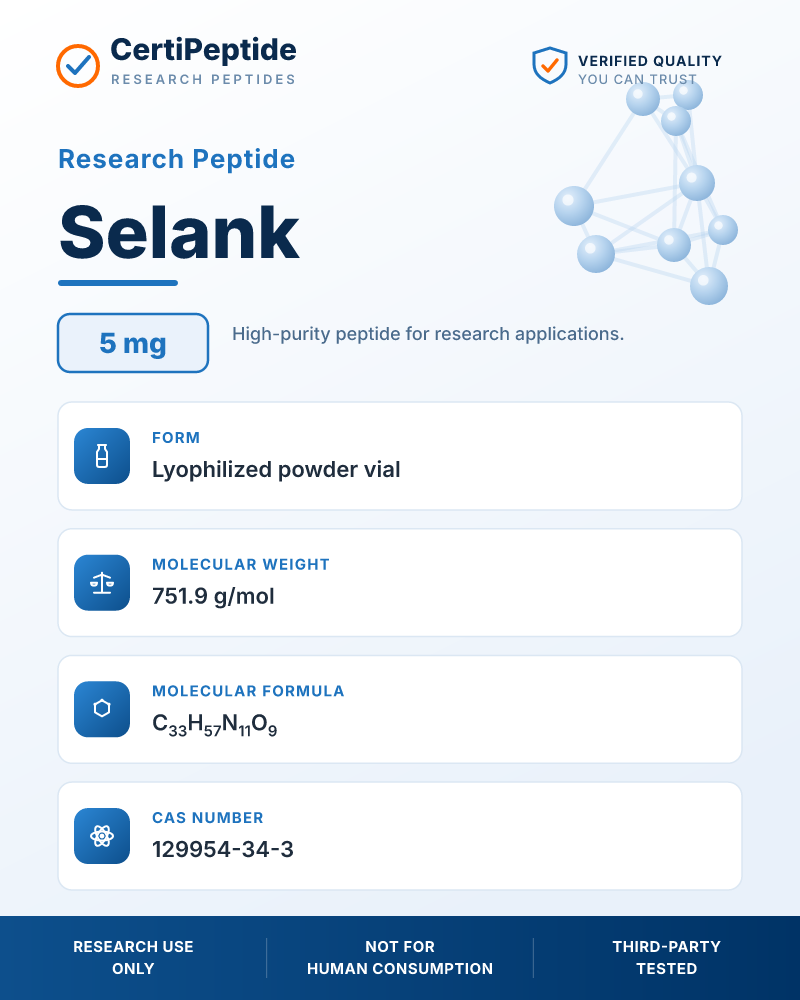
Chemical Structure and Classification ### Selank Selank is a synthetic heptapeptide (Thr-Lys-Pro-Arg-Pro-Gly-Pro) modeled on the endogenous immunomodulatory peptide tuftsin, with a Pro-Gly-Pro extension that improves metabolic stability in experimental systems. It is frequently classified among synthetic regulatory peptides used in CNS and behavioral pharmacology research. Analytical characterization typically includes HPLC purity, mass identity, and sequence confirmation.
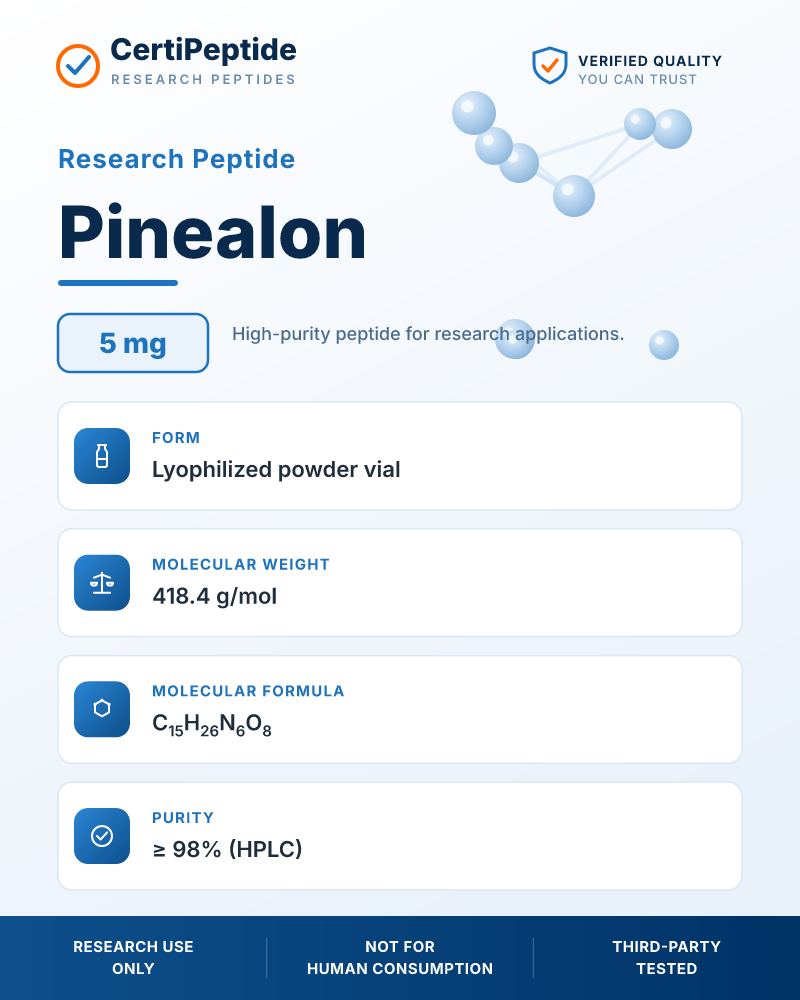
Pinealon Pinealon is a tripeptide with the sequence Glu-Asp-Arg (EDR). It belongs to a group of short bioregulator peptides studied for effects on cellular homeostasis and gene expression in neural tissues. Its small size and charged residues influence solubility, membrane interaction hypotheses, and handling in buffer systems. Identity confirmation likewise relies on MS and chromatographic methods.
Structural contrast at a glance | Feature | Selank | Pinealon | | --- | --- | --- | | Length | Heptapeptide (7 aa) | Tripeptide (3 aa) | | Sequence motif | Tuftsin-related + PGP | EDR | | Typical research class | Synthetic regulatory / nootropic-oriented peptide | Short bioregulator peptide | | Stability notes in literature | Designed for greater resistance to proteolysis vs parent motifs | Small peptide; protocol-dependent stability |
These differences drive distinct formulation, storage, and assay considerations even before biological endpoints are chosen.
Proposed Mechanisms Examined in Studies ### Selank-oriented pathways Published experimental work on Selank often explores: - Modulation of monoamine and enkephalin-related systems in brain tissue preparations - Interactions with GABAergic signaling and allosteric-type readouts in receptor or behavioral assays - Gene-expression changes linked to BDNF and inflammatory mediators in stress or learning models - Immune-adjacent markers (tuftsin lineage) measured alongside CNS endpoints
Researchers is researched in the context of these as mechanistic hypotheses to test, not established therapeutic profiles.
Pinealon-oriented pathways Pinealon studies more frequently emphasize: - Markers of oxidative stress and reactive oxygen species in neuronal or glial cultures - Apoptosis- and senescence-related protein expression - Possible nuclear or DNA-associated interactions proposed for short charged peptides - Cognitive or motor endpoints in aging or toxin-challenge animal models
Mechanistic maps for Pinealon are still developing; many papers focus on phenotypic protection or expression arrays rather than a single receptor target.
Overlap and divergence Both peptides appear in neurocentric literature and may influence stress- or plasticity-related genes in some designs. Divergence is clearer at the level of primary literature clusters: Selank papers skew toward anxiety-like behavior, learning, and neurotransmitter balance; Pinealon papers skew toward cellular resilience, aging biology, and oxidative burden. A rigorous **Selank vs Pinealon** review should therefore separate shared “CNS interest” from non-overlapping pathway depth.
Experimental Models and Endpoints ### Common model systems for Selank - Rodent elevated plus-maze, open-field, and conditioned fear paradigms - Learning and memory tasks (e.g., passive avoidance, maze learning) - Ex vivo brain monoamine or peptide content assays - In vitro immune or cytokine panels when dual CNS–immune hypotheses are tested
Common model systems for Pinealon - Primary neuronal cultures or cell lines under oxidative or hypoxic challenge - Aged animal cohorts with cognitive or motor batteries - Histology and immunohistochemistry for neurodegeneration markers - Transcriptomic or proteomic snapshots after peptide exposure
Shared methodological themes Both compounds are handled as research chemicals: sterile technique, validated identity, vehicle controls, and blinded scoring where behavior is involved. Dose–response exploration in animals or cells remains model-specific and must stay within institutional ethical and regulatory frameworks for laboratory animals and in vitro work only.
Similarities Relevant to Study Design Despite structural disparity, Selank and Pinealon share several practical similarities for lab teams: 1. **Peptide logistics** — Both require cold-chain or controlled storage, protection from repeated freeze–thaw, and documented purity. 2. **CNS research clustering** — Literature for each intersects cognitive and stress biology, so libraries that stock one often evaluate the other for complementary arms. 3. **Non-classical small-molecule pharmacology** — Neither is a typical blood–brain-barrier small-molecule drug candidate in the classic medicinal-chemistry sense; distribution and stability questions are peptide-specific. 4. **Need for orthogonal readouts** — Behavioral scores alone are insufficient; pairing with biochemistry, imaging, or expression data strengthens interpretation for either compound.
These parallels explain why a single methods section template can sometimes support parallel pilot arms—provided hypotheses remain distinct.
Selank or Pinealon: Decision Framework for Protocols Choosing **Selank or Pinealon** is less about superiority and more about fit:
**Lean toward Selank when the primary question involves:**
- Anxiety-like or stress-coping behavioral constructs
- GABAergic or monoaminergic correlates
- Tuftsin-related immune–CNS crosstalk hypotheses
- Comparative work against other synthetic regulatory peptides of similar length
**Lean toward Pinealon when the primary question involves:**
- Oxidative injury or cytoprotection in neural cells
- Age-associated cognitive decline models
- Short-peptide bioregulator mechanisms and gene-expression screens
- Minimal sequence complexity for structure–activity explorations around EDR
**Consider dual-arm designs when:**
- The lab wants a broad neuro-peptide screen before committing to deep mechanism work
- Reviewers or collaborators expect positive and negative pathway contrasts
- Resource sharing (shared vehicle, shared behavioral suite) lowers cost without conflating endpoints
Document the rationale in the protocol so that later meta-analysis or replication does not is researched in the context of the two as functional equivalents.
Analytical and Quality Considerations For either peptide, research integrity depends on: - Certificate of analysis (HPLC, MS) - Endotoxin awareness for cell-culture applications - Solvent and pH compatibility (especially for charged sequences such as Pinealon) - Stability time-course under the exact buffer and temperature used in the assay - Clear separation of lots when multi-week behavioral studies are planned
Comparing **Selank vs Pinealon** without matched quality controls risks attributing handling artifacts to biology.
Limitations in the Current Literature Several caveats apply to any **Selank Pinealon comparison**: - Heterogeneous doses, routes, and species across papers limit head-to-head inference - Mechanistic resolution is incomplete for both, with more receptor-level detail often cited for Selank-related GABAergic hypotheses than for Pinealon’s nuclear/oxidative narratives - Translation from rodent behavior or cell culture to higher-order systems is outside the scope of pure research-supply discussions and must not be overstated - Publication bias toward positive behavioral or protective findings can skew narrative reviews
Researchers should prioritize primary methods sections over secondary summaries when designing new work.
Practical Takeaways for Laboratory Teams 1. Define the biological axis first (stress/anxiety circuitry vs oxidative/aging resilience), then map to Selank or Pinealon. 2. Match peptide length and physicochemical properties to delivery and detection methods. 3. Use orthogonal endpoints and rigorous vehicle controls. 4. Keep lot-level analytics on file for both **Selank** and **Pinealon** if both are stocked. 5. is researched in the context of comparative pilots as hypothesis generators, not proof of interchangeability.
Conclusion A careful **Selank vs Pinealon** assessment shows two research peptides that occupy neighboring but non-identical niches in experimental neuroscience and cell biology. Selank’s heptapeptide, tuftsin-derived design aligns with behavioral pharmacology and selected neurotransmitter/immune readouts. Pinealon’s compact EDR structure aligns with cytoprotection, oxidative stress, and aging-oriented neural models. Similarities in CNS interest and peptide-handling practice do not erase differences in sequence, proposed pathways, or dominant literature clusters. For investigators deciding **Selank or Pinealon**, the strongest designs start from a precise endpoint map, verified material quality, and transparent reporting—supporting clearer, more reproducible laboratory science.
Frequently Asked Questions
What is the main structural difference in a Selank vs Pinealon comparison?
Selank is a synthetic heptapeptide (Thr-Lys-Pro-Arg-Pro-Gly-Pro) related to tuftsin, while Pinealon is the tripeptide Glu-Asp-Arg. Length, charge distribution, and literature-linked pathway hypotheses differ accordingly in laboratory work.
When might researchers choose Selank or Pinealon for a protocol?
Selank is more often selected for stress-response, GABAergic, and learning-related behavioral or neurochemical models. Pinealon is more often selected for oxidative stress, neuronal resilience, and age-related CNS expression studies. Choice should follow the primary experimental endpoint.
Do Selank and Pinealon share any research similarities?
Yes. Both appear in neuro-oriented peptide research, require standard peptide handling and purity documentation, and benefit from orthogonal biochemical or behavioral readouts. They are not mechanistic substitutes for each other.
Can Selank and Pinealon be compared directly in one animal study?
Parallel arms are possible if hypotheses, vehicles, and endpoints are predefined and statistics account for multiple comparisons. Direct equivalence testing is rarely justified because sequences and dominant literature pathways differ.
What quality controls matter for Selank Pinealon comparison studies?
Use lot-matched certificates of analysis (HPLC/MS), control freeze–thaw and buffer conditions, monitor endotoxin for culture work, and keep vehicle-only controls identical across arms so handling variables do not confound peptide-specific results.
Explore Further
Browse our [research peptide catalog](/shop) and review third-party [lab reports & COAs](/lab-reports) for every batch.
---
**Research use only.** The information above is provided for educational and laboratory research purposes only. The compounds discussed are not approved for human or veterinary use, diagnosis, treatment, or the prevention of any disease. Nothing here is medical advice.