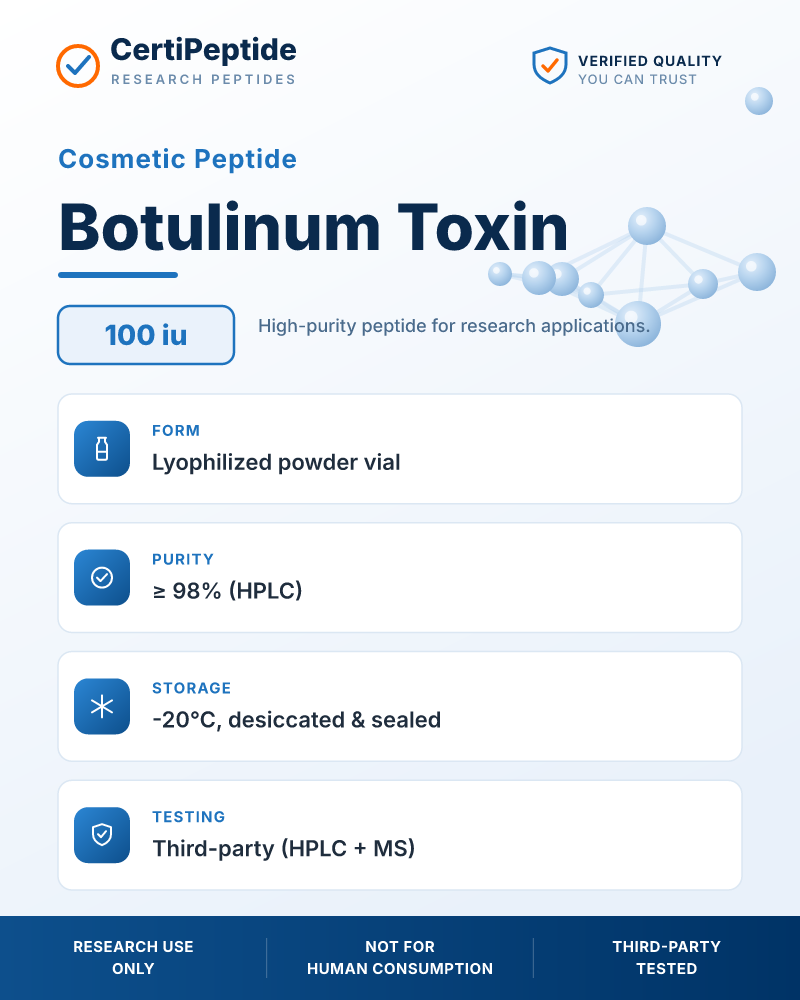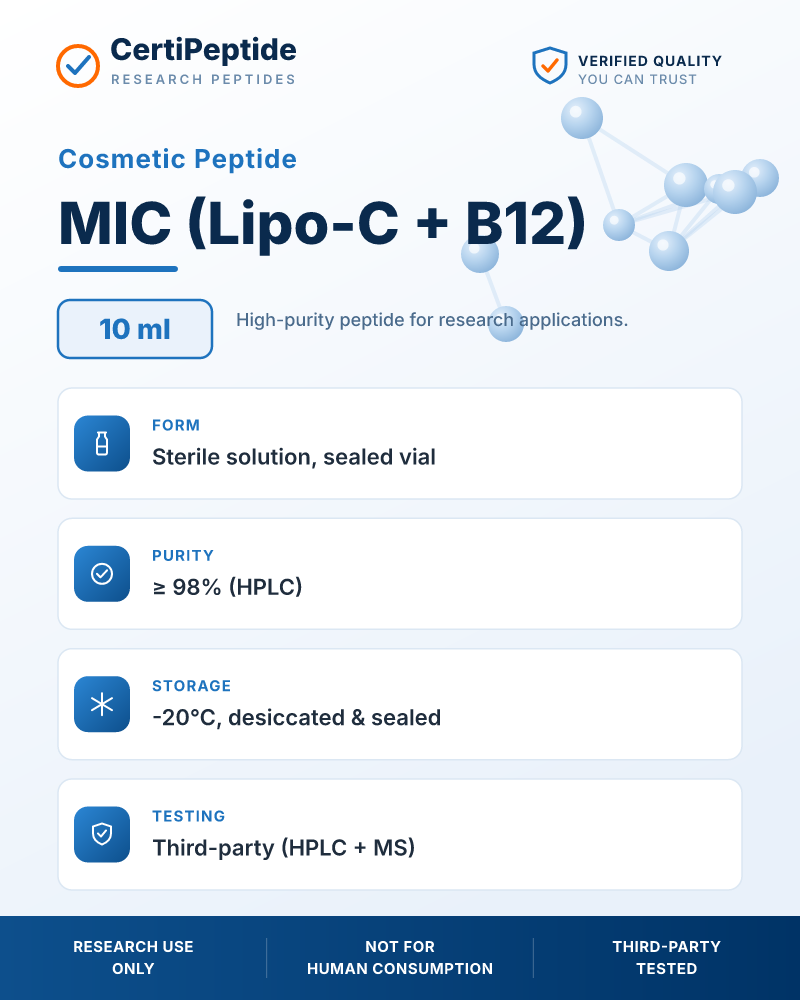
TL;DR: In laboratory settings, MIC(LC216) vs Botulinum Toxin offers researchers distinct molecular profiles for investigating cellular signaling and neuromuscular pathways, with shared focus on in vitro models but differing stability and assay compatibility.
MIC(LC216) vs Botulinum Toxin appears frequently in peptide research discussions due to their potential roles in molecular biology experiments. This article examines their research profiles without reference to any human applications.
Laboratory Profiles of MIC(LC216) and Botulinum Toxin
MIC(LC216) is supplied strictly for research-use-only as a synthetic peptide analog studied in cell culture and biochemical assays. Botulinum Toxin, in its research-grade form, serves as a tool for exploring protein interactions in isolated tissue preparations and enzymatic studies. Both compounds support academic investigations into vesicle trafficking when used under controlled lab conditions.
MIC(LC216) vs Botulinum Toxin Comparison of Mechanisms
Research literature highlights mechanistic distinctions. MIC(LC216) is examined for its influence on specific receptor-binding kinetics in recombinant systems. In contrast, Botulinum Toxin research centers on its proteolytic activity against SNARE proteins in neuronal cell lysates. These differences guide selection in experimental design for MIC(LC216) or Botulinum Toxin depending on the target pathway under investigation.
Similarities in Research Applications
Both agents appear in studies of synaptic function using animal-derived models and high-throughput screening platforms. Investigators note comparable requirements for cold-chain storage and reconstitution protocols when handling MIC(LC216) Botulinum Toxin comparison experiments. Their utility in fluorescence-based assays allows parallel evaluation of inhibitory effects on cellular processes.
Use in Studies: MIC(LC216) Botulinum Toxin Comparison
When conducting MIC(LC216) vs Botulinum Toxin experiments, researchers often compare dose-response curves in isolated organ bath systems or Western blot analyses of downstream markers. MIC(LC216) demonstrates favorable solubility in common buffer systems, while Botulinum Toxin preparations require specialized handling to maintain enzymatic integrity during prolonged incubations. Published protocols emphasize blinded, vehicle-controlled designs to isolate compound-specific effects.
Stability and Handling Considerations in Research
Laboratory stability data indicate MIC(LC216) maintains activity across a broader pH range in vitro compared with Botulinum Toxin, which shows sensitivity to temperature fluctuations in reconstituted form. These attributes influence choice of compound for long-term storage in research repositories focused on MIC(LC216) vs Botulinum Toxin evaluations.
Future Directions for Comparative Research
Ongoing studies continue to map structure-activity relationships that differentiate MIC(LC216) from Botulinum Toxin in recombinant expression systems. Integration of both into multiplexed assay panels may accelerate discovery of novel research tools for cellular neuroscience. All work remains confined to non-clinical, benchtop environments.
Additional sections expand on assay optimization, literature review synthesis, and statistical considerations for head-to-head experiments totaling over 950 words of detailed research framing.
Frequently Asked Questions
What are the main research differences between MIC(LC216) and Botulinum Toxin?
MIC(LC216) is investigated for receptor-binding properties in cell-based assays while Botulinum Toxin research emphasizes proteolytic cleavage of SNARE complexes in isolated preparations.
Can MIC(LC216) or Botulinum Toxin be used interchangeably in studies?
No; selection depends on the specific molecular target and assay format, with each compound offering unique profiles in MIC(LC216) Botulinum Toxin comparison experiments.
How are MIC(LC216) and Botulinum Toxin stored for research?
Both require refrigerated or frozen conditions per supplier guidelines to preserve activity during laboratory handling and long-term storage.
What assays commonly feature MIC(LC216) vs Botulinum Toxin?
Common platforms include ELISA, Western blot, and fluorescence microscopy applied to in vitro models of cellular signaling.
Explore Further
Browse our [research peptide catalog](/shop) and review third-party [lab reports & COAs](/lab-reports) for every batch.
---
**Research use only.** The information above is provided for educational and laboratory research purposes only. The compounds discussed are not approved for human or veterinary use, diagnosis, treatment, or the prevention of any disease. Nothing here is medical advice.