TL;DR
**Melanotan II vs Melanotan I** comparisons in the research literature focus on peptide structure, melanocortin receptor selectivity, potency in pigmentation and behavioral models, and practical handling in laboratory protocols. Melanotan I (afamelanotide-related analog) is a linear α-MSH analog often studied for melanogenesis endpoints with a relatively narrower receptor profile. Melanotan II is a cyclic lactam analog frequently used when broader melanocortin receptor engagement and stronger in vitro/in vivo signal are required. Choice between **Melanotan II or Melanotan I** depends on assay design, receptor targets (MC1R vs MC3R/MC4R), and readout type—not on any clinical or consumer use case.
Why Compare Melanotan II and Melanotan I in Studies?
Researchers evaluating melanocortin pathways often need a clear **Melanotan II Melanotan I comparison** before selecting a reference agonist. Both peptides derive from α-melanocyte-stimulating hormone (α-MSH) sequence logic and are used as tools to probe pigmentation biology, receptor pharmacology, and downstream cyclic AMP and MAPK signaling. They are not interchangeable: cyclization, amino-acid substitutions, and resulting receptor affinity shift potency, stability, and off-target engagement in cell and animal models.
In controlled laboratory settings, side-by-side work with **Melanotan II** and **Melanotan I** helps isolate MC1R-driven melanogenesis from broader MC3R/MC4R-linked effects on energy balance or sexual behavior endpoints reported in preclinical literature. Framing the comparison around mechanism and assay fitness keeps protocols aligned with research-use-only objectives.
Structural and Pharmacological Differences
Sequence and conformation
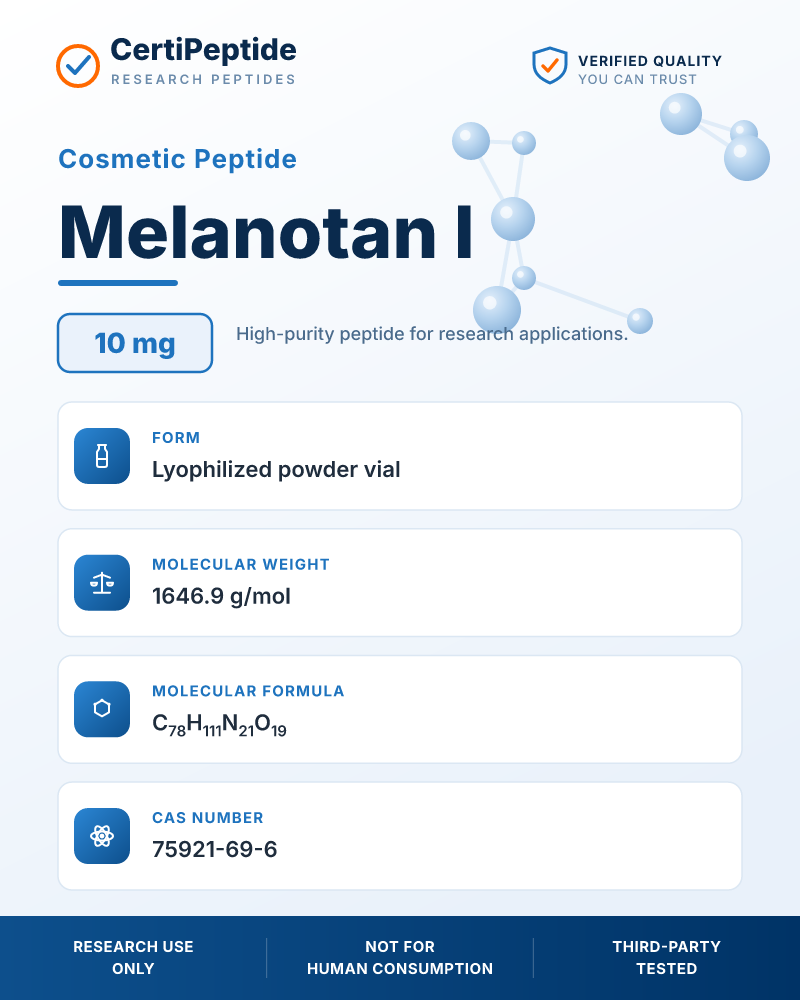
Melanotan I is a linear tridecapeptide analog of α-MSH, classically associated with the [Nle4, D-Phe7]-α-MSH (NDP-MSH) design. That linear scaffold retains strong MC1R activity relevant to melanocyte and melanoma cell line assays.
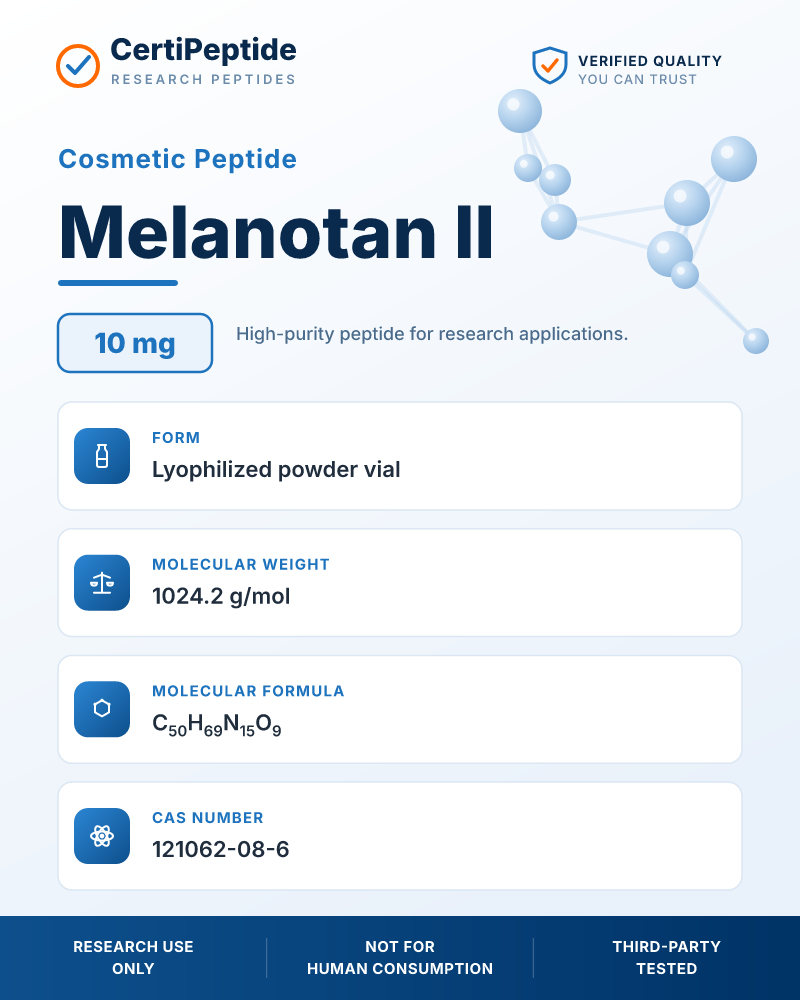
Melanotan II is a shorter, cyclic lactam heptapeptide analog engineered for conformational constraint. Cyclization generally improves proteolytic stability in biological matrices and can increase potency at several melanocortin receptors. In binding and functional screens, Melanotan II typically shows high affinity at MC1R and notable activity at MC3R and MC4R, which matters when study designs must account for central or peripheral non-pigment endpoints.
Receptor selectivity snapshot (research context)
| Feature | Melanotan I (NDP-MSH class) | Melanotan II |
| --- | --- | --- |
| Backbone | Linear | Cyclic lactam |
| Primary research focus | MC1R / melanogenesis models | MC1R plus MC3R/MC4R engagement |
| Relative stability | Moderate in many matrices | Often higher vs linear analogs |
| Common readouts | Pigmentation, cAMP in melanocytes | Pigmentation, receptor panels, behavioral/metabolic models |
These are generalized literature patterns; exact Ki/EC50 values depend on cell background, radioligand, and assay buffer. Always qualify potency with the system used in your lab.
Similarities Relevant to Laboratory Work
Despite structural divergence, **Melanotan II vs Melanotan I** pairs share several practical and mechanistic similarities:
- **Melanocortin agonism**: Both stimulate Gs-coupled melanocortin receptors and elevate intracellular cAMP in responsive cells.
- **Pigmentation pathway relevance**: Both are used to study tyrosinase induction, melanin synthesis, and related transcriptional programs in vitro and in selected animal models.
- **Peptide handling themes**: Both are typically supplied as research-grade lyophilized powders, reconstituted in suitable aqueous vehicles, aliquoted to limit freeze–thaw cycles, and stored cold and dry per institutional SOPs.
- **Analytical needs**: Identity and purity checks (HPLC, MS) and documentation of lot-specific certificates of analysis support reproducible comparison studies.
Neither peptide should be framed as a finished pharmaceutical in research catalogs; both are experimental tools for non-clinical investigation.
Melanotan II or Melanotan I: Choosing for Study Design
Selecting **Melanotan II or Melanotan I** is an experimental design decision:
1. **MC1R-focused melanogenesis panels** — Melanotan I is often sufficient when the primary question is α-MSH-like stimulation of pigment cells with a classic linear NDP-MSH reference.
2. **Broader receptor coverage or higher constrained potency** — Melanotan II is frequently preferred for multi-receptor profiling, stability-sensitive incubations, or models where literature already benchmarks cyclic analogs.
3. **Head-to-head pharmacology** — Parallel arms with both **Melanotan II** and **Melanotan I** clarify whether an observed phenotype tracks MC1R-selective logic or requires MC3R/MC4R contribution.
4. **Control architecture** — Include vehicle controls, optional peptide-scrambled or inactive comparators where available, and orthogonal readouts (cAMP, pCREB, melanin content, receptor internalization).
Document solvent, pH, adsorption losses to plastics, and serum content—small handling differences can confound apparent potency gaps between the two peptides.
Endpoints Commonly Used in Melanotan II Melanotan I Comparison Studies
Research groups comparing these agonists often report:
- **Binding and functional potency**: Radioligand displacement, cAMP accumulation, β-arrestin recruitment, and label-free impedance in MC1R/MC3R/MC4R-expressing lines.
- **Pigment biology**: Melanin quantification, tyrosinase activity, MITF pathway markers in melanocytes or melanoma models.
- **Stability and ADME-tinted assays** (non-clinical): Plasma or hepatocyte stability, permeability screens—interpreted strictly as chemical biology data.
- **In vivo preclinical models** (where ethically approved): Coat color or melanin endpoints, plus monitoring of non-pigment melanocortin-linked behaviors when Melanotan II is used, given its broader receptor footprint.
All animal work must follow institutional animal care rules. Human administration, therapeutic claims, or dosing guidance fall outside research-supply framing and are not discussed here.
Practical Laboratory Considerations
When running a **Melanotan II vs Melanotan I** protocol:
- **Identity confirmation**: Verify sequence and purity on receipt; cyclic vs linear species are distinguishable by MS and chromatographic behavior.
- **Solubility**: Use validated diluents; avoid repeated warming of stock solutions.
- **Dose–response design in vitro**: Span several log concentrations to capture potency shifts; report EC50 with confidence intervals.
- **Cross-contamination control**: Separate tips and vials; cyclic and linear analogs can be easy to swap during multi-agonist days.
- **Data interpretation**: Attribute differences to receptor pharmacology and stability only after ruling out handling artifacts.
Suppliers serving research markets typically present **Melanotan II** and **Melanotan I** as discrete catalog items so labs can order the analog that matches the receptor hypothesis under test.
Summary: Framing the Comparison Correctly
A rigorous **Melanotan II Melanotan I comparison** is researched in the context of both molecules as melanocortin research probes with overlapping pigment-pathway utility but distinct structural and selectivity profiles. Melanotan I suits many linear NDP-MSH-style MC1R questions; Melanotan II suits constrained-peptide and multi-receptor designs. Similarities in cAMP-linked signaling and general peptide workflow allow fair head-to-head experiments when analytics and controls are tight. Keep language, protocols, and procurement firmly inside laboratory research use—mechanism, assay performance, and reproducibility—not human application.
FAQ
Explore Further
Browse our [research peptide catalog](/shop) and review third-party [lab reports & COAs](/lab-reports) for every batch.
---
**Research use only.** The information above is provided for educational and laboratory research purposes only. The compounds discussed are not approved for human or veterinary use, diagnosis, treatment, or the prevention of any disease. Nothing here is medical advice.