TL;DR
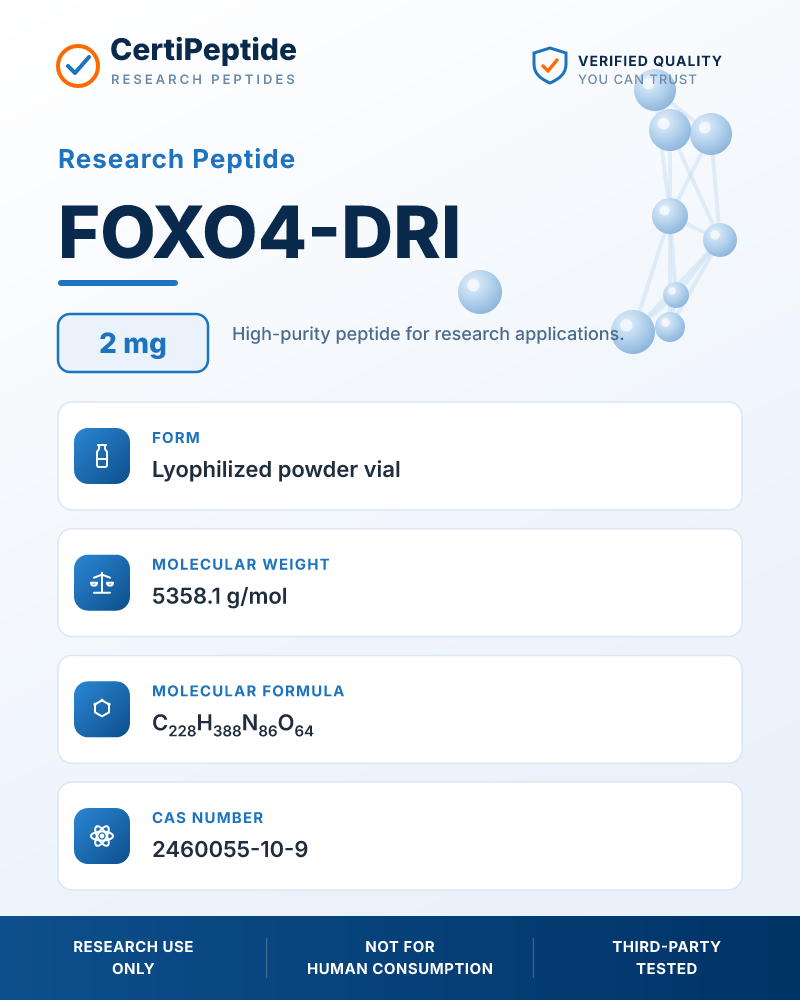
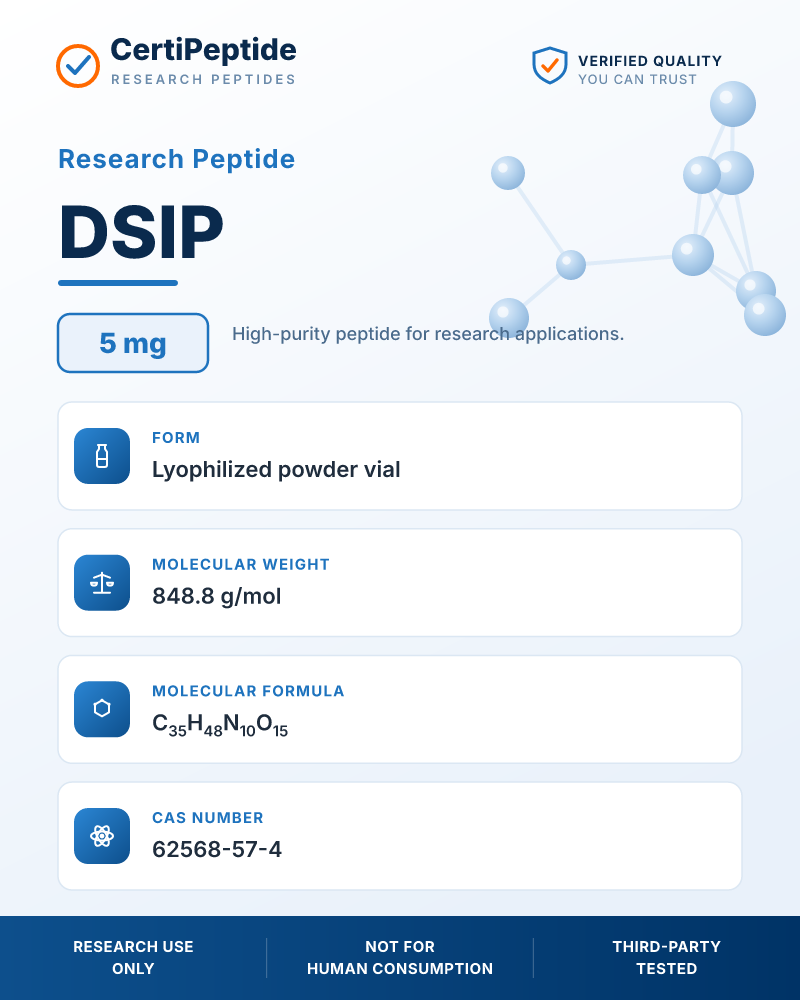
**DSIP vs FOXO4-DRI** is less a head-to-head contest than a contrast between two research peptides with largely non-overlapping biology. DSIP (delta sleep-inducing peptide) is a short neuropeptide studied in sleep architecture, stress physiology, and neuroendocrine assays. FOXO4-DRI is a D-retro-inverso peptide designed to perturb FOXO4–p53 interactions and is used mainly in cellular senescence and aging-biology models. Investigators comparing **DSIP or FOXO4-DRI** should align the compound with pathway, model system, and readout—not with interchangeable “peptide” use. This article summarizes mechanisms, experimental contexts, similarities limited to research logistics, and practical study-design differences for laboratory work only.
Why Compare DSIP and FOXO4-DRI in Research?
Catalogs of research peptides often place chemically unrelated molecules side by side. A structured **DSIP FOXO4-DRI comparison** helps labs avoid category errors: both may arrive as lyophilized research materials, yet they map to different literature bases, controls, and endpoints. DSIP work typically sits near sleep electrophysiology, hypothalamic–pituitary signaling, and stress or antioxidant readouts in preclinical systems. FOXO4-DRI work clusters around senescent-cell biology, p53-dependent transcription, and tissue or cell models of age-associated dysfunction. Clarifying that split reduces wasted assays and misaligned vehicle or stability protocols.
For SEO and literature search alike, queries such as **DSIP vs FOXO4-DRI** usually mean: which peptide fits my hypothesis? The answer depends on whether the hypothesis concerns sleep-related peptides and neuromodulation or FOXO4-centered senescence pathways.
What Is DSIP? Research Background
DSIP is a nonapeptide originally associated with sleep-related fractions in animal studies and later examined as a synthetic research peptide. In the literature it is discussed in relation to:
- Sleep architecture and EEG-defined sleep stages in animal models
- Modulation of stress-axis markers and selected neurotransmitter systems
- Exploratory work on oxidative stress markers and thermoregulation in controlled lab settings
- Stability, blood–brain barrier penetration hypotheses, and peptide metabolism in pharmacokinetic-style research designs
DSIP research is peptide-and-physiology oriented. Typical tools include polysomnography or simplified sleep scoring in rodents, hormone panels, behavioral stress paradigms, and in vitro neuronal or endocrine cell assays where applicable. Batch identity (HPLC, mass spectrometry), solubility in aqueous buffers, and protection from proteolytic degradation are common analytical concerns when handling **DSIP** in the lab.
Importantly, DSIP is not a FOXO-pathway tool compound. Framing DSIP studies around senescence clearance or p53–FOXO4 disruption would misalign the molecule with its primary evidence base.
What Is FOXO4-DRI? Research Background
FOXO4-DRI (FOXO4 D-retro-inverso) is a designed peptide intended to interfere with the interaction between FOXO4 and p53. Research interest centers on senescent cells, in which FOXO4–p53 associations have been linked to survival of cells that have exited the cell cycle but remain metabolically active and secretory (SASP-related phenotypes in many models).
Laboratory themes for **FOXO4-DRI** include:
- Disruption of FOXO4–p53 binding in biochemical or cellular interaction assays
- Selective effects on senescent versus proliferating cell populations in culture
- Readouts such as apoptosis markers in senescent cells, senescence-associated β-galactosidase, SASP factors, and tissue function metrics in aging or damage models
- Use of D-amino acid / retro-inverso design to improve proteolytic stability relative to L-peptide counterparts in experimental systems
FOXO4-DRI is therefore a pathway- and phenotype-specific research tool within geroscience and cell-stress biology—not a sleep peptide. Handling still requires standard peptide QC, but experimental controls often include senescent-cell induction methods (e.g., genotoxic or replicative stress), isotype or scrambled peptide controls where appropriate, and careful distinction between acute cytotoxicity and senescence-biased clearance phenotypes.
DSIP vs FOXO4-DRI: Mechanisms and Targets
| Dimension | DSIP | FOXO4-DRI |
| --- | --- | --- |
| Chemical class | Endogenous-sequence-related nonapeptide (research synthetic) | Engineered D-retro-inverso peptide |
| Primary research axis | Sleep, stress, neuroendocrine physiology | FOXO4–p53, cellular senescence |
| Typical models | Sleep/EEG, stress paradigms, endocrine assays | Senescent cell culture, aging/damage tissue models |
| Core molecular story | Neuromodulatory peptide signaling (still incompletely mapped) | Competitive interference at FOXO4–p53 interface |
| Common endpoints | Sleep stage %, latency, hormones, redox markers | Apoptosis in senescent cells, SASP, function scores |
Pathway specificity
In a **DSIP FOXO4-DRI comparison**, pathway specificity is the decisive separator. DSIP literature does not position the peptide as a FOXO4 ligand or senolytic design. FOXO4-DRI literature does not position the peptide as a classical sleep-inducing endogenous fragment for EEG studies. Cross-over experiments are conceivable only if a lab has a explicit hypothesis linking sleep peptides to senescence (or vice versa); that is an advanced, hypothesis-driven design—not a default substitution.
Stability and design philosophy
DSIP studies often wrestle with natural-sequence peptide stability and delivery to central compartments in animal work. FOXO4-DRI’s D-retro-inverso construction is itself part of the research rationale: resistance to proteases and altered interaction geometry versus native FOXO4 segments. Thus “peptide stability” means different experimental questions for each molecule.
Similarities in Laboratory Practice
Despite divergent biology, **DSIP** and **FOXO4-DRI** share practical similarities as research reagents:
1. **Research-use framing** — Both are handled as laboratory materials for in vitro or preclinical in vivo protocols defined by institutional oversight, not as clinical products.
2. **Analytical QC** — Identity, purity, and net peptide content matter for reproducibility; certificate-of-analysis review is standard before longitudinal studies.
3. **Formulation variables** — Solvent choice, pH, freeze–thaw cycles, and adsorption to plastics can alter effective concentration for either peptide.
4. **Control design** — Vehicle controls, scrambled or inactive analogs (where justified), and blinded scoring improve interpretability.
5. **Documentation** — Lot tracking, storage temperature logs, and predefined primary endpoints reduce batch-to-batch narrative drift.
These similarities are operational. They do not imply interchangeable biological roles when choosing **DSIP or FOXO4-DRI**.
Use in Studies: How Investigators Deploy Each Peptide
DSIP-oriented study patterns
Researchers using DSIP commonly:
- Define sleep or stress hypotheses with species-appropriate behavioral and physiological monitoring
- Combine peptide administration routes suitable for the model with time-locked sampling (EEG windows, hormone time courses)
- Report negative or mixed findings honestly—sleep-peptide literature is heterogeneous across decades and methods
- Pair DSIP arms with positive controls known to alter sleep architecture in that model when ethical and scientific standards allow
FOXO4-DRI-oriented study patterns
Researchers using FOXO4-DRI commonly:
- Validate senescence induction before testing clearance or phenotype reversal hypotheses
- Quantify both senescent-cell burden and off-target effects on proliferating cells
- Use orthogonal senescence markers rather than a single stain
- Contextualize results within FOXO, p53, and SASP pathway data (transcripts, secreted factors, interaction assays)
When a lab might run both (still not “versus” as substitutes)
A multi-peptide portfolio study might include DSIP and FOXO4-DRI in parallel arms only when the program spans distinct pillars (e.g., a core facility supporting both neurophysiology and senescence groups). Parallel purchasing does not create a mechanistic **DSIP vs FOXO4-DRI** contest; it reflects diversified research themes.
Experimental Design Checklist for DSIP FOXO4-DRI Comparison Projects
If the goal is a formal written comparison for a methods paper, internal white paper, or procurement justification, structure the work as follows:
1. **Hypothesis domain** — Sleep/neuroendocrine vs senescence/FOXO4–p53; write separate aims.
2. **Model validity** — Confirm the model expresses the relevant biology (sleep phenotyping capability vs measurable senescent populations).
3. **Endpoint hierarchy** — Pre-register primary endpoints appropriate to each peptide; avoid forcing one peptide onto the other’s classic assays without rationale.
4. **Dose-finding in the model** — Use species- and system-specific ranges from peer-reviewed methods; optimize for assay dynamic range, not human-oriented schedules.
5. **Statistics** — Power for the noisier endpoint (EEG variability vs senescence marker variance) independently.
6. **Reporting** — Sequence, salt form, purity, vehicle, and lot data for both **DSIP** and **FOXO4-DRI**.
Choosing DSIP or FOXO4-DRI for a Protocol
Choose **DSIP** when the scientific question concerns delta sleep-inducing peptide biology, sleep-related physiology, or adjacent neuroendocrine and stress readouts in controlled laboratory systems.
Choose **FOXO4-DRI** when the question concerns FOXO4–p53 interaction, senescent-cell survival phenotypes, or aging-biology models built around those mechanisms.
Choose neither as a generic “research peptide control” for unrelated pathways. Mechanism-first selection beats catalog proximity.
Key Takeaways for Research Teams
- **DSIP vs FOXO4-DRI** contrasts a sleep- and stress-associated neuropeptide research line with a senescent-cell / FOXO4–p53 tool peptide.
- Similarities are mostly logistical (QC, storage, vehicle discipline), not mechanistic.
- A sound **DSIP FOXO4-DRI comparison** in grant text or lab SOPs should emphasize model fit, endpoints, and pathway controls.
- Natural mention of product identity—research-grade **DSIP** versus research-grade **FOXO4-DRI**—should always stay tied to documented purity and experimental purpose.
FAQ
Short answers to long-tail questions appear below for quick scanning; deeper protocol details belong in institutional methods and primary literature.
Explore Further
Browse our [research peptide catalog](/shop) and review third-party [lab reports & COAs](/lab-reports) for every batch.
---
**Research use only.** The information above is provided for educational and laboratory research purposes only. The compounds discussed are not approved for human or veterinary use, diagnosis, treatment, or the prevention of any disease. Nothing here is medical advice.