TL;DR
In controlled laboratory settings, **5-Amino-1MQ vs L-Carnitine** comparisons center on distinct biochemical targets rather than interchangeable roles. 5-Amino-1MQ is investigated primarily as a small-molecule inhibitor of nicotinamide N-methyltransferase (NNMT), with research interest in NAD+ salvage pathways, adipocyte biology, and energy-expenditure readouts in cellular and animal models. L-Carnitine is studied as an endogenous quaternary ammonium compound that shuttles long-chain fatty acyl groups into mitochondria via the carnitine palmitoyltransferase (CPT) system. Researchers evaluating **5-Amino-1MQ or L-Carnitine** typically choose based on whether the experimental question prioritizes NNMT/NAD+ axis modulation or fatty-acid oxidation logistics. This **5-Amino-1MQ L-Carnitine comparison** summarizes mechanisms, common study designs, overlapping metabolic themes, and practical differences for bench work—strictly within research-use framing.
Why Compare 5-Amino-1MQ vs L-Carnitine in Studies?
Metabolic research frequently intersects lipid handling, mitochondrial function, and cellular energy sensing. Both 5-Amino-1MQ and L-Carnitine appear in literature streams related to fat metabolism and energy balance, which can create superficial overlap in keyword searches or protocol brainstorming. A structured **5-Amino-1MQ vs L-Carnitine** analysis helps laboratories avoid conflating an enzyme-targeted probe (5-Amino-1MQ) with a cofactor-like transport intermediate (L-Carnitine).
Key reasons labs run side-by-side or sequential experiments include:
- Clarifying whether an observed phenotype depends on NNMT activity versus CPT-mediated acyl transport
- Mapping convergent endpoints (e.g., oxygen consumption, lipid droplet dynamics, transcript panels for oxidative genes)
- Building multi-arm designs that isolate pathway contributions in the same cell line or animal strain
- Documenting reagent identity, purity, and handling differences for reproducibility
Neither compound should be framed as interchangeable “metabolic agents” for non-research contexts. Selection belongs inside hypothesis-driven experimental design.
Chemical Identity and Research Context
5-Amino-1MQ
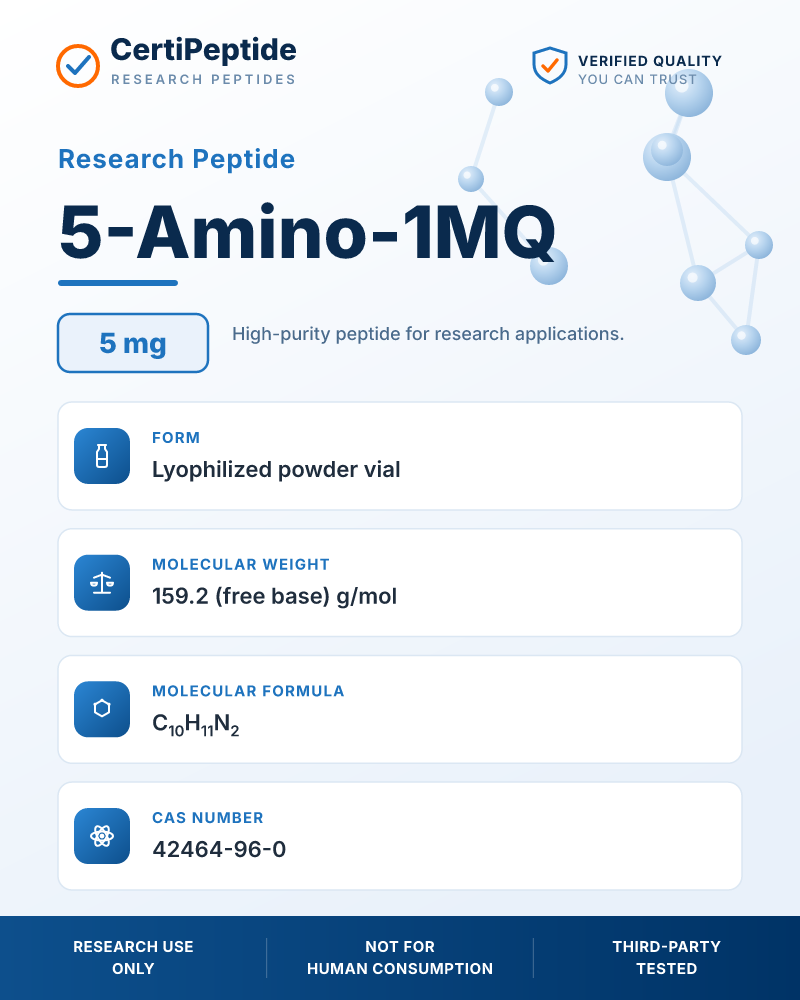
5-Amino-1MQ (5-amino-1-methylquinolinium) is a quinolinium-derived small molecule used in research as an NNMT inhibitor. NNMT methylates nicotinamide using S-adenosyl-L-methionine (SAM), influencing the NAD+ salvage pathway and methyl-donor balance. In vitro and in vivo model papers often explore how NNMT inhibition alters nicotinamide availability, SAM/SAH ratios, and downstream metabolic gene programs—particularly in adipose-relevant systems.
Research handling notes commonly emphasize verifying identity (e.g., LC-MS or NMR lot documentation), solubility in appropriate vehicles, and stability under storage conditions specified by the supplier. As with other research chemicals, lot-to-lot analytical certificates support quantitative work.
L-Carnitine
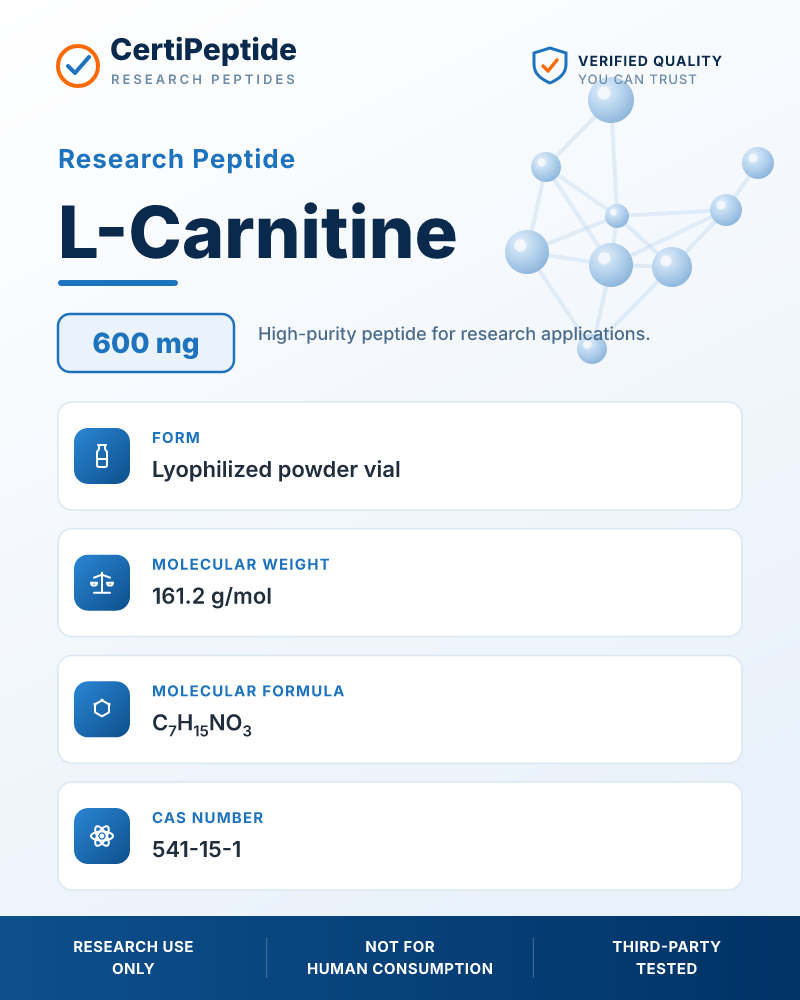
L-Carnitine (L-3-hydroxy-4-N,N,N-trimethylaminobutyrate) is a well-characterized molecule central to mitochondrial long-chain fatty acid import. The carnitine shuttle involves CPT1 (outer membrane), carnitine-acylcarnitine translocase, and CPT2 (inner membrane). Laboratory applications range from cell-culture media supplementation studies to isotopic tracing of fatty-acid oxidation and mitochondrial stress assays.
Because L-Carnitine is endogenous and extensively profiled, research literature often uses it as a pathway tool, a control condition, or a co-variable when fatty-acid oxidation capacity is rate-limiting in the model.
Mechanism: Where the Pathways Differ
A rigorous **5-Amino-1MQ L-Carnitine comparison** starts at the primary target.
| Dimension | 5-Amino-1MQ (research focus) | L-Carnitine (research focus) |
| --- | --- | --- |
| Primary biochemical role studied | NNMT inhibition; NAD+ salvage / methyl balance | Acyl group transport into mitochondria |
| Upstream node | Nicotinamide methylation, SAM consumption | CPT1 substrate availability, CoA buffering |
| Typical pathway readouts | NNMT activity, NAD+/NADH, methylomics proxies, adipocyte gene sets | FAO rates, acylcarnitine profiles, OCR linked to palmitate |
| Model emphasis in literature | Adipose biology, energy expenditure phenotypes in models | Broad mitochondrial and lipid oxidation systems |
**5-Amino-1MQ** experiments often ask: *If NNMT activity is reduced, how do NAD+-linked and methylation-linked networks reshape metabolic phenotype?*
**L-Carnitine** experiments often ask: *Is long-chain fatty-acid entry into mitochondria limiting for the measured oxidation or bioenergetic output?*
Overlap exists at the level of *downstream metabolic phenotypes* (lipid content, respiration, transcript signatures), not at the level of identical molecular targets. That distinction should drive assay choice.
Similarities Observed Across Metabolic Study Designs
Despite different entry points, published and protocol-level work sometimes measures shared endpoint families when labs discuss **5-Amino-1MQ or L-Carnitine**:
1. **Bioenergetics panels** — Seahorse-style OCR/ECAR, mitochondrial membrane potential dyes, or ATP-linked assays in appropriate cell models.
2. **Lipid phenotype metrics** — Nile red/Oil Red O quantification, triglyceride assays, lipidomics snapshots.
3. **Gene and protein panels** — PGC-1α, CPT isoforms, FAO enzymes, NAD+-sensitive sirtuin-related transcripts (interpreted cautiously and model-specifically).
4. **Isotope or metabolite tracing** — labeled fatty acids, nicotinamide-related metabolites, or acylcarnitine species depending on hypothesis.
5. **In vivo model physiology readouts** (non-clinical) — body composition imaging, indirect calorimetry, tissue weights, and circulating metabolite panels under institutional ethical oversight.
These similarities explain why comparison content is useful for SEO and for lab planning, but they do not imply mechanistic equivalence.
Differences That Change Experimental Design
Target specificity and interpretation
- **5-Amino-1MQ**: Interpretation hinges on NNMT engagement and off-target assessment. Controls may include NNMT expression modulation (knockdown/overexpression), nicotinamide/NAD+ metabolite measurements, and structurally related inactive comparators when available.
- **L-Carnitine**: Interpretation hinges on whether transport or CoA/carnitine equilibrium was limiting. Controls often include CPT1 inhibitors (e.g., etomoxir in carefully controlled contexts), substrate pairwise designs (palmitate ± carnitine), and acylcarnitine profiling.
Dependency on nutritional and media context
L-Carnitine effects in cell systems can be highly media-dependent (basal carnitine content, serum, fatty-acid load). 5-Amino-1MQ study outcomes can be sensitive to nicotinamide availability, methylation stress, and cell-type NNMT expression. Matching media and documenting lot composition improves reproducibility for both.
Analytical companion assays
- For **5-Amino-1MQ**: NNMT enzymatic assays, SAM/SAH, NAD+ metabolomics, and target engagement checks.
- For **L-Carnitine**: CPT activity proxies, FAO flux, and free carnitine/acylcarnitine ratios.
Practical lab handling
Researchers should is researched in the context of each material according to its certificate of analysis, solvent compatibility, and light/moisture sensitivity. Stock preparation, vehicle-matched controls, and blinded quantification reduce bias in comparative arms.
Typical Laboratory Use Cases
When studies lean toward 5-Amino-1MQ
- Hypothesis centers on NNMT as a regulatory node in adipose or metabolic cell models
- Interest in NAD+ salvage intersections with methylation metabolism
- Need for a small-molecule probe to complement genetic NNMT perturbation
- Multi-omics designs linking methyl donor status to energy-metabolism transcripts
When studies lean toward L-Carnitine
- Hypothesis centers on mitochondrial import of long-chain fatty acids
- FAO capacity is a suspected bottleneck under high lipid load
- Need to normalize or stress the carnitine shuttle in primary cells, lines, or tissues
- Acylcarnitine metabolomics is a primary endpoint family
When dual-arm or factorial designs make sense
Some advanced designs include both reagents as separate factors to test independence versus synergy of NNMT-related and CPT-related interventions on a shared phenotype (for example, lipid droplet clearance under defined substrates). Factorial ANOVA or mixed-effects models are common analysis frameworks. Claims should remain limited to the model system and measured endpoints.
Study Design Checklist for Head-to-Head Work
1. **Define the primary endpoint** before reagent selection (e.g., NNMT activity vs palmitate-dependent OCR).
2. **Validate expression/context**: NNMT levels for 5-Amino-1MQ arms; CPT1/FAO competence for L-Carnitine arms.
3. **Match vehicles and osmotic/solvent load** across groups.
4. **Include pathway-positive and pathway-negative controls** appropriate to each mechanism.
5. **Use orthogonal readouts** (metabolite + functional + transcriptional) to reduce single-assay artifacts.
6. **Pre-register analysis plans** where institutional workflows allow, including outlier rules.
7. **Report full methods**: catalog numbers, purity, storage, passage number, diet composition in animal work, and fasting/substrate timing.
Interpreting Overlapping Phenotypes Without Overclaiming
If both 5-Amino-1MQ and L-Carnitine arms shift a similar macroscopic endpoint (for example, reduced neutral lipid staining in a cell model), researchers should not automatically conclude a shared molecular mechanism. Mediation tests, rescue experiments, and metabolite bypass designs help separate:
- Parallel pathways converging on lipid storage
- Indirect media or toxicity confounds
- True epistatic interaction
Language in manuscripts and internal reports should stay model-bound (“in differentiated adipocytes under X substrate conditions”) and avoid translational or human-use framing.
Practical Notes on Sourcing for Research
Laboratories sourcing **5-Amino-1MQ** and **L-Carnitine** for in vitro or non-clinical in vivo work typically prioritize:
- Transparent analytical documentation
- Consistent salt/form identity where applicable
- Clear research-use labeling and institutional compliance alignment
- Batch traceability for longitudinal studies
Natural mention in comparative procurement discussions is common because metabolic cores may stock both a NNMT-pathway probe and carnitine-shuttle reagents for shared equipment schedules and parallel projects.
Summary: Choosing for the Hypothesis
| Research question emphasis | More aligned tool among the pair |
| --- | --- |
| NNMT activity / NAD+ salvage / methyl balance | 5-Amino-1MQ |
| Long-chain fatty acid mitochondrial import / FAO flux | L-Carnitine |
| Convergent lipid or OCR phenotypes with pathway dissection | Factorial design using both, with orthogonal controls |
In short, **5-Amino-1MQ vs L-Carnitine** is a comparison of different molecular levers that can influence related metabolic readouts. **5-Amino-1MQ or L-Carnitine** selection should follow the pathway under test, not generic “metabolism” branding. A careful **5-Amino-1MQ L-Carnitine comparison** improves experimental clarity, statistics, and reproducibility in laboratory research.
FAQ
See structured FAQ field for long-tail laboratory questions commonly associated with this comparison.
Explore Further
Browse our [research peptide catalog](/shop) and review third-party [lab reports & COAs](/lab-reports) for every batch.
---
**Research use only.** The information above is provided for educational and laboratory research purposes only. The compounds discussed are not approved for human or veterinary use, diagnosis, treatment, or the prevention of any disease. Nothing here is medical advice.