TL;DR
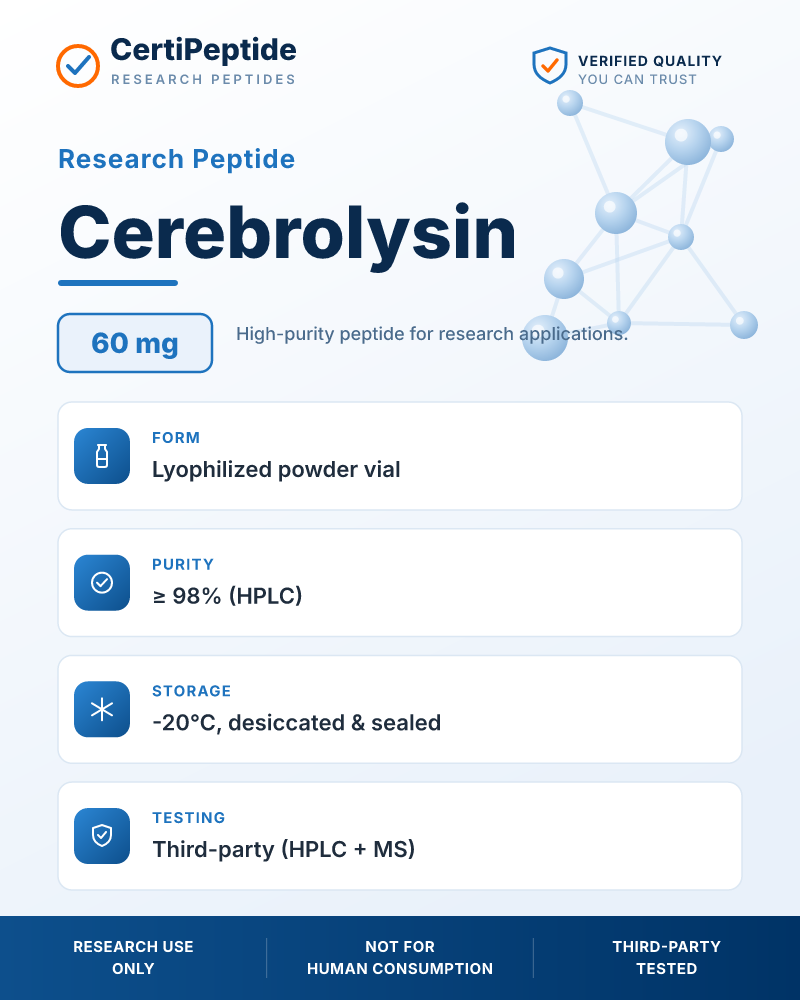
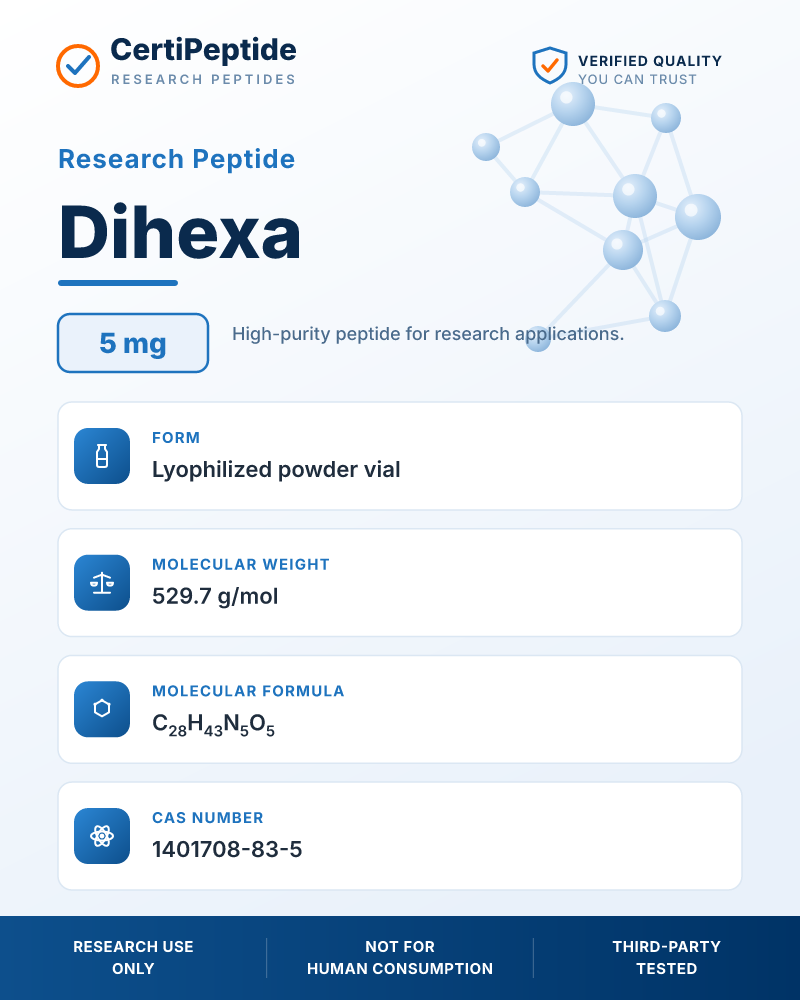
**Dihexa vs Cerebrolysin** is a frequent comparison in neurotrophic and cognitive neuroscience research. Dihexa is a synthetic angiotensin IV–derived peptidomimetic studied mainly for HGF/c-Met–linked synaptogenic signaling. Cerebrolysin is a complex porcine-brain-derived peptide mixture investigated for multimodal neurotrophic and neuroprotective effects. Both appear in preclinical models of plasticity, injury, and cognition-related endpoints, but they differ sharply in chemical definition, batch complexity, mechanism breadth, and experimental handling. This article outlines research differences, similarities, and practical study-design considerations—strictly in a laboratory, research-use context.
Dihexa vs Cerebrolysin: Why Researchers Compare Them
Investigators searching for **Dihexa or Cerebrolysin** typically work on overlapping questions: synaptic density, neurotrophic signaling, recovery after experimental injury, and molecular correlates of learning and memory in cell or animal models. A clear **Dihexa Cerebrolysin comparison** helps labs choose a tool matched to hypothesis, assay readout, and analytical needs.
Dihexa entered the literature as a stable, blood–brain-barrier–penetrant analog related to angiotensin IV fragments, with emphasis on hepatocyte growth factor (HGF)/c-Met pathway modulation and synapse formation in rodent and cellular systems. Cerebrolysin has a longer, broader publication trail as a standardized mixture of low-molecular-weight peptides and free amino acids obtained from enzymatic breakdown of purified porcine brain proteins; studies often frame it as providing neurotrophin-like and neuroprotective activity across ischemia, trauma, and neurodegeneration models.
Neither compound is interchangeable with the other. Choosing between them—or designing parallel arms—depends on whether the lab needs a discrete synthetic ligand or a multi-component biological preparation.
Chemical Identity and Composition
Dihexa
Dihexa (often referenced in research as an oligopeptide angiotensin IV analog / peptidomimetic) is chemically defined. That definition supports:
- Single-entity quantification (HPLC, LC-MS)
- Consistent structure–activity discussion
- Clear vehicle and stability protocols in vitro and in vivo
- Easier attribution of observed effects to one molecular scaffold
Research lots are typically evaluated for purity, identity, and residual solvents so that dose–response and receptor/pathway work remain interpretable.
Cerebrolysin
Cerebrolysin is not a single molecule. It is a complex peptide hydrolysate containing numerous small peptides plus amino acids. Research implications include:
- Batch-to-batch characterization relies on manufacturing controls and fingerprint methods rather than one CAS-defined structure
- Mechanistic attribution is distributed across multiple constituents
- Analytical work often focuses on total peptide content, molecular-weight distribution, and bioassay consistency rather than a single peak
For **Dihexa vs Cerebrolysin** study design, this is the first fork: discrete ligand versus multi-peptide preparation.
Mechanisms Examined in Laboratory Studies
Pathways associated with Dihexa research
Published preclinical work links Dihexa primarily to:
- Potentiation or modulation of HGF/c-Met signaling
- Markers of spinogenesis and synaptogenesis in hippocampal and cortical preparations
- Behavioral and electrophysiological readouts in models of cognitive deficit or synaptic loss
- Relatively focused pathway hypotheses that suit receptor pharmacology, Western blot, and imaging pipelines
Because Dihexa is a defined entity, labs can pair it with c-Met inhibitors, HGF neutralization, or genetic tools to test pathway dependence.
Pathways associated with Cerebrolysin research
Cerebrolysin literature commonly discusses:
- Neurotrophic-factor–like activity (often compared conceptually to BDNF, GDNF, NGF signaling patterns without equating it to a single recombinant factor)
- Anti-apoptotic and anti-excitotoxic readouts in injury models
- Effects on neurogenesis, plasticity markers, and inflammatory or oxidative stress endpoints after experimental ischemia or trauma
- Multimodal, systems-level changes rather than one receptor target
Mechanism work with Cerebrolysin is therefore often descriptive and multi-endpoint, reflecting its composition.
Overlap
Both tool compounds are studied where labs care about:
- Synaptic protein levels (e.g., PSD-95, synaptophysin-type markers)
- Neurite outgrowth or dendritic complexity in culture
- Functional recovery scores after controlled CNS injury
- Molecular signatures of plasticity and resilience in aged or lesioned animals
The **Dihexa Cerebrolysin comparison** is strongest at the level of *phenotype* (plasticity / protection endpoints) and weakest at the level of *single-target pharmacology*.
Similarities in Research Use
When teams evaluate **Dihexa or Cerebrolysin** for a protocol, shared themes include:
1. **Neuroplasticity focus** — Both appear in designs measuring structural and functional synaptic change.
2. **Preclinical CNS models** — Rodent ischemia, trauma, toxin, or aging paradigms are common contexts in the literature.
3. **Combination with behavioral batteries** — Morris water maze, novel object recognition, and motor scoring often accompany molecular assays.
4. **Interest in blood–brain exposure** — Dihexa is discussed for CNS penetration as a designed small peptidomimetic; Cerebrolysin research debates peptide fragment delivery and peripheral-to-central effects, so sampling and timing strategies matter for both.
5. **Research-only procurement channels** — Specialty suppliers provide materials labeled for laboratory investigation, with CoAs supporting identity and quality control.
These similarities explain why comparison articles and forum-style researcher discussions frequently pair the two names—even though the underlying chemistry differs.
Key Differences for Experimental Design
| Dimension | Dihexa | Cerebrolysin |
| --- | --- | --- |
| Chemical nature | Defined synthetic peptidomimetic | Complex brain-derived peptide mixture |
| Mechanistic focus | HGF/c-Met–centered hypotheses | Multimodal neurotrophic / protective |
| Analytics | Single-analyte LC-MS/HPLC friendly | Fingerprint / peptide profile methods |
| Attribution of effects | Higher (one scaffold) | Distributed across constituents |
| Typical rationale | Targeted synaptogenic pathway work | Broad neuroprotection & recovery models |
| Formulation complexity | Generally simpler defined solutions | Mixture stability and handling nuances |
Practical lab consequences
- **Hypothesis testing:** Prefer Dihexa when the question is pathway-specific (c-Met dependence, dose–response at a defined ligand). Prefer Cerebrolysin when the question is systems-level recovery under multi-peptide exposure.
- **Controls:** Dihexa studies benefit from inactive analogs or pathway blockers. Cerebrolysin studies often need vehicle matched to the commercial matrix and, where possible, comparator peptide mixtures or denatured controls depending on ethics and design.
- **Reproducibility:** Dihexa’s single-entity nature eases inter-lab chemical replication. Cerebrolysin reproducibility leans on lot documentation and consistent sourcing.
- **Readout choice:** Imaging of spines and targeted phospho-assays fit Dihexa well; multiplex cytokine, apoptosis arrays, and composite neurological scores are frequent in Cerebrolysin-oriented designs.
- **Regulatory framing of materials:** Both should be inventoried and documented as research chemicals / research preparations, with institutional oversight appropriate to animal or cell work.
Study Models and Endpoints Commonly Reported
In vitro
- Primary neurons or iPSC-derived neurons: neurite length, synapse puncta, viability under stress
- Slice cultures: LTP/LTD electrophysiology, structural plasticity
- Cell lines: pathway phosphorylation (e.g., Met pathway nodes for Dihexa-oriented work)
In vivo (preclinical)
- Focal ischemia or global hypoperfusion models
- Controlled cortical impact or other TBI paradigms
- Chemically or genetically induced synaptic/cognitive impairment models
- Aging cohorts with molecular and behavioral endpoints
Endpoints that appear across **Dihexa vs Cerebrolysin** papers include synaptic marker immunohistochemistry, Golgi spine counts, ELISA/multiplex for trophic and inflammatory mediators, transcriptomics, and standardized behavioral tests. Side-by-side arms are still relatively uncommon; most literature evaluates one agent per study. That gap is an opportunity for well-controlled comparative pharmacology projects.
Handling, Documentation, and Quality Points
For Dihexa, document purity, peptide content, storage temperature, reconstitution solvent, and freeze–thaw limits. For Cerebrolysin-type preparations, retain lot numbers, peptide concentration specifications, appearance, and any manufacturer analytical summaries. In both cases:
- Align vehicle controls with the active arm
- Pre-register primary endpoints when possible
- Separate exploratory omics from confirmatory assays
- Report full methods so others can attempt chemical and biological replication
These practices matter more than brand preference when the goal is publishable, interpretable data.
Which Direction Fits Which Research Question?
**Lean toward Dihexa** when you need:
- A defined molecular probe
- Clear SAR or pathway-blockade logic
- Synaptogenesis-focused imaging and biochemistry
- Simpler analytical verification of exposure
**Lean toward Cerebrolysin** when you need:
- A multi-peptide biological preparation with a large historical CNS literature
- Broad neuroprotective and recovery batteries after injury
- Phenotypic screening across many parallel endpoints
- Models where mixture effects are scientifically intentional
**Consider parallel arms** when the lab’s goal is explicitly a **Dihexa Cerebrolysin comparison**—for example, head-to-head spine density, proteomics, or functional recovery under matched severity injury. Matched timing, route appropriate to each material’s published preclinical use, and identical behavioral/molecular batteries are essential for a fair contrast.
Summary
A rigorous **Dihexa vs Cerebrolysin** assessment separates *shared research themes* (plasticity, injury, cognition-related preclinical endpoints) from *divergent tools* (single synthetic peptidomimetic vs complex brain-derived peptide mixture). Dihexa suits targeted HGF/c-Met–oriented and synaptogenic hypothesis testing with clean analytics. Cerebrolysin suits multimodal neurotrophic and neuroprotection study designs grounded in a heterogeneous peptide preparation. For neuroscience groups, the better choice is the one that matches chemical control needs, mechanism depth, and endpoint strategy—not a generic ranking. Used with sound controls, either Dihexa or Cerebrolysin can serve as a productive research probe within institutional laboratory protocols.
FAQ
Explore Further
Browse our [research peptide catalog](/shop) and review third-party [lab reports & COAs](/lab-reports) for every batch.
---
**Research use only.** The information above is provided for educational and laboratory research purposes only. The compounds discussed are not approved for human or veterinary use, diagnosis, treatment, or the prevention of any disease. Nothing here is medical advice.