TL;DR
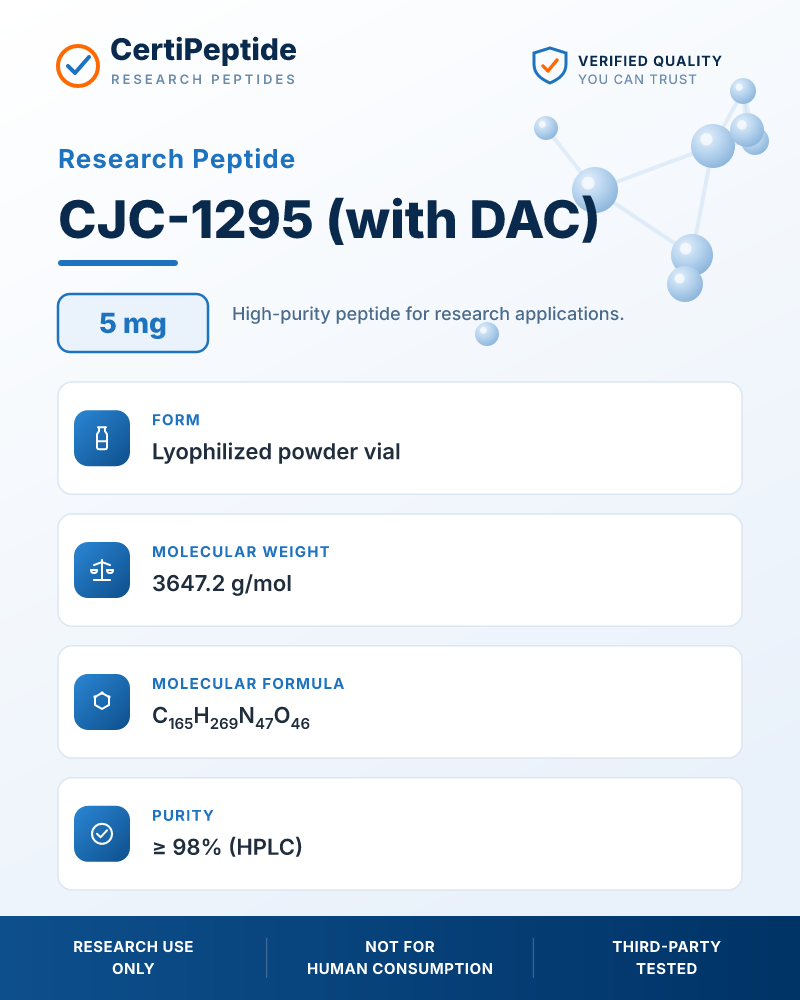
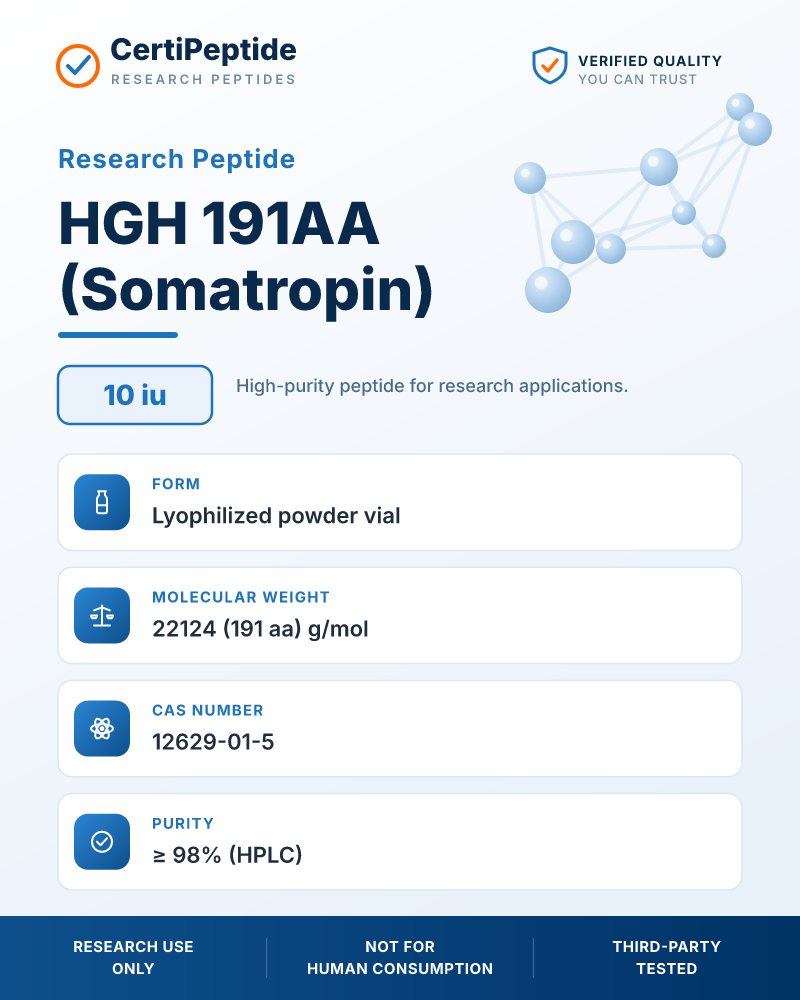
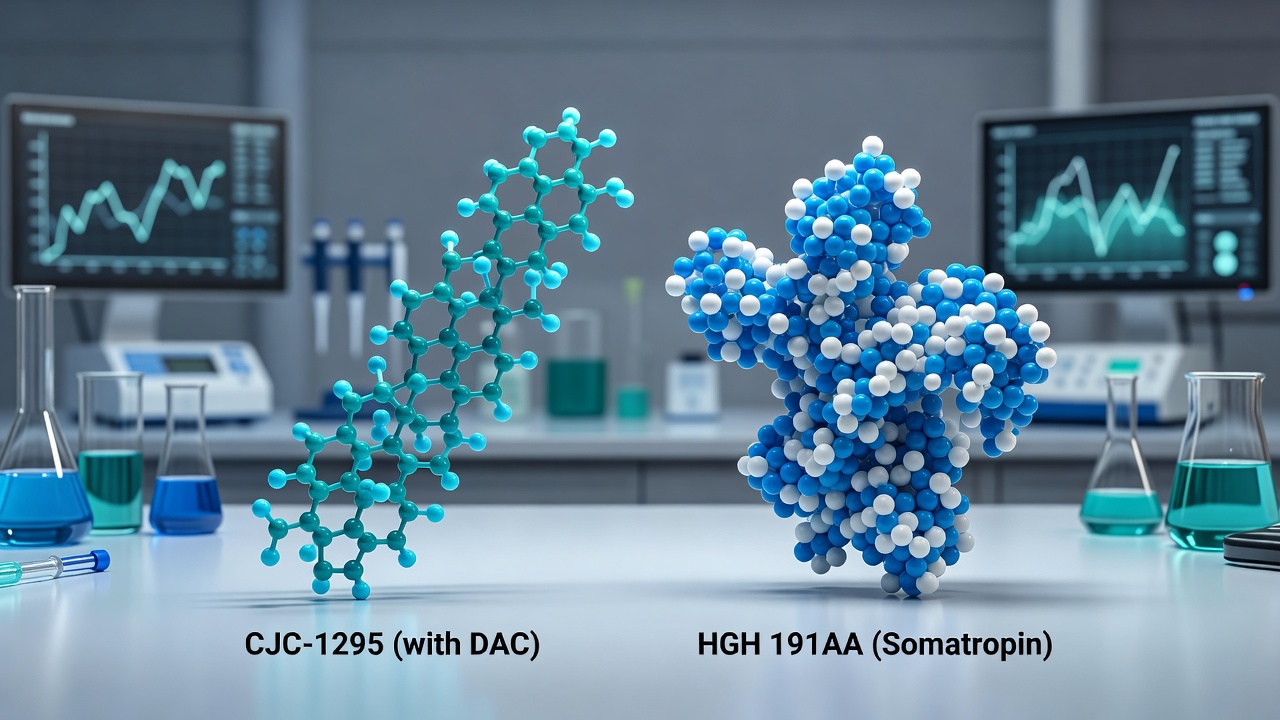
**CJC-1295 (with DAC) vs HGH 191AA (Somatropin)** contrasts two distinct tools for growth-hormone (GH) axis research. CJC-1295 with DAC is a long-acting GHRH analog that stimulates *endogenous* GH release; HGH 191AA (Somatropin) is recombinant 191-amino-acid human GH supplied *exogenously*. They differ in mechanism, pharmacokinetics, feedback dynamics, and how they are typically deployed in controlled laboratory models. Neither is interchangeable without redesigning endpoints, sampling schedules, and controls.
Why Compare CJC-1295 (with DAC) and HGH 191AA in Research?
Investigators studying somatotropic signaling, IGF-1 induction, body composition models, recovery biology, or metabolic flux often face a design choice: **CJC-1295 (with DAC) or HGH 191AA (Somatropin)**. A clear **CJC-1295 (with DAC) HGH 191AA (Somatropin) comparison** helps match the probe to the hypothesis—whether the goal is to preserve physiologic pulse architecture, clamp circulating GH, or isolate pituitary responsiveness versus peripheral GH receptor activation.
Both compounds appear frequently in preclinical and in vitro literature related to the GH/IGF-1 axis, yet they act at different nodes. Selecting the wrong tool can confound interpretation of feedback loops, desensitization, and tissue-specific readouts.
Molecular Identity and Mechanism of Action
CJC-1295 (with DAC)
CJC-1295 (with DAC) is a synthetic analog of growth hormone–releasing hormone (GHRH), modified for extended residence time. The Drug Affinity Complex (DAC) moiety enables covalent binding to circulating albumin, markedly prolonging half-life relative to native GHRH or short-acting GHRH fragments.
In research systems, CJC-1295 (with DAC) binds GHRH receptors on pituitary somatotrophs, amplifying **endogenous** GH secretion. Downstream effects (e.g., hepatic IGF-1 output) therefore depend on intact pituitary function, endogenous GHRH/somatostatin tone, and receptor sensitivity. Studies often use it when the question involves *stimulation* of the axis rather than replacement of the hormone itself.
HGH 191AA (Somatropin)
HGH 191AA (Somatropin) is recombinant human growth hormone with the canonical 191-amino-acid sequence of pituitary GH. It is supplied as the finished peptide ligand. In experimental models it binds GH receptors (GHR) directly on target tissues (liver, muscle, adipose, and others), activating JAK2–STAT5 and related cascades independent of pituitary output.
Because it bypasses the pituitary, HGH 191AA is suited to designs that require a defined exogenous GH exposure, receptor pharmacology studies, or work in systems where endogenous GH production is impaired, suppressed, or irrelevant to the endpoint.
Pharmacokinetics and Exposure Profile
| Feature | CJC-1295 (with DAC) | HGH 191AA (Somatropin) |
| --- | --- | --- |
| Primary action | GHRH-receptor agonism → endogenous GH | Direct GHR agonism |
| Typical research half-life context | Extended (albumin-bound DAC construct) | Short relative to DAC-GHRH; multi-hour range in many models |
| GH pattern | Amplified pulses / sustained stimulatory drive | Exogenous concentration curve set by administration schedule |
| Pituitary dependence | Required | Not required |
| Common research use | Axis stimulation, pulse biology, GHRH-pathway work | GH replacement models, GHR signaling, IGF-1 clamp-style designs |
CJC-1295 (with DAC)’s prolonged activity reduces the need for frequent redosing in longer protocols but can blur fine temporal resolution of GH pulses. HGH 191AA offers tighter control of peak and trough levels when investigators titrate exogenous peptide, at the cost of more intensive sampling or administration schedules if physiologic-like patterns are desired.
Similarities Relevant to Study Design
Despite different entry points, both compounds converge on overlapping readouts:
- **IGF-1 and IGFBP dynamics** — Both can elevate circulating IGF-1 in responsive models; timing and magnitude differ.
- **Anabolic and metabolic gene programs** — Overlap in STAT5-driven transcripts, lipid mobilization markers, and protein-turnover proxies in tissue assays.
- **Feedback on the axis** — Elevated GH/IGF-1 can increase somatostatin tone and reduce GHRH effectiveness; this matters more when interpreting CJC-1295 (with DAC) data after prolonged stimulation, and when stacking or sequencing compounds.
- **Analytical needs** — Validated GH and IGF-1 assays, attention to species cross-reactivity, and standardized sample timing remain essential for either arm.
These shared downstream nodes explain why a head-to-head **CJC-1295 (with DAC) vs HGH 191AA (Somatropin)** arm appears in comparative protocols: same broad pathway, different control points.
Key Research Differences
1. Endogenous vs exogenous GH
CJC-1295 (with DAC) reports on *pituitary capacity and GHRH-receptor coupling*. Flat GH responses may indicate somatotroph fatigue, receptor downregulation, or high somatostatin tone—not failure of the peptide per se. HGH 191AA reports on *peripheral GHR competence* and ligand pharmacokinetics; non-response points toward receptor, post-receptor, or assay issues.
2. Pulse architecture vs concentration clamp
Physiologic GH is pulsatile. GHRH-pathway probes like CJC-1295 (with DAC) can preserve or exaggerate pulse-related signaling, which some tissues interpret differently than continuous GH exposure. Exogenous HGH 191AA can approximate continuous or multi-peak profiles depending on the protocol, enabling deliberate comparison of continuous versus intermittent GH signaling—an important variable in metabolic and growth studies.
3. Feedback and desensitization
Chronic GHRH-receptor stimulation may alter pituitary responsiveness over time. Chronic exogenous GH can suppress endogenous production via IGF-1 and hypothalamic feedback. Longitudinal designs must specify washout, baseline GH profiles, and whether the hypothesis concerns stimulation durability or steady-state GHR activation.
4. Model constraints
- Hypophysectomized, pituitary-suppressed, or GHRH-receptor–deficient models favor HGH 191AA for GH-dependent endpoints.
- Models probing secretagogue pharmacology, hypothalamic–pituitary dialogue, or residual somatotroph function favor CJC-1295 (with DAC).
- Combination designs (secretagogue + exogenous GH) require careful endpoint separation to avoid double-counting IGF-1 effects.
Practical Considerations for Laboratory Protocols
When choosing **CJC-1295 (with DAC) or HGH 191AA (Somatropin)** for a given study:
1. **Define the node of interest** — Pituitary release versus peripheral GHR.
2. **Match PK to sampling** — Extended exposure from CJC-1295 (with DAC) suits sparse sampling of IGF-1; HGH 191AA may need denser GH curves if Cmax/AUC is primary.
3. **Control for feedback** — Measure concurrent GH, IGF-1, and where possible GHRH/somatostatin-related markers.
4. **Standardize matrices** — Serum vs plasma, freeze–thaw limits, and assay kits validated for the species.
5. **Document identity** — Confirm peptide content, purity, and (for HGH) correct 191AA sequence/isoform expectations; for CJC-1295, specify *with DAC* versus non-DAC CJC-1295/Mod GRF 1-29, which have different half-lives.
6. **Avoid human-use assumptions** — Frame concentrations, vehicles, and schedules strictly around in vitro, ex vivo, or approved animal-research contexts.
Research suppliers typically offer **CJC-1295 (with DAC)** and **HGH 191AA (Somatropin)** as separate catalog items so labs can run parallel arms or sequential crossover designs under institutional research guidelines.
Which Tool Fits Which Hypothesis?
- **Hypothesis: GHRH-receptor agonism increases pulsatile GH and downstream IGF-1 in an intact pituitary model** → CJC-1295 (with DAC).
- **Hypothesis: Defined exogenous GH exposure activates hepatic STAT5 and elevates IGF-1 independent of pituitary output** → HGH 191AA (Somatropin).
- **Hypothesis: Continuous GH signaling differs from secretagogue-driven patterns in adipose gene expression** → Head-to-head comparison of both.
- **Hypothesis: Somatotroph reserve after metabolic challenge** → CJC-1295 (with DAC) stimulation test–style design with rich GH sampling.
- **Hypothesis: GHR pathway integrity after receptor knockdown** → HGH 191AA dose–response in controlled media or in vivo replacement-style arms.
Summary
A rigorous **CJC-1295 (with DAC) HGH 191AA (Somatropin) comparison** centers on *where* each molecule enters the GH axis. CJC-1295 (with DAC) is a long-acting GHRH analog used to drive endogenous GH release; HGH 191AA (Somatropin) is recombinant GH used to impose exogenous ligand exposure. Similarities in IGF-1 and metabolic readouts make them complementary; differences in pituitary dependence, pharmacokinetics, and pulse versus clamp dynamics make them non-equivalent. Study quality hinges on matching the compound to the biological question, synchronizing analytics with exposure profiles, and interpreting feedback effects explicitly.
FAQ
Is CJC-1295 (with DAC) the same as HGH 191AA? No. CJC-1295 (with DAC) is a GHRH analog that stimulates the pituitary to release GH. HGH 191AA (Somatropin) is recombinant growth hormone itself.
Can research protocols use both compounds? Yes. Comparative or sequential designs are common when contrasting secretagogue-driven versus exogenous GH exposure, provided endpoints and washouts are clearly defined.
Why does “with DAC” matter in CJC-1295 studies? DAC (Drug Affinity Complex) extends half-life via albumin binding. Results from CJC-1295 with DAC should not be assumed identical to short-acting GHRH analogs without DAC.
Which raises IGF-1 in laboratory models? Both can increase IGF-1 in responsive systems, but through different routes (endogenous GH pulses vs exogenous GH). Magnitude and time course depend on model, dose paradigm, and sampling.
What endpoints differ most between the two? Pituitary GH secretory capacity and pulse metrics are central for CJC-1295 (with DAC). Direct GHR signaling, exogenous GH AUC, and pituitary-independent readouts are central for HGH 191AA.
Explore Further
Browse our [research peptide catalog](/shop) and review third-party [lab reports & COAs](/lab-reports) for every batch.
---
**Research use only.** The information above is provided for educational and laboratory research purposes only. The compounds discussed are not approved for human or veterinary use, diagnosis, treatment, or the prevention of any disease. Nothing here is medical advice.