TL;DR
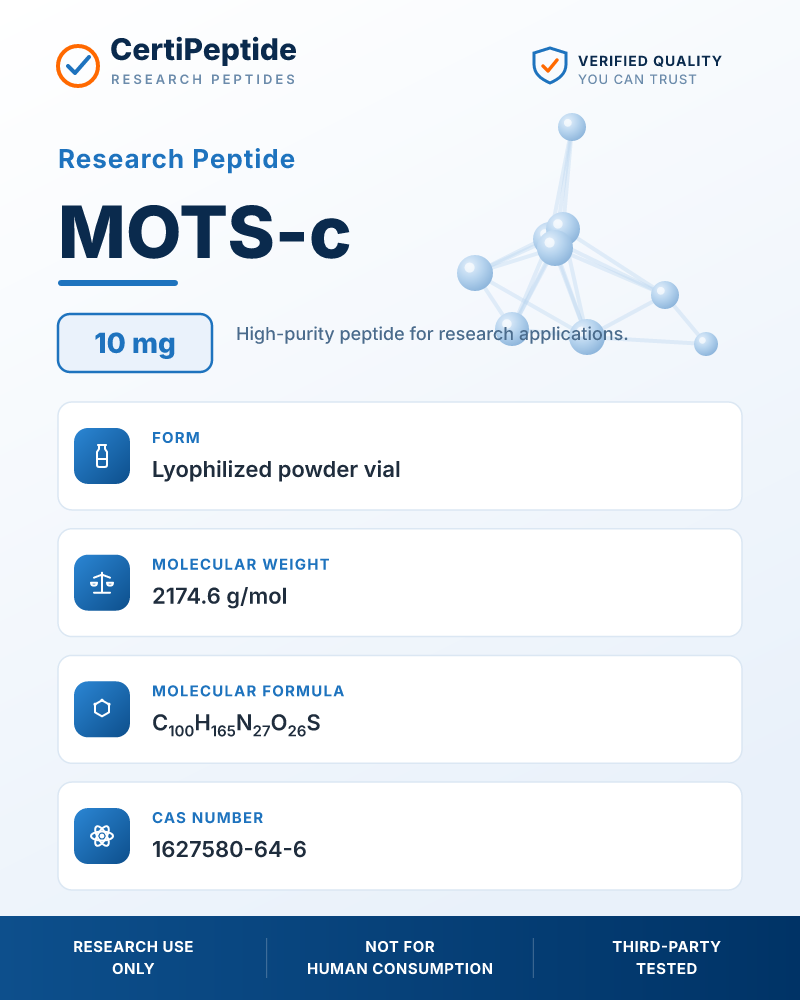
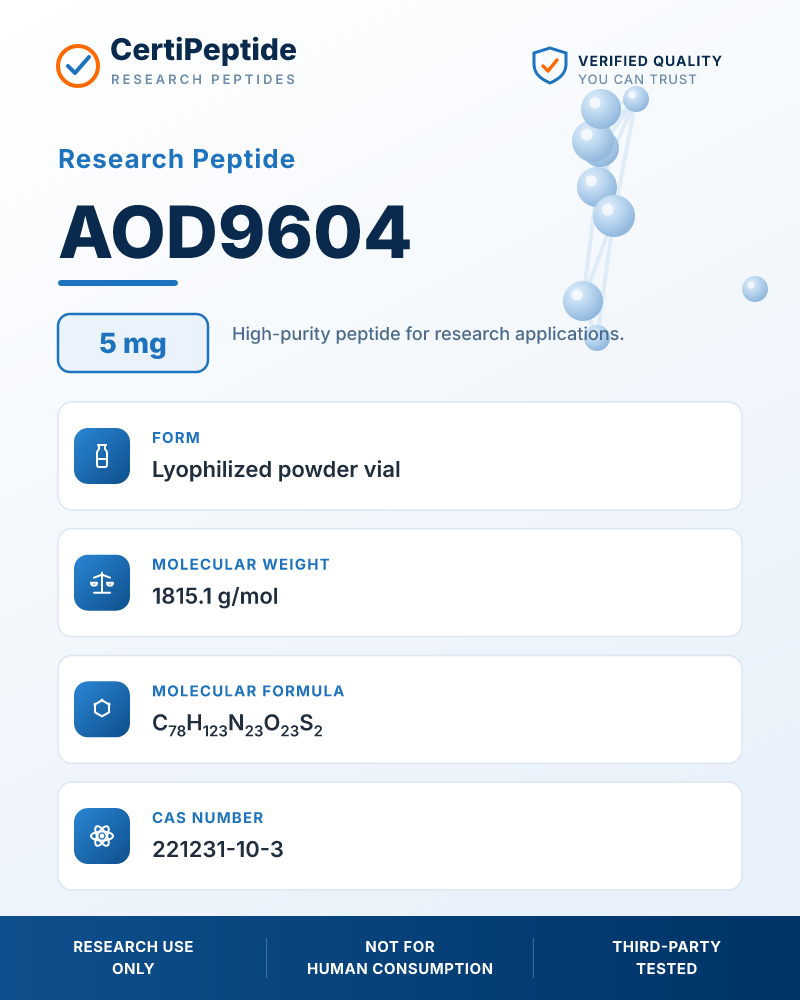
**AOD9604 vs MOTS-c** is a frequent comparison when laboratories plan metabolic and mitochondrial research. AOD9604 is a modified C-terminal fragment of human growth hormone (hGH 177–191 with a Tyr addition) studied mainly for fat-metabolism and lipolytic pathway readouts. MOTS-c is a mitochondria-derived peptide encoded in the mitochondrial genome and studied for AMPK-related signaling, metabolic stress responses, and cellular energy homeostasis. Neither compound is interchangeable in study design: AOD9604 work often centers on adipose and lipid-handling models, while MOTS-c protocols emphasize mitochondrial and metabolic-flexibility endpoints. This article summarizes structural origins, proposed mechanisms in vitro/in vivo models, overlapping research themes, and practical differences investigators weigh when selecting **AOD9604 or MOTS-c** for controlled laboratory work.
Why Compare AOD9604 vs MOTS-c in Laboratory Research?
Comparison articles help research teams align peptide choice with hypothesis, assay battery, and model system. Searches for **AOD9604 MOTS-c comparison** usually arise when a lab is mapping metabolic endpoints—lipid flux, glucose handling proxies, mitochondrial function, or exercise-mimetic signaling—and needs clarity on which tool peptide fits the experimental question.
Both molecules appear in the broader literature on energy metabolism, yet they differ in origin, primary pathway emphasis, and typical study endpoints. Framing the decision as **AOD9604 or MOTS-c** reduces protocol mismatch: using a GH-fragment analog when the question is purely mitochondrial peptide signaling (or the reverse) can weaken mechanistic interpretation.
For catalog and sourcing context, research-use materials such as **AOD9604** and **MOTS-c** are selected against purity documentation, identity confirmation, and storage guidance appropriate to peptide work—not clinical narratives.
Molecular Origins and Structural Profiles
AOD9604
AOD9604 is described in the research literature as a synthetic analog based on the C-terminal region of human growth hormone (residues 177–191), often noted with an N-terminal tyrosine modification relative to the native fragment. Its design history is tied to isolating metabolic/lipolytic research activity associated with that GH region while separating it from the broader endocrine profile of full-length hGH in experimental systems.
Key research-facing attributes typically discussed:
- **Class:** Modified GH fragment peptide
- **Research focus areas:** Adipose tissue biology, lipolysis-related markers, lipid metabolism assays
- **Handling notes (general peptide practice):** Lyophilized storage, reconstitution planning, protection from repeated freeze–thaw—standard for short peptides in lab inventories
MOTS-c
MOTS-c (mitochondrial open reading frame of the twelve S rRNA type-c) is a mitochondria-derived peptide (MDP). It is encoded within mitochondrial DNA and has been investigated as a signaling peptide linking mitochondrial status to cellular metabolic regulation. Literature commonly associates MOTS-c research with AMPK pathway engagement, stress adaptation, and metabolic homeostasis models.
Key research-facing attributes typically discussed:
- **Class:** Mitochondria-derived peptide
- **Research focus areas:** AMPK-related signaling, metabolic stress, mitochondrial–nuclear communication hypotheses, exercise and aging biology models in animals/cells
- **Handling notes:** Same core peptide laboratory practices; sequence-specific stability and solvent choices should follow supplier COA and institutional SOPs
Side-by-Side Origin Snapshot
| Feature | AOD9604 | MOTS-c |
| --- | --- | --- |
| Conceptual origin | Synthetic GH (177–191)–based analog | mtDNA-encoded MDP |
| Primary research “home” | Lipid/adipose metabolic readouts | Mitochondrial metabolic signaling |
| Typical mechanistic lens | Lipolytic / fat-metabolism pathways in models | AMPK and energy-stress pathways in models |
| Interchangeable in design? | No—different biological framing | No—different biological framing |
Mechanisms Emphasized in Published and Preclinical-Style Studies
AOD9604: Lipid Metabolism and Related Readouts
In laboratory and preclinical research contexts, AOD9604 is most often discussed in relation to:
- Markers and assays linked to **lipolysis** and fat-tissue metabolism
- Experimental questions about **GH-fragment–associated metabolic activity** without modeling full-length GH
- In vitro adipocyte systems or in vivo metabolic phenotyping where lipid endpoints are primary
Investigators comparing **AOD9604 vs MOTS-c** should note that AOD9604 study rationales rarely center on mitochondria-encoded peptide biology; the peptide is a tool for GH-region metabolic hypotheses.
MOTS-c: Mitochondrial Peptide Signaling and AMPK-Linked Models
MOTS-c research commonly explores:
- **Cellular energy sensing**, frequently with AMPK pathway readouts
- Responses to metabolic challenge (diet, exercise analogs, stress paradigms in animal or cell models)
- Hypotheses about **mitochondrial–nuclear crosstalk** and metabolic flexibility
When the experimental question is “how does an MDP influence metabolic signaling under stress?”, MOTS-c is the mechanistically aligned choice. When the question is “how does a GH C-terminal fragment analog affect lipid-handling endpoints?”, AOD9604 is the more direct fit.
Overlap Without Equivalence
Similarities that drive **AOD9604 MOTS-c comparison** searches:
1. **Metabolic theme:** Both appear in energy-balance and metabolism-oriented research portfolios.
2. **Peptide format:** Both are short peptides used as discrete experimental variables in controlled studies.
3. **Non-identical pathway maps:** Overlap at the level of “metabolism” does not imply shared primary targets or interchangeable dose–response logic in models.
4. **Need for rigorous controls:** Vehicle, stability, and endpoint specificity matter for both.
Differences that decide **AOD9604 or MOTS-c**:
- **Genetic/structural story:** Nuclear GH-derived fragment analog vs mtDNA-encoded peptide
- **Dominant pathway narrative:** Lipolytic/adipose-focused vs AMPK/mitochondrial signaling-focused
- **Model selection:** Adipocyte and lipid flux designs vs mitochondrial stress, exercise-mimetic, or metabolic disease model designs
- **Biomarker panels:** Free fatty acids, glycerol, adipocyte gene programs (AOD9604-oriented) versus p-AMPK, mitochondrial function assays, metabolic transcriptome modules (MOTS-c-oriented)
Designing Studies: Practical Differences for Research Teams
Hypothesis Alignment
- Choose **AOD9604** when the hypothesis explicitly references GH 177–191–region biology, adipose lipolysis markers, or lipid metabolism endpoints in laboratory models.
- Choose **MOTS-c** when the hypothesis references MDPs, AMPK-linked energy sensing, or mitochondrial metabolic regulation.
- Avoid forcing a single peptide to answer both frames without a factorial or dual-arm design and clear mechanistic justification.
Model Systems
Common research settings (illustrative, not prescriptive):
- **Cell culture:** Differentiated adipocytes, hepatocytes, myotubes, or other metabolically active lines—with endpoint panels matched to the peptide’s literature context
- **Animal models:** Diet-induced metabolic stress, exercise, aging, or genetic metabolic models—again matched to the question
- **Ex vivo tissues:** Adipose explants (AOD9604-leaning questions) vs muscle or multi-tissue mitochondrial readouts (MOTS-c-leaning questions)
Endpoint Selection
A disciplined **AOD9604 vs MOTS-c** protocol defines primary endpoints before unblinding analytics:
- **AOD9604-oriented batteries:** Lipolytic markers, adipocyte morphology/gene expression, circulating lipid-related measures in animal work, relevant enzyme activities
- **MOTS-c-oriented batteries:** AMPK phosphorylation and downstream targets, respirometry or mitochondrial content proxies, glucose-handling related assays in models, stress-adaptation transcripts
- **Shared supportive measures:** Body composition imaging in animals, food intake, activity—interpreted only within the approved research protocol and IACUC/ethics framework
Controls, Replication, and Reporting
For either peptide:
- Use identity-confirmed material (HPLC/MS as provided on COAs)
- Document lot numbers, storage, and reconstitution vehicles
- Power studies for the primary endpoint; pre-register analysis plans where institutional practice encourages it
- Report negative and null results to reduce publication bias in peptide metabolism research
Similarities Relevant to Procurement and Lab Operations
Operationally, labs stocking **AOD9604** and **MOTS-c** often apply the same quality bar:
- Research-use-only labeling and institutional compliance
- Cold-chain and desiccated storage for lyophilized peptides
- Aliquoting to limit freeze–thaw
- Compatibility checks for solvents and assay matrices
- Clear separation from any clinical or consumer-use framing in SOPs and publications
These similarities simplify inventory SOPs even though the biology is not interchangeable.
How Investigators Choose: Decision Framework
Use this condensed framework when the literature search lands on **AOD9604 or MOTS-c**:
1. **Primary biological question** — Adipose/lipid GH-fragment biology → AOD9604; MDP/AMPK/mitochondrial signaling → MOTS-c.
2. **Pathway diagram** — If your cartoon starts at GH fragment receptors/pathways vs mitochondrial peptide signaling, pick accordingly.
3. **Endpoint hierarchy** — Rank one primary endpoint family; do not split power across unrelated mechanisms without sample-size justification.
4. **Prior art** — Match methods sections to the closest high-quality papers for that specific peptide.
5. **Combination studies** — Dual-agent designs are possible only with explicit interaction hypotheses, separate single-agent arms, and careful statistics—not as a default “stack.”
Limitations and Evidence Hygiene
Responsible **AOD9604 MOTS-c comparison** writing acknowledges:
- Heterogeneity of models, doses used in animals/cells, and endpoints across papers
- Species differences and in vitro–in vivo translation limits
- The distinction between mechanistic laboratory observations and any non-research claims
- Need to read primary methods, not only abstracts or secondary summaries
Research teams should is researched in the context of vendor content as educational orientation and rely on peer-reviewed methods, institutional review, and internal validation assays.
Summary Table for Quick Reference
| Decision factor | Favors AOD9604 | Favors MOTS-c |
| --- | --- | --- |
| Core hypothesis | GH 177–191 region / lipolytic research | MDP / AMPK–metabolic stress research |
| Typical tissues of interest | Adipose, lipid-handling systems | Muscle, multi-tissue metabolic/mitochondrial systems |
| Pathway emphasis | Fat metabolism markers | Energy sensing, mitochondrial signaling |
| Combination logic | Only with justified interaction design | Only with justified interaction design |
Conclusion
An accurate **AOD9604 vs MOTS-c** comparison for scientific audiences is simple at the strategic level and nuanced at the assay level: both peptides support metabolism-themed laboratory research, but they answer different mechanistic questions. AOD9604 aligns with modified GH-fragment and lipid-metabolism study designs; MOTS-c aligns with mitochondria-derived peptide and AMPK-linked energy-regulation designs. Selecting **AOD9604 or MOTS-c** should follow hypothesis, model, and endpoint fit—not trend overlap. When both appear in one program, is researched in the context of them as distinct experimental factors with independent controls. For procurement, research-grade **AOD9604** and **MOTS-c** should be qualified by analytical documentation and handled under standard peptide laboratory SOPs within research-use-only programs.
FAQ
Common long-tail questions from research planners are addressed below.
Explore Further
Browse our [research peptide catalog](/shop) and review third-party [lab reports & COAs](/lab-reports) for every batch.
---
**Research use only.** The information above is provided for educational and laboratory research purposes only. The compounds discussed are not approved for human or veterinary use, diagnosis, treatment, or the prevention of any disease. Nothing here is medical advice.