TL;DR
**ACTH (1-39) vs PT-141 (Bremelanotide)** is a frequent comparison in melanocortin and endocrine research. ACTH (1-39) is the full-length endogenous adrenocorticotropic hormone peptide used mainly to study HPA-axis signaling and MC2R-mediated steroidogenesis in vitro and in animal models. PT-141 (Bremelanotide) is a synthetic cyclic heptapeptide melanocortin receptor agonist investigated primarily for central MC3R/MC4R pathways and behavioral endpoints. They share melanocortin-system roots but differ sharply in receptor preference, research endpoints, assay design, and handling. This guide outlines similarities, differences, and practical considerations for laboratory studies only.
Why Compare ACTH (1-39) and PT-141 (Bremelanotide)?
Researchers evaluating melanocortin ligands often weigh **ACTH (1-39) or PT-141 (Bremelanotide)** when designing receptor-profiling, pathway-mapping, or comparative pharmacology experiments. Both peptides engage aspects of the melanocortin system, yet they serve distinct experimental niches. ACTH (1-39) is the classical pituitary peptide that drives adrenal glucocorticoid production via melanocortin-2 receptor (MC2R) and its accessory protein MRAP. PT-141 (Bremelanotide), a metabolite-related analog of Melanotan II, is used to probe central melanocortin receptors (especially MC4R and MC3R) and associated behavioral or neuroendocrine readouts in preclinical models.
An **ACTH (1-39) PT-141 (Bremelanotide) comparison** helps labs select the right tool for receptor selectivity panels, second-messenger assays, tissue explants, or in vivo mechanistic work—always under controlled research-use conditions.
Molecular Identity and Structure
ACTH (1-39)
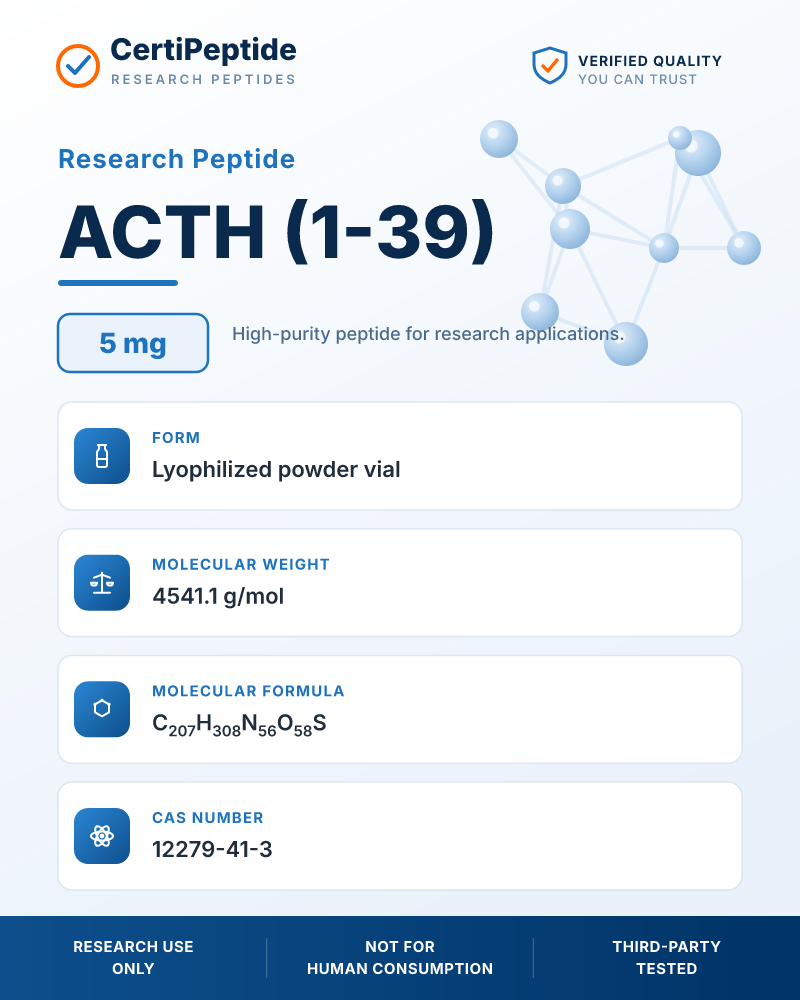
Adrenocorticotropic hormone (ACTH), also called corticotropin, is a 39-amino-acid linear peptide cleaved from pro-opiomelanocortin (POMC). The N-terminal region (roughly residues 1–24) contains the core sequence required for MC2R activation, while the C-terminal portion influences stability and species-specific interactions. In research catalogs, ACTH (1-39) is supplied as a research-grade peptide for receptor binding, cAMP assays, adrenal cell stimulation, and HPA-axis modeling.
Key structural notes for laboratory work:
- Linear 39-mer peptide
- High affinity for MC2R when MRAP is present
- Susceptible to proteolytic cleavage; cold-chain and protease-aware buffers matter
- Often referenced against shorter analogs (e.g., ACTH 1–24) in structure–activity studies
PT-141 (Bremelanotide)
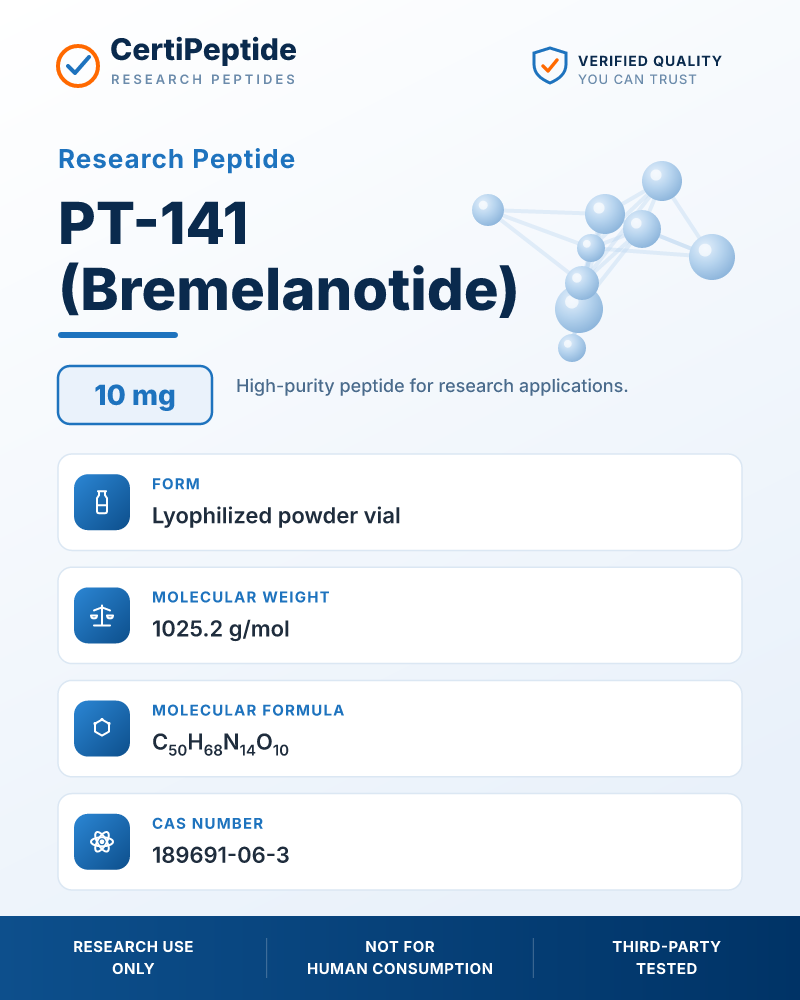
PT-141 (Bremelanotide) is a synthetic cyclic heptapeptide. It is structurally related to α-MSH / Melanotan II scaffolds and is optimized for agonist activity at melanocortin receptors other than the classic adrenal MC2R pathway. In research settings it is used to interrogate MC3R and MC4R signaling, often with behavioral, autonomic, or central-nervous-system endpoints in animal models, as well as recombinant receptor assays.
Key structural notes:
- Cyclic peptide architecture (improved metabolic stability relative to many linear melanocortins)
- Preferential activity at MC3R/MC4R over MC2R in many reported systems
- Useful as a reference agonist in melanocortin GPCR panels
- Handling still requires attention to light, temperature, and solvent choice for stock solutions
Receptor Pharmacology: Core Research Differences
| Feature | ACTH (1-39) | PT-141 (Bremelanotide) |
| --- | --- | --- |
| Primary research receptors | MC2R (+ MRAP) | MC4R, MC3R (context-dependent) |
| Canonical pathway focus | Adrenal steroidogenesis, HPA axis | Central melanocortin signaling |
| Typical second messenger | Gs–cAMP in adrenal/MC2R systems | Gs–cAMP at MC3R/MC4R; pathway bias studies |
| Common prep types | Adrenal cells, Y1 cells, MC2R+MRAP lines | HEK/CHO MC3R or MC4R lines, CNS tissue, behavioral models |
| Endogenous vs synthetic | Endogenous POMC product | Synthetic research agonist |
**ACTH (1-39)** remains the reference ligand when the experimental question centers on MC2R activation, cortisol/corticosterone output, or adrenal cortical cell physiology. Co-expression of MRAP is often essential for robust MC2R surface expression and signaling in heterologous systems.
**PT-141 (Bremelanotide)** is selected when the question involves MC4R- or MC3R-dependent cAMP accumulation, β-arrestin recruitment, receptor internalization, or downstream behavioral/neuroendocrine correlates in approved animal research protocols. Cross-reactivity and species differences should be validated in each assay system.
Similarities Relevant to Study Design
Despite divergent primary uses, an **ACTH (1-39) vs PT-141 (Bremelanotide)** comparison reveals several shared experimental themes:
1. **Melanocortin GPCR superfamily** – Both are studied as ligands within the five-receptor melanocortin family (MC1R–MC5R), enabling side-by-side selectivity tables.
2. **cAMP-centric readouts** – Many protocols quantify Gs-coupled cAMP, CRE-luciferase, or phospho-PKA substrates.
3. **POMC lineage context** – ACTH is a direct POMC product; PT-141 scaffolds echo α-MSH pharmacophores, so both appear in POMC-pathway reviews.
4. **Peptide handling norms** – Lyophilized storage, reconstitution in appropriate diluents, aliquoting to avoid freeze–thaw, and documentation of purity (HPLC/MS) apply to both research materials.
5. **Need for controls** – Vehicle, reference agonists/antagonists (e.g., SHU9119, α-MSH, NDP-MSH, ACTH 1–24), and receptor-null or knockdown conditions strengthen interpretation.
These overlaps make dual-ligand experiments attractive for mapping receptor preference and off-target risk in melanocortin screens.
Divergent Research Applications
Typical ACTH (1-39) study contexts - MC2R/MRAP structure–function and trafficking assays - Primary adrenal cortical cells or adrenocortical cell lines - Ex vivo adrenal slice steroidogenesis (corticosterone/cortisol quantification) - HPA-axis challenge paradigms in laboratory animals under ethical approval - Comparison with truncated ACTH fragments for SAR work
Typical PT-141 (Bremelanotide) study contexts - Recombinant MC3R/MC4R binding and potency ranking - Signaling bias (G protein vs β-arrestin) at central melanocortin receptors - Neuroendocrine and behavioral pharmacology models where MC4R pathways are hypothesized - Comparative agonist panels alongside α-MSH, MT-II, and selective tool compounds - Formulation and stability studies of cyclic melanocortin peptides
Neither compound should be framed as a therapeutic recommendation in research content; endpoints must remain mechanistic, analytical, or model-based.
Experimental Design Tips for Side-by-Side Work
When running an **ACTH (1-39) PT-141 (Bremelanotide) comparison** in the same campaign:
- **Confirm receptor expression** – qPCR, Western blot, or radioligand/fluorescent binding to verify MC2R+MRAP versus MC3R/MC4R in each cell or tissue system.
- **Match assay kinetics** – Cyclic peptides and linear ACTH analogs can differ in onset and washout; time-course cAMP measurements reduce false potency rankings.
- **Watch buffer and serum effects** – Peptidases in serum-containing media disproportionately affect linear ACTH (1-39); serum-free or inhibitor-supplemented conditions improve comparability.
- **Use orthogonal readouts** – Pair cAMP with receptor internalization, label-free impedance, or hormone ELISA where biology dictates.
- **Document lot analytics** – Identity, purity, peptide content, and counter-ion data support reproducibility across ACTH (1-39) and PT-141 (Bremelanotide) lots.
- **Species and accessory proteins** – MC2R function is MRAP-dependent; MC4R accessory proteins (e.g., MRAP2) can modulate pharmacology—include them when physiologically relevant.
Analytical and Quality Considerations
For both research peptides:
- Verify sequence and molecular weight by mass spectrometry.
- Assess purity by reverse-phase HPLC (research suppliers typically provide certificates of analysis).
- Store lyophilized material desiccated at recommended low temperatures; protect solutions from repeated freeze–thaw.
- Prepare fresh working dilutions when possible; validate vehicle compatibility (e.g., dilute acetic acid, sterile water, or buffered saline per protocol).
- Include endotoxin awareness for cell-based and in vivo laboratory models where applicable.
These practices keep **ACTH (1-39) vs PT-141 (Bremelanotide)** datasets comparable and audit-ready.
Choosing Between ACTH (1-39) or PT-141 (Bremelanotide)
Select **ACTH (1-39)** when the hypothesis centers on adrenal MC2R signaling, steroid output, or endogenous corticotropin biology. Select **PT-141 (Bremelanotide)** when the hypothesis centers on MC3R/MC4R agonism, cyclic melanocortin SAR, or central pathway models. For selectivity fingerprinting, include both alongside reference melanocortins to map potency and efficacy across MC1R–MC5R panels.
Budget, required milligram scale, and assay throughput also influence choice: shorter cyclic peptides sometimes offer handling advantages in high-throughput screens, while full-length ACTH (1-39) is indispensable for authentic MC2R pharmacology.
Summary
An evidence-minded **ACTH (1-39) vs PT-141 (Bremelanotide)** comparison shows complementary—not interchangeable—research tools. ACTH (1-39) anchors HPA-axis and MC2R/MRAP experiments; PT-141 (Bremelanotide) anchors MC3R/MC4R and cyclic-agonist studies. Shared melanocortin cAMP biology enables elegant head-to-head designs, provided receptor context, peptide stability, and analytical controls are rigorously managed. Laboratories can mention ACTH (1-39) and PT-141 (Bremelanotide) together in methods sections when building selectivity matrices or pathway maps, always within authorized research frameworks.
FAQ
Explore Further
Browse our [research peptide catalog](/shop) and review third-party [lab reports & COAs](/lab-reports) for every batch.
---
**Research use only.** The information above is provided for educational and laboratory research purposes only. The compounds discussed are not approved for human or veterinary use, diagnosis, treatment, or the prevention of any disease. Nothing here is medical advice.