BPC-157
Research Peptide | Lyophilized Powder | Batch Tested
For laboratory research use only. Not for human or animal consumption. Insulated shipping · Styrofoam box available.
Product Overview
BPC-157 (Body Protection Compound-157) is a stable synthetic pentadecapeptide — a 15-amino-acid chain — derived from a protective protein found in gastric juice. It is one of the most extensively studied peptides in tissue-repair research, valued for its remarkable stability (it resists degradation in acidic environments) and for the broad range of tissues it has been examined in, including muscle, tendon, ligament, nerve and gut.
Labor: Stand Science & Technology Pharmaceutical (Qingdao) Co., Ltd. (Stand Group)
Prüfergebnisse für Charge 3DVY0XVINYZZ →1 / 4
| Prüfung | Ergebnis |
|---|---|
| AppearanceVisual | White loose powderPass |
| Mass spectrumMS | 1418.8 DaPass |
| PurityHPLC | 99.3 %Pass |
| Peptide contentHPLC | 90.7 %Pass |
| Actual fillGravimetric | 24.00 mgPass |
| Water contentKarl Fischer | 3.4 %Pass |
| Bacterial endotoxinsLAL (gel-clot) | <3 EU/mgPass |
SKU & Verpackung
| SKU | Pro Fläschchen | Fläschchen pro Packung | Packungspreis |
|---|---|---|---|
| BC2 | 2 mg | 10 | 25,00 $ |
| BC5 | 5 mg | 10 | 48,00 $ |
| BC10 | 10 mg | 10 | 72,00 $ |
| BC20 | 20 mg | 10 | 139,00 $ |
Nennmengen entsprechen dem Produktetikett; Messwerte stehen im jeweiligen Chargenbericht. Veröffentlichte Berichte bestätigen nicht die Charge einer künftigen Bestellung.
Fragen zu Produkt und Dokumentation
Wie lese ich Größe und Packungsmenge?
Menge pro Fläschchen und Fläschchen pro Packung stehen getrennt in der Tabelle. Der Preis gilt für eine Packung. Bei Mischungen kann die Menge alle Bestandteile zusammen bezeichnen; Einzelangaben stehen auf Etikett und Bericht.
Wie finde ich das passende COA?
Gleichen Sie Produkt, SKU und Chargennummer ab. Die Chargenseite zeigt Messwerte, Originalbericht und Verifizierungslink. Falls Ihre Bestellung keine Charge nennt, fragen Sie den Support.
Bedeutet ein Reinheitswert, dass alle Tests bestanden wurden?
Nein. Identität, Reinheit, Füllmenge und Endotoxin sind getrennte Messungen. Beachten Sie Ergebnis und Einheit. Ein fehlender Wert ist kein bestandenes Ergebnis; ein Kleiner-als-Wert ist nicht null.
Research Information
BPC-157 is investigated for its effects on angiogenesis (new blood-vessel formation), growth-factor signaling, collagen organization and the nitric-oxide pathway in cell and animal models. Studies in rat models have explored tendon-to-bone and muscle-to-bone healing, gastrointestinal protection and recovery of injuries that do not normally regenerate on their own, and researchers examine its cytoprotective activity across many tissue types. Supplied strictly for in-vitro and laboratory research use only — not for human or animal consumption.
BPC-157 Research & Studies
What is BPC-157?
BPC-157 is a synthetic, stable pentadecapeptide composed of a 15-amino-acid sequence derived from a partial region of a protein identified in gastric juice. In laboratory settings it is valued as a robust research peptide because it remains stable in aqueous solution and does not require complex carriers, which makes it a convenient tool compound for studying tissue-repair and cytoprotection pathways in vitro and in animal models.
Mechanism of Action
Research interest in BPC-157 centers on its apparent influence on angiogenesis and the formation of new blood-vessel networks, a process frequently linked to the vascular endothelial growth factor (VEGF) pathway. Investigators also examine its modulation of nitric-oxide signaling and growth-factor receptor expression, both of which are commonly associated with cell migration, extracellular-matrix organization and the early stages of connective-tissue remodeling.
Primary Areas of Research
The peptide is most often studied in models of musculoskeletal and gastrointestinal tissue integrity — including tendon-to-bone connections, muscle, ligament and gut-lining preparations. Because of its reported cytoprotective profile, it is additionally used as a comparator when researchers probe how experimental compounds affect healing timelines, inflammatory markers and tissue tensile properties in controlled preclinical conditions.
Key Research Findings
In published preclinical literature, rodent and in-vitro studies have explored how stable gastric pentadecapeptide preparations relate to accelerated closure of experimentally induced tissue lesions and to functional-recovery indices in tendon and muscle models. Reported observations commonly include increased fibroblast activity and improved organization of collagen fibers. These findings are strictly limited to laboratory research systems and are not statements about outcomes in humans or animals outside a research context.
Research Handling & Considerations
As a lyophilized powder, BPC-157 is typically reconstituted with bacteriostatic or sterile water for in-vitro use, aliquoted, and stored cold to preserve peptide integrity. Researchers characterize purity by mass spectrometry and HPLC and confirm each lot against its batch Certificate of Analysis. All handling should follow standard laboratory safety practice for research reagents.
Frequently Asked Questions
What class of compound is BPC-157?
It is a synthetic pentadecapeptide (15 amino acids) used as a research reagent. It is supplied as a lyophilized powder for laboratory study only.
What pathways do researchers associate with BPC-157?
Published preclinical work most frequently links it to angiogenesis and the VEGF pathway, nitric-oxide signaling, and growth-factor-related processes involved in tissue remodeling.
What model systems is it studied in?
Primarily in-vitro cell preparations and rodent models of tendon, muscle, ligament and gastrointestinal tissue integrity.
How is it stored and reconstituted for research?
The lyophilized powder is typically reconstituted with sterile or bacteriostatic water, aliquoted, and kept cold. Follow your laboratory's standard reagent-handling procedures.
Is BPC-157 intended for human or animal use?
No. It is supplied strictly for in-vitro and laboratory research use only — not for human or animal consumption.
Learn more
Read research overviews, COA verification guides, and reconstitution notes in our Knowledge Hub.
Explore Other High-Purity Peptides
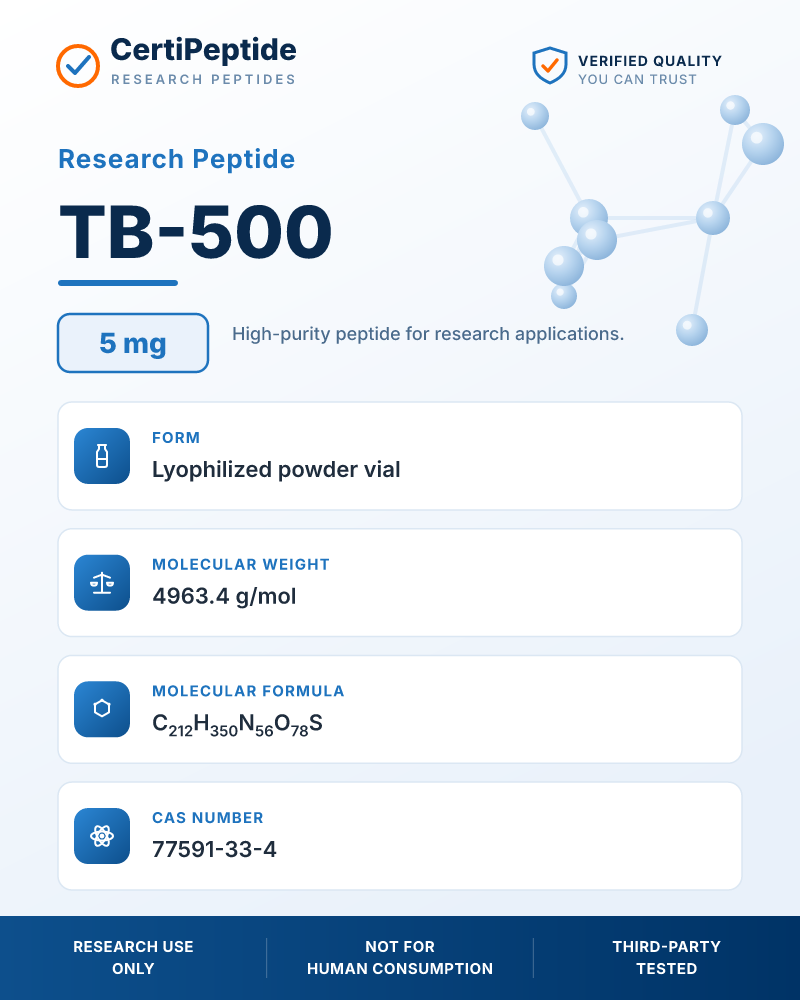
TB-500
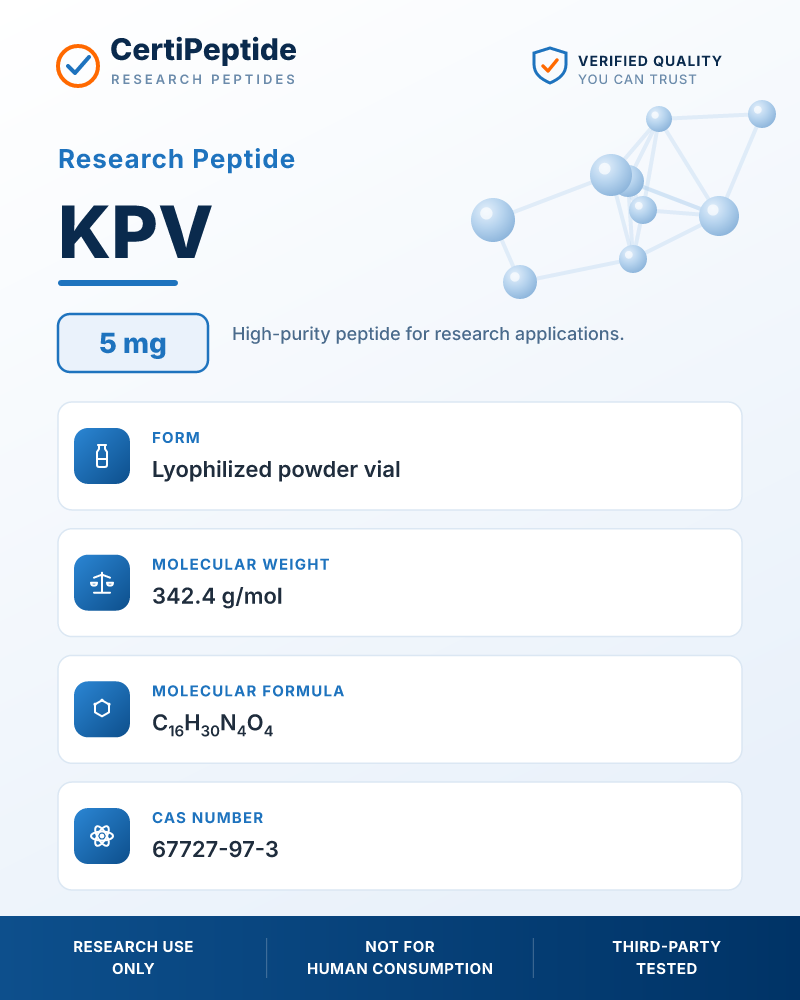
KPV
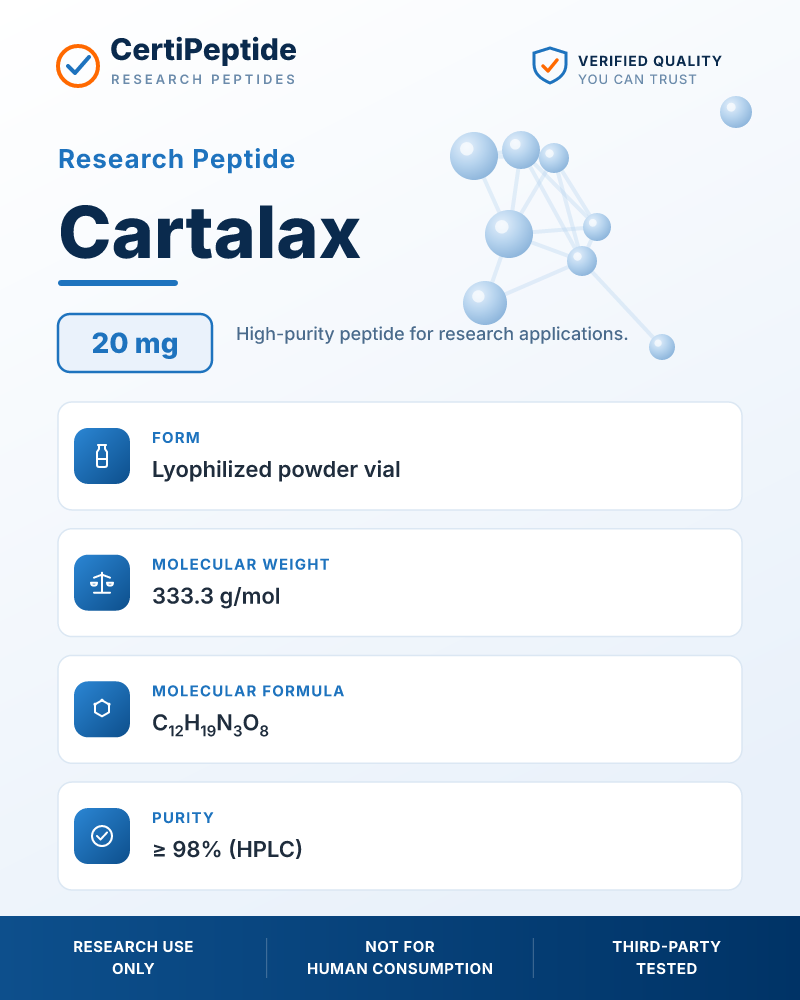
Cartalax