TL;DR
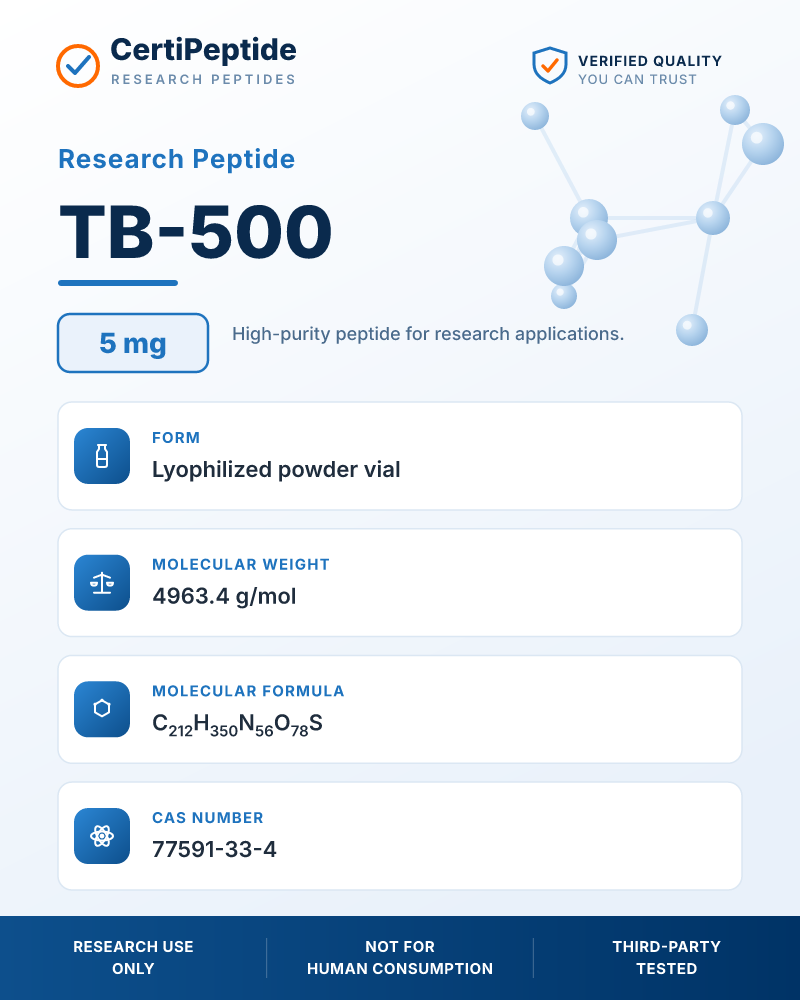
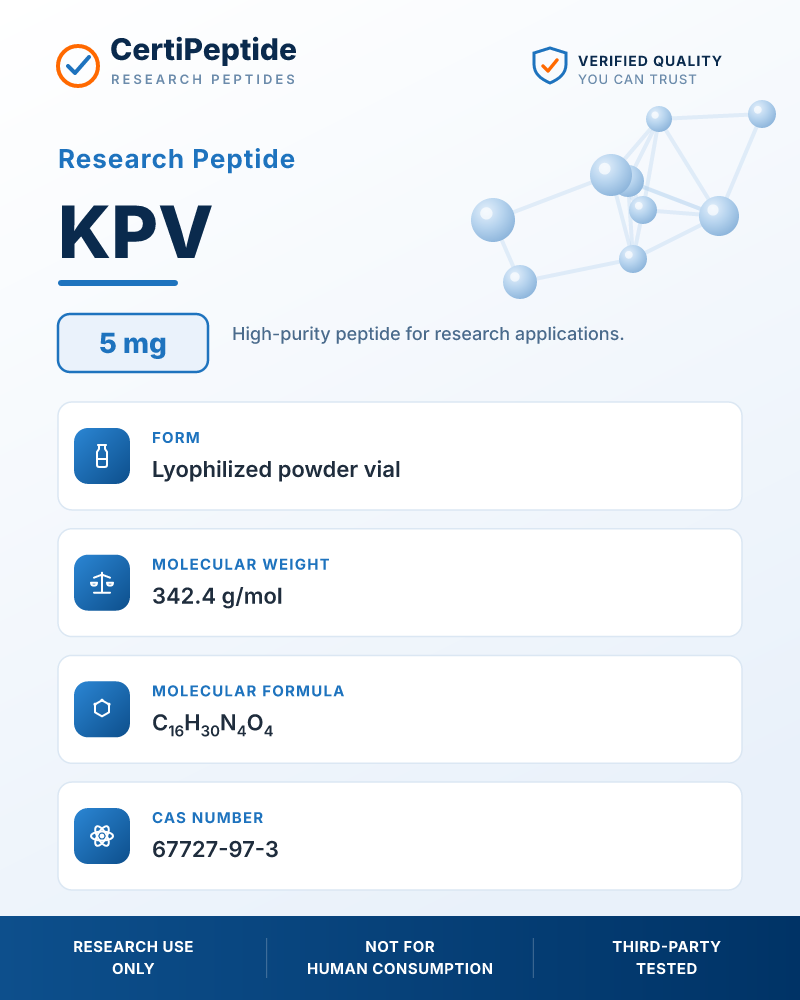
**TB-500 vs KPV** is a frequent comparison in peptide research design. TB-500 (a synthetic fragment related to thymosin β4) is typically studied for actin-binding, cell migration, and tissue-remodeling endpoints. KPV (Lys-Pro-Val), a C-terminal tripeptide fragment of α-MSH, is more often examined for anti-inflammatory signaling and epithelial barrier models. They differ in size, primary pathways, and common assay readouts, though both appear in in vitro and preclinical laboratory literature on inflammation and repair-related biology. This article outlines structural features, mechanisms under study, experimental use cases, and practical selection criteria for research teams evaluating **TB-500 or KPV**.
Why Researchers Compare TB-500 and KPV
Laboratory groups often search for a **TB-500 KPV comparison** when planning multi-arm studies on inflammation, wound-healing models, or cytoskeletal dynamics. The peptides are not interchangeable tool compounds. TB-500 is associated with thymosin β4–related pathways and G-actin sequestration biology, while KPV is linked to melanocortin-related anti-inflammatory peptide research without the full hormonal profile of α-MSH.
Choosing **TB-500 or KPV** usually depends on the primary endpoint: cytoskeletal organization and migration assays versus cytokine modulation and barrier-integrity readouts. Understanding those distinctions reduces protocol noise and improves interpretability of controls and combination arms.
Structural and Biochemical Differences
TB-500 in research context
TB-500 is a synthetic peptide sequence derived from the active region of thymosin beta-4 (Tβ4). In published laboratory work, Tβ4 and related fragments are discussed in connection with:
- Actin binding and sequestration of monomeric G-actin
- Regulation of cytoskeletal dynamics
- Cell motility and migration assays
- Angiogenesis-related and tissue-remodeling models (preclinical)
Research-grade **TB-500** is typically handled as a lyophilized peptide for reconstitution under controlled laboratory conditions, with identity and purity verified by HPLC/MS as specified by the supplier’s certificate of analysis.
KPV in research context
**KPV** is the tripeptide lysine–proline–valine, corresponding to the C-terminal residues of α-melanocyte-stimulating hormone (α-MSH). In the research literature it is examined primarily as a compact anti-inflammatory peptide candidate in cell and animal models, including:
- Modulation of NF-κB–linked inflammatory signaling in vitro
- Epithelial and mucosal inflammation models
- Studies of cytokine release (for example IL-1β, TNF-α, IL-6) in stimulated cell systems
- Barrier function and permeability assays in epithelial monolayers
Because KPV is only three amino acids, its physicochemical handling, stability profile, and formulation constraints differ markedly from longer peptides such as TB-500.
Side-by-side structural snapshot
| Feature | TB-500 (research) | KPV (research) |
| --- | --- | --- |
| Origin context | Thymosin β4–related fragment | α-MSH C-terminal tripeptide |
| Approximate size | Longer synthetic peptide | 3 amino acids |
| Dominant study themes | Actin, migration, remodeling | Inflammation, epithelial models |
| Typical complexity | Higher (sequence length, folding/handling) | Lower (small peptide) |
| Common assay families | Scratch/wound, motility, cytoskeletal imaging | Cytokine panels, NF-κB reporters, TEER/barrier |
Mechanisms Under Investigation
TB-500: actin-centric and repair-adjacent pathways
In laboratory models, TB-500 / Tβ4-related peptides are frequently discussed for their interaction with actin. By influencing the G-actin pool and downstream cytoskeletal organization, researchers use these compounds to probe:
- Directional cell migration
- Lamellipodia and stress-fiber organization
- Matrix interaction and wound-closure kinetics in 2D cultures
- Soft-tissue injury models in controlled preclinical settings
Secondary literature also explores links to angiogenesis-related markers and progenitor-cell behavior. Those endpoints remain model-dependent; investigators should anchor claims to their specific assay system rather than extrapolating across tissues or species.
KPV: anti-inflammatory and barrier-focused signaling
KPV research centers on inflammation resolution–type biology rather than actin polymerization. Reported laboratory themes include:
- Attenuation of pro-inflammatory mediator release after LPS or cytokine challenge
- Effects on intracellular signaling nodes tied to innate immune activation
- Support of epithelial integrity metrics in gut or skin-relevant cell models
- Comparison against parent α-MSH or other melanocortin-derived fragments
KPV is often selected when the hypothesis is immunomodulatory rather than cytoskeletal. That makes it a poor substitute for TB-500 in migration-first designs, and vice versa.
TB-500 vs KPV: Experimental Use Cases
When TB-500 is the more logical research tool
Consider **TB-500** when the protocol prioritizes:
1. **Cell migration / scratch assays** — quantifying closure rates, velocity, or persistence.
2. **Cytoskeletal imaging** — phalloidin staining, live actin probes, or morphometric analysis.
3. **Tissue-remodeling endpoints** — collagen organization, scar-related histology in preclinical injury models.
4. **Combination designs** with growth-factor or ECM cues where motility is the dependent variable.
When KPV is the more logical research tool
Consider **KPV** when the protocol prioritizes:
1. **Inflammatory challenge models** — LPS, TNF-α, or similar stimuli in macrophages, epithelia, or co-cultures.
2. **Cytokine and chemokine panels** — multiplex or ELISA readouts as primary outcomes.
3. **Epithelial barrier studies** — TEER, FITC-dextran flux, tight-junction protein expression.
4. **Head-to-head fragment comparisons** within the melanocortin peptide family.
Overlap zones in multi-endpoint studies
Some injury and inflammation models involve both immune activation and subsequent structural repair. In those cases, researchers may run parallel arms—**TB-500** for remodeling/migration metrics and **KPV** for acute inflammatory tone—rather than treating them as redundant. A rigorous **TB-500 KPV comparison** inside one study should pre-specify distinct primary endpoints for each arm to avoid underpowered mixed outcomes.
Similarities Relevant to Lab Planning
Despite different core biology, TB-500 and KPV share practical research attributes:
- Both are synthetic research peptides supplied for laboratory use only.
- Both require verified identity/purity documentation and appropriate cold-chain or storage conditions per COA.
- Both appear in literature tied broadly to host-response and tissue-environment biology (inflammation and repair are often sequential in the same models).
- Both benefit from vehicle-matched controls, blinded outcome assessment where feasible, and dose–response characterization *in the experimental system* (cell type, medium, exposure time).
- Neither should be framed as a clinical therapeutic in research communications; results remain context-bound to the model used.
Study Design Considerations for TB-500 or KPV
Model selection
Match the peptide to the biology you can actually measure. Fibroblast or endothelial migration chambers align more naturally with TB-500 hypotheses. Macrophage or intestinal epithelial inflammation panels align more naturally with KPV.
Controls and comparators
Useful controls include:
- Vehicle-only and scrambled or inactive peptide controls when available
- Positive controls appropriate to the pathway (e.g., known actin modulators or anti-inflammatory reference compounds)
- Parent peptides or related fragments (Tβ4 full-length context; α-MSH or other MSH fragments for KPV)
Readout timing
Actin and migration effects may be assessed on shorter motility timescales (hours) plus longer remodeling windows. Inflammatory cytokine changes with KPV are often captured after defined stimulation intervals; barrier metrics may need multi-day monolayer maturation before challenge.
Analytical quality
For either peptide, document lot number, purity, reconstitution solvent, storage aliquots, and freeze–thaw limits. Small peptides like KPV can present different adsorption and stability behaviors than longer sequences; validate concentrations when assays are highly sensitive.
Practical Selection Framework
Use this simplified decision path when choosing **TB-500 vs KPV**:
1. **Primary question is cytoskeletal or migratory?** → lean TB-500.
2. **Primary question is cytokine tone or epithelial inflammation?** → lean KPV.
3. **Need both domains?** → factorial or parallel-arm design with separate endpoints; do not assume additive biology without pilot data.
4. **Resource-limited single-arm pilot?** → pick the peptide that maps to your lab’s strongest assay capability to maximize signal quality.
Summary
A careful **TB-500 vs KPV** review shows complementary—not redundant—research roles. **TB-500** is positioned in laboratory work around thymosin β4–related actin biology, cell movement, and remodeling endpoints. **KPV** is positioned around compact melanocortin-fragment anti-inflammatory and barrier-focused models. Similarities are mainly operational (synthetic peptide handling, need for rigorous controls) and thematic at the broad level of tissue stress biology. For investigators deciding on **TB-500 or KPV**, endpoint alignment beats brand-level analogy: define the pathway, pick the tool that interrogates it, and report model limits clearly.
FAQ
Explore Further
Browse our [research peptide catalog](/shop) and review third-party [lab reports & COAs](/lab-reports) for every batch.
---
**Research use only.** The information above is provided for educational and laboratory research purposes only. The compounds discussed are not approved for human or veterinary use, diagnosis, treatment, or the prevention of any disease. Nothing here is medical advice.