TL;DR
**Acetic Acid (Diluent) vs Sterile Water** is a practical choice for laboratories preparing research peptides and other compounds for in vitro or analytical work. Sterile water is a neutral, low-interference vehicle. Acetic acid diluent supplies controlled acidity that can improve solubility and handling of acid-soluble materials. Neither is interchangeable for every protocol: match solvent pH, ionic character, and stability needs to the analyte, assay, and storage plan. Below is a research-focused comparison of composition, use cases, similarities, and decision criteria.
Why solvent choice matters in research
In laboratory workflows, the reconstitution or dilution vehicle affects dissolution rate, solution clarity, short-term chemical stability, and compatibility with downstream methods (HPLC, cell-based assays, binding studies, and spectroscopy). Poor solvent selection can cause incomplete dissolution, aggregation, pH drift, or assay interference. Comparing **Acetic Acid (Diluent) or Sterile Water** helps teams standardize SOPs, reduce failed preparations, and document conditions for reproducibility.
Both **Acetic Acid (Diluent)** and **Sterile Water** are common research solvents. The right pick depends on the compound’s acid–base properties, required concentration range, and whether the protocol tolerates residual acetate and lower pH.
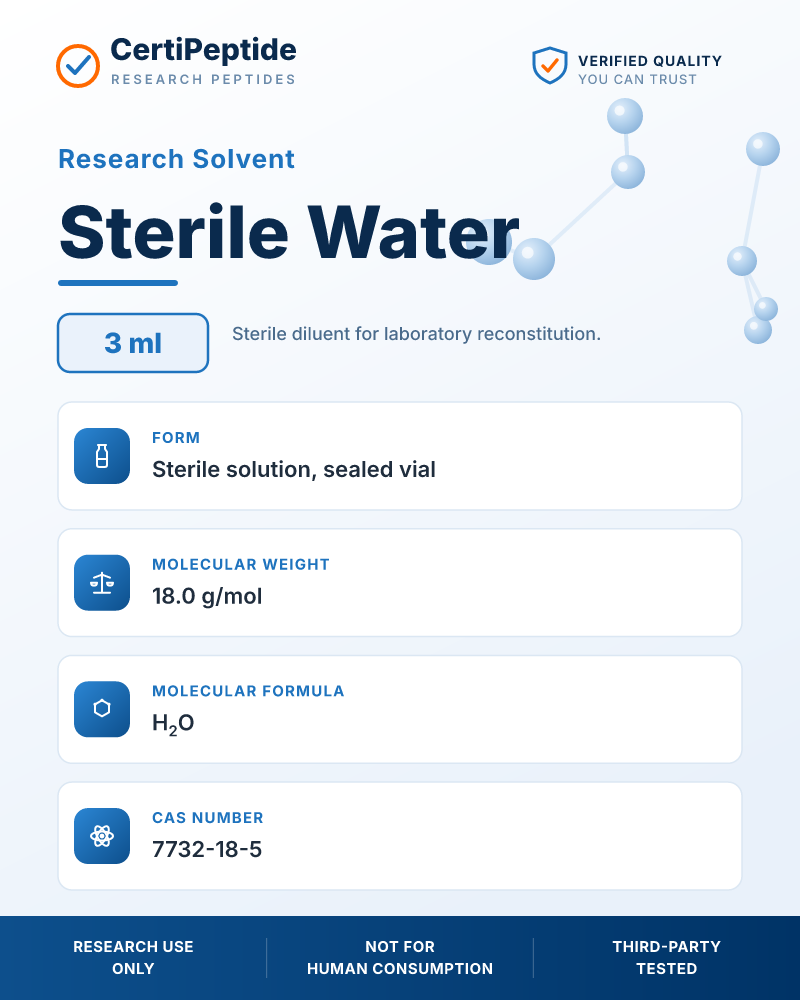
What is Sterile Water in a lab context?
Sterile water (often sterile water for injection-grade or equivalent laboratory sterile water, depending on supplier specs) is water processed to minimize viable microorganisms and particulates. For research use it typically serves as:
- A near-neutral aqueous vehicle with minimal added solutes
- A baseline diluent when the analyte dissolves readily in water
- A rinse or make-up solvent in analytical sample prep
Key research attributes:
- **pH**: Near neutral (commonly ~5.0–7.0 depending on CO₂ absorption and packaging; verify certificate of analysis)
- **Ionic load**: Very low if no additives are present
- **Interference profile**: Generally low for many assays, though pure water can still affect osmolality and protein behavior at low ionic strength
- **Use pattern**: Preferred when acidity is unnecessary or undesirable
Researchers often choose sterile water when working with compounds that are already water-soluble at the intended research concentration, or when the assay is sensitive to acetate or acidic pH.
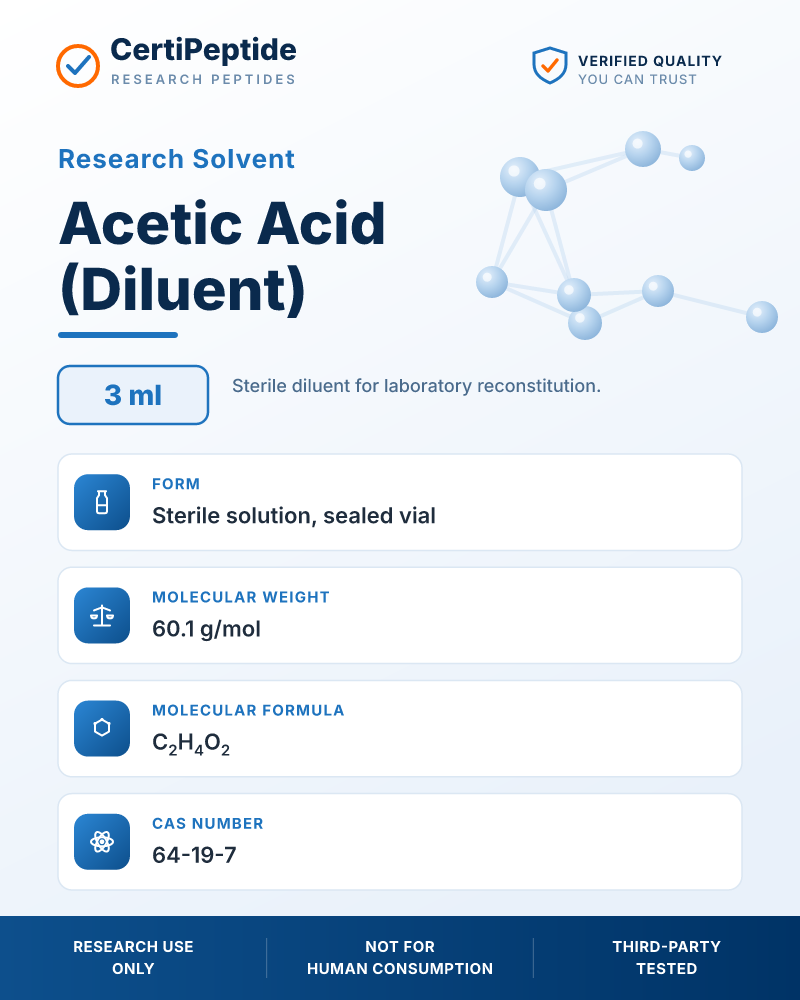
What is Acetic Acid (Diluent)?
**Acetic Acid (Diluent)** in research-peptide and compound supply contexts is typically a dilute aqueous acetic acid solution intended as a laboratory reconstitution or dilution vehicle. Glacial acetic acid itself is concentrated; research diluents are formulated at much lower acid strength suitable for dissolving selected materials under controlled conditions. Always follow the product’s stated concentration and lab SOPs.
Research attributes of acetic acid–based diluents:
- **pH**: Acidic relative to sterile water, which can protonate basic sites and alter net charge
- **Solubility aid**: Can improve dissolution of compounds that are poorly soluble or prone to aggregation in neutral water
- **Buffering contribution**: Acetate/acetic acid can provide limited pH buffering near the acetic acid pKa (~4.76)
- **Chemical identity**: Introduces acetate species that may matter for mass spectrometry, ion-exchange steps, or pH-sensitive readouts
Acetic acid diluent is frequently selected in studies where literature or internal method development shows better clarity, reduced cloudiness, or more consistent stock solutions under acidic aqueous conditions.
Acetic Acid (Diluent) Sterile Water comparison: core differences
| Factor | Sterile Water | Acetic Acid (Diluent) |
| --- | --- | --- |
| Typical pH environment | Near neutral | Acidic |
| Added solute | Essentially none (water) | Acetic acid / acetate |
| Best suited when | Analyte dissolves in water; acid is unwanted | Acid improves solubility or handling |
| Assay interference risk | Low solute interference; low ionic strength effects possible | Acetate and pH may affect some assays |
| Stability considerations | Depends on compound; neutral pH may favor some pathways | Acid may slow certain degradation routes or promote others |
| Documentation | Simple vehicle identity | Must record acid strength and lot |
Solubility and physical appearance
Many research peptides and small molecules show pH-dependent solubility. In neutral sterile water, hydrophobic patches or self-association can yield haze, gels, or incomplete dissolution. Mildly acidic acetic acid diluent can increase net positive charge on basic residues, improving aqueous wettability and clarity for some sequences. That outcome is compound-specific: confirm with small-scale solubility checks, visual inspection, and, where needed, concentration verification.
Chemical stability in solution
Solution stability is multifactorial (temperature, light, concentration, headspace oxygen, and pH). Acidic conditions can:
- Reduce deamidation rates for some asparagine-containing sequences under certain conditions
- Influence oxidation kinetics differently than neutral water
- Affect ester or other acid-labile motifs if present
Conversely, some analytes are more stable near neutral pH. is researched in the context of stability as an experimental variable: use matched time-point analytics rather than assuming one solvent is universally “more stable.”
Analytical and bioassay compatibility
- **Chromatography / MS**: Acetate is usually manageable but should be noted in method files; ion suppression or adduct patterns can differ from pure water matrices.
- **Cell culture or receptor assays (research use)**: Final pH, osmolality, and residual acid after dilution into media matter. Vehicle controls with the same diluent are essential.
- **Spectroscopy**: Far-UV measurements and some dye-binding assays can be pH-sensitive; blank with the identical solvent.
Handling, sterility, and contamination control
Both products are handled with aseptic technique in research settings when sterility of the working solution matters. Differences to plan for:
- Open-vial time, aliquot strategy, and single-use vs multi-use containers
- Compatibility of acid with certain plastics or metal fittings over long contact times
- Labeling that clearly distinguishes acidic diluent from water to prevent protocol mix-ups
Similarities between the two vehicles
Despite pH and composition differences, **Acetic Acid (Diluent) vs Sterile Water** share several practical similarities in the lab:
1. **Aqueous base** — Both are water-based systems for hydrophilic or amphipathic research materials.
2. **Reconstitution role** — Both are used to prepare stocks or working solutions prior to further dilution into buffers or media as the protocol requires.
3. **Need for documentation** — Lot numbers, open dates, storage temperature, and exact composition belong in the lab notebook either way.
4. **Not a substitute for method validation** — Neither solvent guarantees activity, purity retention, or assay performance without analytical confirmation.
5. **Research-use framing** — Both are laboratory materials; selection is driven by experimental design, not clinical application.
Decision guide: Acetic Acid (Diluent) or Sterile Water?
Use the following research-oriented criteria when choosing:
**Lean toward Sterile Water when:**
- Prior data show adequate solubility and clear solutions in water
- Downstream methods are sensitive to acetate or low pH
- You need minimal added chemical identity in the vehicle
- The protocol specifies neutral aqueous reconstitution
**Lean toward Acetic Acid (Diluent) when:**
- Neutral water yields incomplete dissolution, cloudiness, or aggregation for the specific lot/compound
- Literature or internal DOE supports acidic aqueous stocks
- Short-term handling benefits from the acidic microenvironment before transfer into buffered systems
- You can control and record final pH after dilution into the experimental matrix
**Hybrid laboratory practice (common):**
Some workflows dissolve a material in a small volume of acetic acid diluent for initial solubilization, then bring to volume with sterile water or a defined buffer so that the final acid concentration is low and controlled. Any such step must be written into the SOP, including order of addition and mixing method, because local pH extremes during preparation can matter.
Practical lab workflow tips (research only)
- **Verify identity of the bottle** before use; mis-picking water vs acid diluent is a frequent SOP failure mode.
- **Record concentration of acetic acid** if the diluent strength is specified on the label or CoA.
- **Use calibrated pipettes and low-retention tips** for small volumes; viscosity differences are minor but technique still affects accuracy.
- **Inspect solutions** against light for particulates; filter only if the method allows and you have assessed analyte binding to membranes.
- **Aliquot stocks** to limit freeze–thaw or repeated vial entry when your stability data support frozen storage.
- **Match vehicle controls** in every assay plate or analytical batch.
- **Do not assume interchangeability** across different research compounds—even similar peptide lengths can diverge in solubility behavior.
Storage and quality considerations
Store both **Acetic Acid (Diluent)** and **Sterile Water** per supplier guidance (typically controlled room temperature or as labeled; protect from contamination). For opened containers, lab policy should define in-use hold times. Quality documentation to keep on file includes sterility claims where applicable, endotoxin specifications if relevant to the assay, appearance, and any stated acid normality or percentage for the diluent.
If a protocol is transferred between labs, specify the exact solvent grade. “Water” and “acetic acid diluent” are not sufficiently precise without concentration, sterility grade, and supplier part numbers.
Summary comparison for study design
Choosing in the **Acetic Acid (Diluent) Sterile Water comparison** is less about which product is “better” in absolute terms and more about alignment with physicochemical needs:
- **Sterile Water** — minimal vehicle, near-neutral starting point, broad default for water-soluble research materials.
- **Acetic Acid (Diluent)** — acidic aqueous option when solubility or handling improves under acid conditions, with mandatory attention to residual acetate and pH in the final experimental system.
Build solubility screens, short-term stability checks, and vehicle-matched controls into method development. Document every parameter so results remain interpretable and reproducible across operators and sites.
FAQ-oriented notes embedded in practice
When training new staff, emphasize that solvent choice is part of the controlled method, not an informal preference. Pair each research compound’s preparation sheet with a justified default vehicle, acceptable alternatives, and analytical acceptance criteria (clarity, measured concentration, purity profile over time). That discipline prevents silent protocol drift when bottles of **Acetic Acid (Diluent)** and **Sterile Water** sit side by side on the same bench.
Explore Further
Browse our [research peptide catalog](/shop) and review third-party [lab reports & COAs](/lab-reports) for every batch.
---
**Research use only.** The information above is provided for educational and laboratory research purposes only. The compounds discussed are not approved for human or veterinary use, diagnosis, treatment, or the prevention of any disease. Nothing here is medical advice.