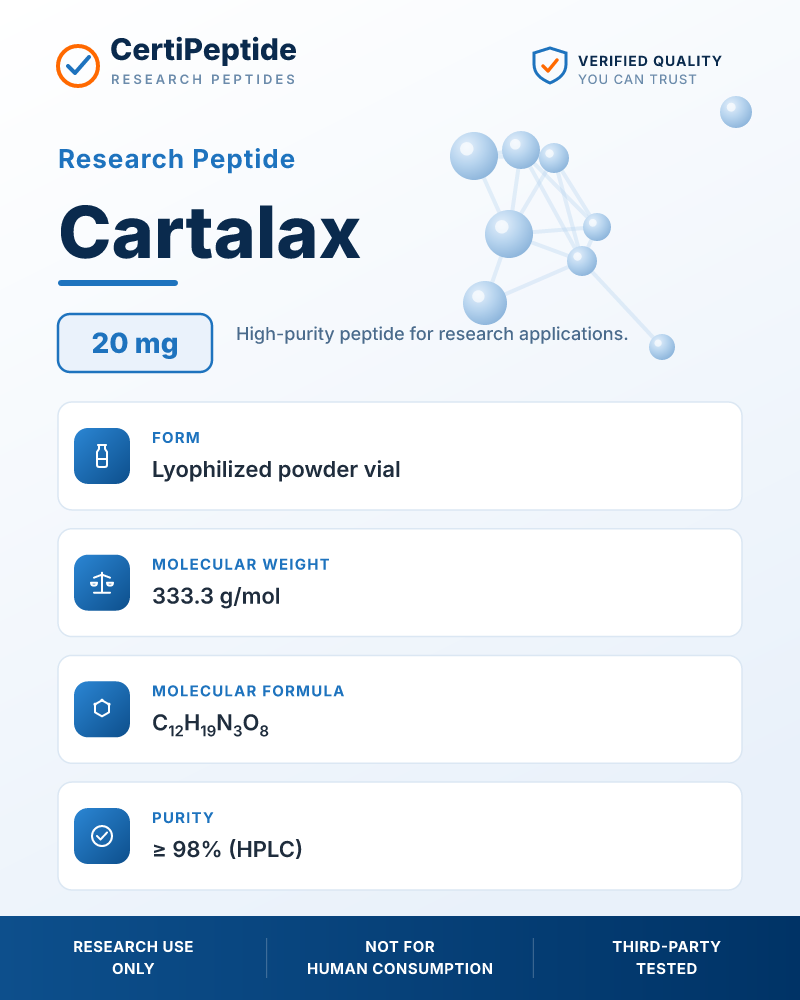
Cartalax
Research Peptide | Lyophilized Powder | Batch Tested
For laboratory research use only. Not for human or animal consumption. Insulated shipping · Styrofoam box available.
Product Overview
Cartalax is a short synthetic peptide bioregulator (Alanine-Glutamate-Aspartate) belonging to the Khavinson family of tripeptides, which are studied for tissue-specific regulatory effects. It is associated with cartilage and connective tissue.
| Test | Result | Status |
|---|---|---|
| Purity | 99.0% | Passed ✓ |
Research Information
Cartalax is studied for peptide-bioregulator effects on gene expression and cellular activity in connective-tissue and cartilage models, part of the broader research program into how ultra-short peptides may bind DNA regions and modulate tissue-specific protein synthesis. Supplied strictly for in-vitro and laboratory research use only — not for human or animal consumption.
Cartalax Research & Studies
What is Cartalax?
Cartalax is a short synthetic tripeptide bioregulator with the amino acid sequence Alanine-Glutamate-Aspartate. It belongs to the Khavinson family of ultra-short peptides investigated for tissue-specific regulatory activity. Research associates Cartalax primarily with cartilage and connective-tissue models. The compound is supplied strictly for in-vitro and laboratory research use only.
Mechanism of Action
Studies of Khavinson-class tripeptides examine how Cartalax may interact with DNA regions and influence gene expression patterns. Research explores its potential to modulate tissue-specific protein synthesis within connective-tissue and cartilage cellular systems. Proposed pathways center on nuclear localization and selective binding that could alter transcriptional activity. These mechanisms are investigated exclusively in controlled laboratory model systems.
Primary Areas of Research
Cartalax is studied for peptide-bioregulator effects on gene expression and cellular activity in connective-tissue and cartilage models. Investigators examine its influence on extracellular-matrix-related processes and chondrocyte-like cell behavior under experimental conditions. Work also addresses how ultra-short peptides may support tissue-specific regulatory networks in vitro. All investigations remain confined to non-clinical laboratory settings.
Key Research Findings
Published research on the broader Khavinson peptide series indicates that certain tripeptides can enter cells and nuclei and alter expression of genes linked to tissue maintenance. Cartalax-specific inquiries focus on cartilage-associated gene programs and protein-synthesis modulation in cultured connective-tissue models. Findings remain exploratory and are generated under controlled in-vitro conditions. No clinical or therapeutic conclusions are drawn from this laboratory work.
Research Handling & Considerations
Cartalax is intended solely for qualified laboratory research and must be handled according to standard peptide storage and reconstitution protocols. Investigators typically store lyophilized material under cool, dry, light-protected conditions and reconstitute with appropriate research-grade solvents. All experimental designs should employ validated in-vitro or cellular model systems. The material is not for human or animal consumption or any form of administration outside research protocols.
Frequently Asked Questions
Cartalax is the synthetic tripeptide Alanine-Glutamate-Aspartate, a member of the Khavinson family of short peptide bioregulators studied in laboratory settings.
Explore Other High-Purity Peptides
BPC-157
TB-500
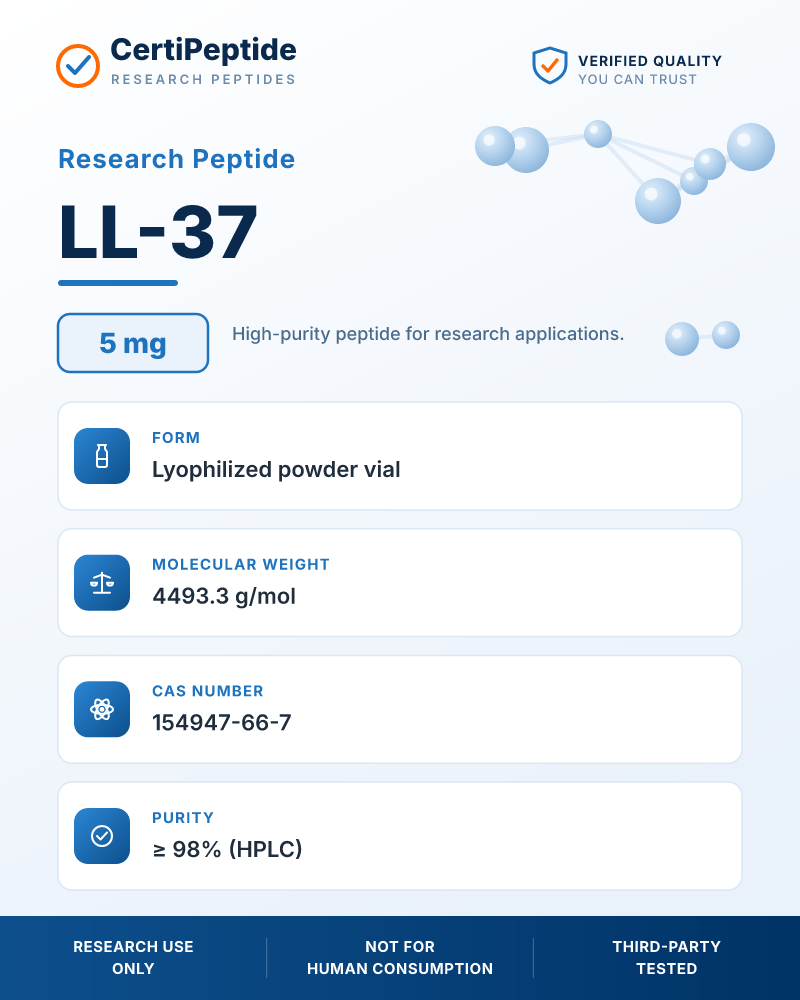
LL-37