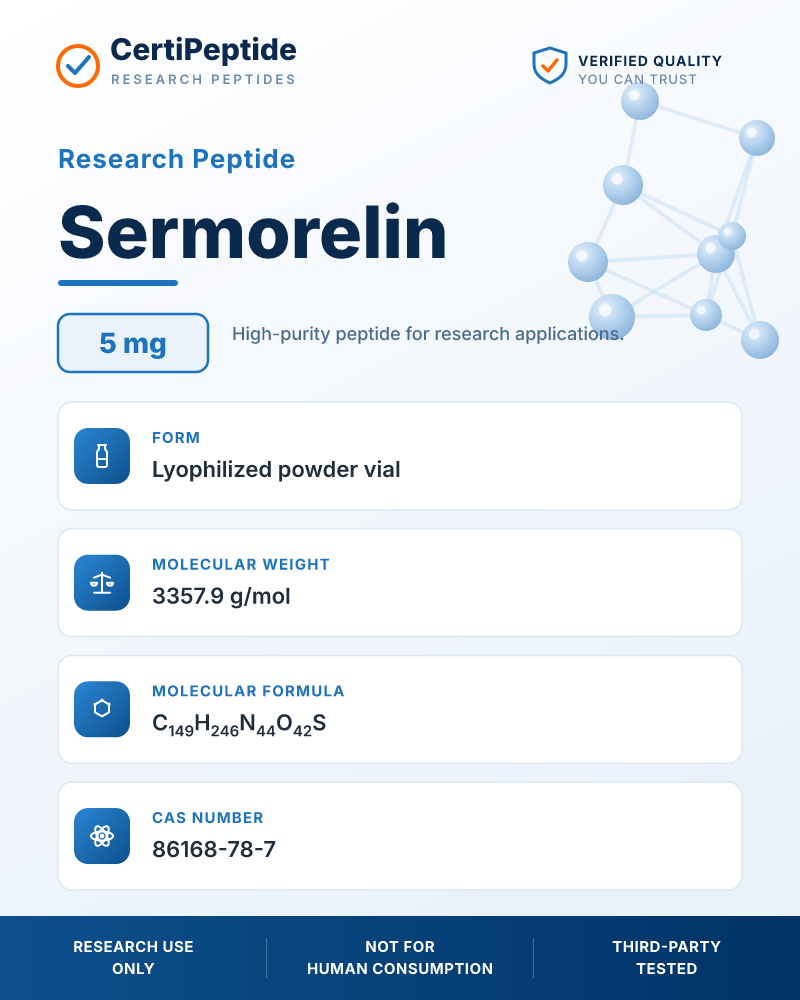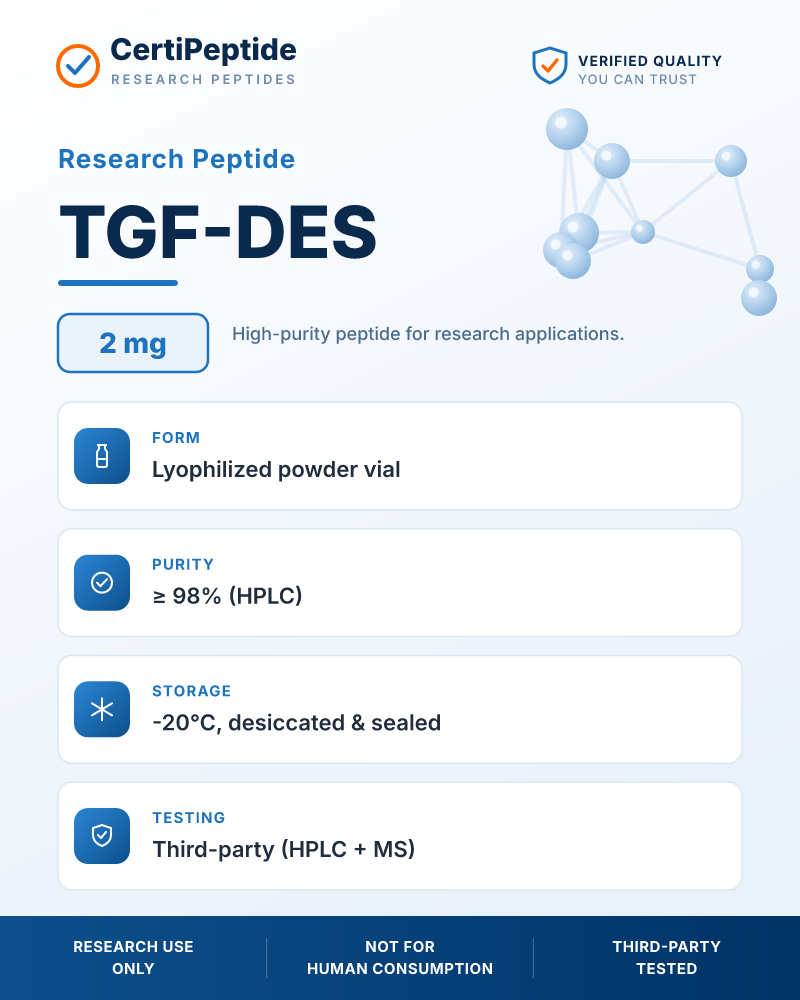
TGF-DES vs Sermorelin: Key Research Insights
TGF-DES vs Sermorelin represents a focused comparison in peptide research. In laboratory settings, researchers examine these compounds for their distinct mechanisms and potential applications in cellular and animal models. This article reviews the available research data on TGF-DES and Sermorelin without any implications for laboratory research.
TL;DR: TGF-DES and Sermorelin differ in structure and primary research pathways. TGF-DES shows activity related to growth factor signaling in vitro, while Sermorelin is studied for its effects on growth hormone release in research models. Both appear in comparative studies exploring peptide interactions.
Overview of TGF-DES in Research
TGF-DES is a modified peptide investigated in laboratory environments for its role in signaling pathways. Studies often focus on its interactions with cellular receptors and downstream effects in controlled assays. Research models have explored its stability and binding properties compared to related growth factors.
Overview of Sermorelin in Research
Sermorelin, a growth hormone-releasing hormone analog, is commonly used in research to investigate pituitary cell responses. Laboratory experiments typically measure its influence on hormone secretion in isolated tissues or animal models. Researchers note its shorter half-life in certain study designs.
Similarities Between TGF-DES and Sermorelin
Both TGF-DES and Sermorelin are synthetic peptides evaluated in research contexts for their effects on growth-related pathways. Studies may compare their solubility, receptor affinity, and performance in cell culture systems. In some experimental setups, investigators assess how each compound modulates specific biomarkers under identical conditions.
Differences in TGF-DES vs Sermorelin
Key distinctions emerge in their molecular targets. TGF-DES research centers on transforming growth factor pathways, whereas Sermorelin studies emphasize growth hormone axis stimulation. Comparative analyses reveal variations in potency, duration of action in vitro, and metabolic profiles across different research species.
Use in Laboratory Studies
In research protocols, TGF-DES vs Sermorelin often appears when designing experiments on tissue regeneration or endocrine function. Scientists select one or both based on the specific endpoint, such as gene expression analysis or protein phosphorylation assays. Published work highlights their utility in exploring synergistic or antagonistic effects when combined with other research compounds.
Practical Considerations for Researchers
When planning studies involving TGF-DES or Sermorelin, factors like storage conditions, reconstitution methods, and assay compatibility receive attention. Literature reviews suggest standardizing experimental variables to enable direct comparisons between the two peptides. This approach supports reproducible findings in academic and industrial labs.
Future Directions in Peptide Research
Ongoing investigations continue to refine understanding of TGF-DES vs Sermorelin through advanced techniques such as mass spectrometry and high-throughput screening. Researchers aim to map additional interaction networks that could inform new experimental designs. These efforts remain strictly within the bounds of non-clinical research applications.
Frequently Asked Questions
What are the main research differences between TGF-DES and Sermorelin?
TGF-DES is primarily studied for growth factor signaling in cell assays, while Sermorelin research focuses on growth hormone release mechanisms in models.
Can TGF-DES and Sermorelin be used together in studies?
Some laboratory protocols examine combined effects of TGF-DES and Sermorelin on shared pathways, though results vary by experimental design.
How do researchers choose between TGF-DES or Sermorelin?
Selection depends on the target pathway, with TGF-DES suited for TGF-related assays and Sermorelin for endocrine response investigations.
What similarities exist in TGF-DES Sermorelin comparison studies?
Both peptides are evaluated for receptor binding and stability in controlled research environments, allowing parallel testing in some protocols.
Explore Further
Browse our [research peptide catalog](/shop) and review third-party [lab reports & COAs](/lab-reports) for every batch.
---
**Research use only.** The information above is provided for educational and laboratory research purposes only. The compounds discussed are not approved for human or veterinary use, diagnosis, treatment, or the prevention of any disease. Nothing here is medical advice.