TL;DR
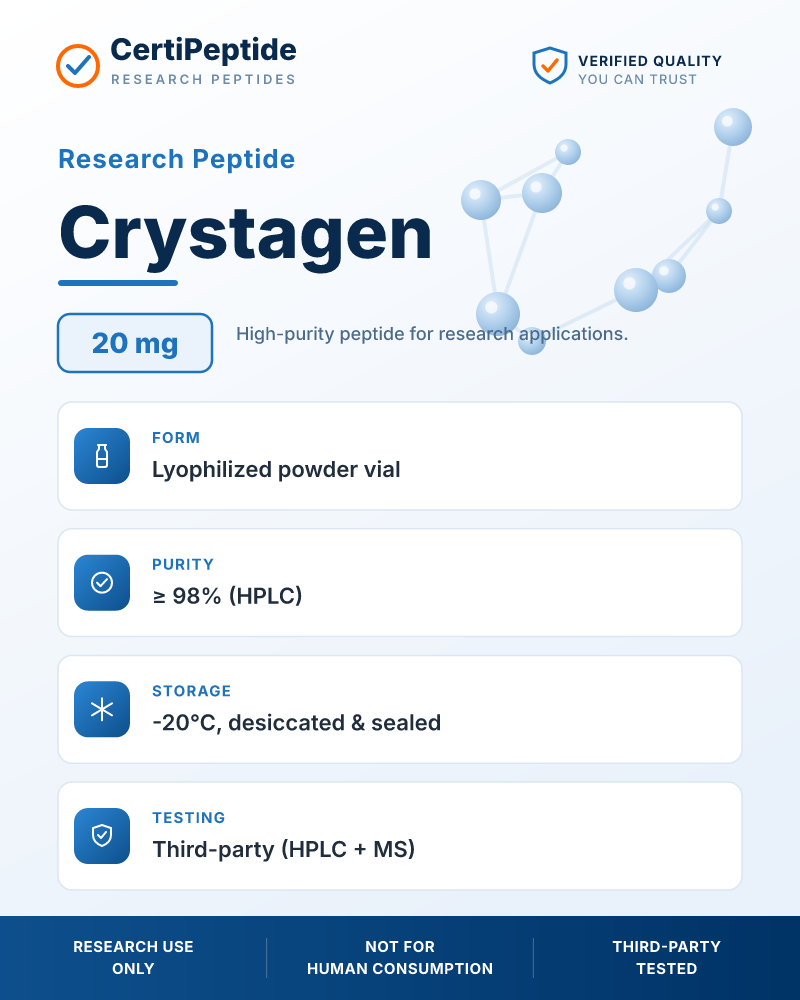
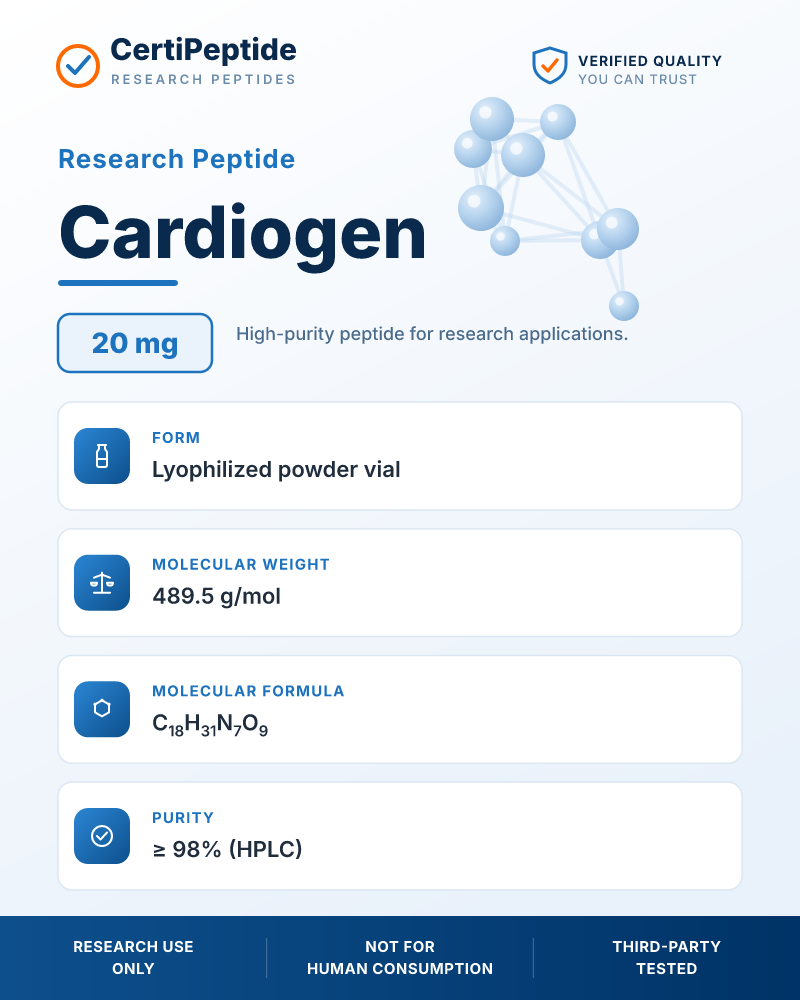
**Cardiogen vs Crystagen** is a frequent comparison for labs working with short bioregulatory peptides. Both are synthetic peptide complexes studied as tissue-oriented bioregulators, yet they are investigated in different experimental systems. Cardiogen is typically examined in cardiovascular and cardiomyocyte models; Crystagen is more often used in immune and lymphoid-tissue research. This article outlines structural context, shared research traits, documented differences, and practical study-design considerations so investigators can decide whether Cardiogen or Crystagen fits a given protocol.
Cardiogen vs Crystagen: Why Researchers Compare Them
Laboratories evaluating peptide bioregulators often place **Cardiogen** and **Crystagen** side by side because both belong to the broader class of short synthetic peptides explored for organ- or system-specific gene-expression and cell-culture effects. A **Cardiogen Crystagen comparison** helps teams align compound choice with endpoint assays, tissue models, and analytical readouts rather than with informal reputation.
In controlled in vitro and preclinical research settings, selection usually hinges on:
- Target tissue or cell type in the model
- Desired molecular or phenotypic endpoints
- Compatibility with existing peptide panels
- Purity, solubility, and handling requirements
Neither compound is interchangeable by default. Understanding the research differences and similarities reduces protocol noise and improves interpretability of results.
What Is Cardiogen in Laboratory Research?
Cardiogen is a short synthetic peptide bioregulator studied primarily in cardiovascular research contexts. Published and catalog research use often centers on cardiomyocytes, cardiac tissue explants, and models that track markers of myocardial stress, protein synthesis, or cellular resilience under experimental challenge.
Typical laboratory themes associated with Cardiogen include:
- Gene-expression profiling in cardiac-derived cell lines
- Assays of structural or contractile protein markers
- Exploratory work on peptide influence on cultured heart tissue viability or recovery metrics after induced stress
- Comparative panels alongside other cardiovascular-oriented bioregulators
Material supplied for research is generally characterized by sequence identity, HPLC purity, and mass confirmation. Investigators is researched in the context of Cardiogen as a defined research reagent for mechanistic and screening studies, not as a finished therapeutic product.
What Is Crystagen in Laboratory Research?
Crystagen is a short synthetic peptide bioregulator more commonly positioned in immune-system and lymphoid-tissue research. Experimental work frequently involves thymic or immune-cell models, cytokine or differentiation marker panels, and studies of peptide effects on immune-competent cell populations under controlled conditions.
Recurring research angles for Crystagen include:
- Immune cell culture and phenotype assays
- Exploration of peptide effects on markers linked to lymphoid tissue activity
- Combination studies with other immune-oriented short peptides
- Gene-expression or proteomic snapshots in relevant cell types
As with Cardiogen, research-grade Crystagen is evaluated by analytical identity and purity. Study designs emphasize reproducibility, vehicle controls, and clear separation between in vitro observations and any clinical inference.
Similarities in a Cardiogen Crystagen Comparison
Despite different primary tissue associations, Cardiogen and Crystagen share several traits that explain why they appear together in bioregulator catalogs and method papers:
Shared chemical and handling profile
Both are short peptides, typically handled as lyophilized solids that are reconstituted in suitable aqueous or buffered vehicles for cell culture or biochemical assays. Storage recommendations in research SOPs usually emphasize cold, dry conditions and protection from repeated freeze–thaw cycles.
Bioregulator research framing
Each compound is investigated within the scientific tradition of tissue-specific peptide bioregulators—short sequences hypothesized to interact with cellular regulatory pathways in a relatively selective manner. Labs often run parallel assays (qPCR, Western blot, viability, or high-content imaging) to map pathway-level responses.
Use in comparative peptide panels
Many groups include both Cardiogen and Crystagen when screening a panel of organ-oriented peptides. This design supports internal benchmarking: same culture conditions, same analytical pipeline, different peptide identity.
Research-only positioning
Both materials are supplied and discussed for laboratory investigation. Experimental literature and vendor documentation frame them as tools for basic and applied research rather than as approved medical products.
Key Research Differences: Cardiogen or Crystagen?
Choosing **Cardiogen or Crystagen** depends on the biological question.
Primary experimental systems
| Dimension | Cardiogen (typical research focus) | Crystagen (typical research focus) |
| --- | --- | --- |
| Dominant tissue context | Cardiac / cardiovascular models | Immune / lymphoid models |
| Common cell types | Cardiomyocytes, cardiac fibroblasts, related lines | Immune cell subsets, thymic or lymphoid-related cultures |
| Frequent endpoints | Cardiac stress markers, structural proteins, viability under cardiac-relevant challenge | Immune phenotype markers, cytokine-related readouts, lymphoid activity proxies |
| Panel neighbors | Other cardio-oriented short peptides | Other immune-oriented short peptides |
Mechanistic hypotheses under study
Cardiogen-oriented protocols often probe how a short peptide might modulate pathways relevant to myocardial cell function or stress responses in vitro. Crystagen-oriented protocols more often examine immune cell signaling, differentiation markers, or related transcriptional programs. These are experimental hypotheses, not established clinical mechanisms.
Outcome interpretation
Results obtained with Cardiogen in a cardiac explant model should not be assumed to transfer to Crystagen, and vice versa. Cross-system activity can be tested deliberately, but baseline study design usually matches peptide to tissue context to keep signal-to-noise high.
Use of Cardiogen and Crystagen in Studies
In vitro and cell-based work
Both peptides appear in cell-culture experiments where concentration ranges, exposure times, and control arms are defined by the investigator. Readouts may include:
- Transcriptional changes (RNA-seq, targeted qPCR)
- Protein-level shifts (immunoblot, ELISA, immunofluorescence)
- Functional assays appropriate to the cell type (e.g., contractility-related metrics for cardiac cells; activation or proliferation metrics for immune cells)
Ex vivo tissue and organoid-style models
Some groups extend work to tissue slices or more complex constructs. Here, peptide stability in media, penetration, and matrix interactions become additional variables. Documenting vehicle composition and incubation conditions is essential for reproducibility.
Analytical and quality considerations
For any **Cardiogen vs Crystagen** study:
- Confirm identity and purity on receipt (CoA, optional in-house LC-MS)
- Standardize reconstitution and aliquoting
- Include vehicle-only and, where useful, scrambled or unrelated peptide controls
- Pre-register primary endpoints when the work is part of a larger comparative screen
Reporting practices
Transparent methods sections should state peptide source, lot, purity, sequence or catalog identity, solvent, nominal concentrations used in the assay, and exact cell or tissue system. That level of detail allows other laboratories to replicate or challenge findings.
Practical Guidance for Study Design
When deciding between Cardiogen and Crystagen—or whether to run both—consider the following checklist:
1. **Match peptide to model.** Cardiac endpoints → prioritize Cardiogen; immune/lymphoid endpoints → prioritize Crystagen.
2. **Define success metrics before dosing the plate.** Primary assays should be fixed in the protocol to avoid post-hoc bias.
3. **Plan a minimal viable comparison.** If the goal is a head-to-head **Cardiogen Crystagen comparison**, use identical culture conditions and analytics.
4. **Control for peptide handling.** Differences in solubility or aggregation can masquerade as biological differences.
5. **Stay within research scope.** Frame conclusions as laboratory observations about molecular or cellular responses under stated conditions.
Summary
A structured **Cardiogen vs Crystagen** review shows clear overlap in chemical class and research-handling practices, alongside a meaningful split in predominant experimental systems: cardiovascular versus immune/lymphoid. Researchers choosing **Cardiogen or Crystagen** should anchor the decision in model biology, endpoint relevance, and analytical rigor. When both are included, a disciplined side-by-side design yields the most interpretable **Cardiogen Crystagen comparison** for publications, internal screens, and follow-on hypothesis generation.
FAQ
Explore Further
Browse our [research peptide catalog](/shop) and review third-party [lab reports & COAs](/lab-reports) for every batch.
---
**Research use only.** The information above is provided for educational and laboratory research purposes only. The compounds discussed are not approved for human or veterinary use, diagnosis, treatment, or the prevention of any disease. Nothing here is medical advice.