TL;DR
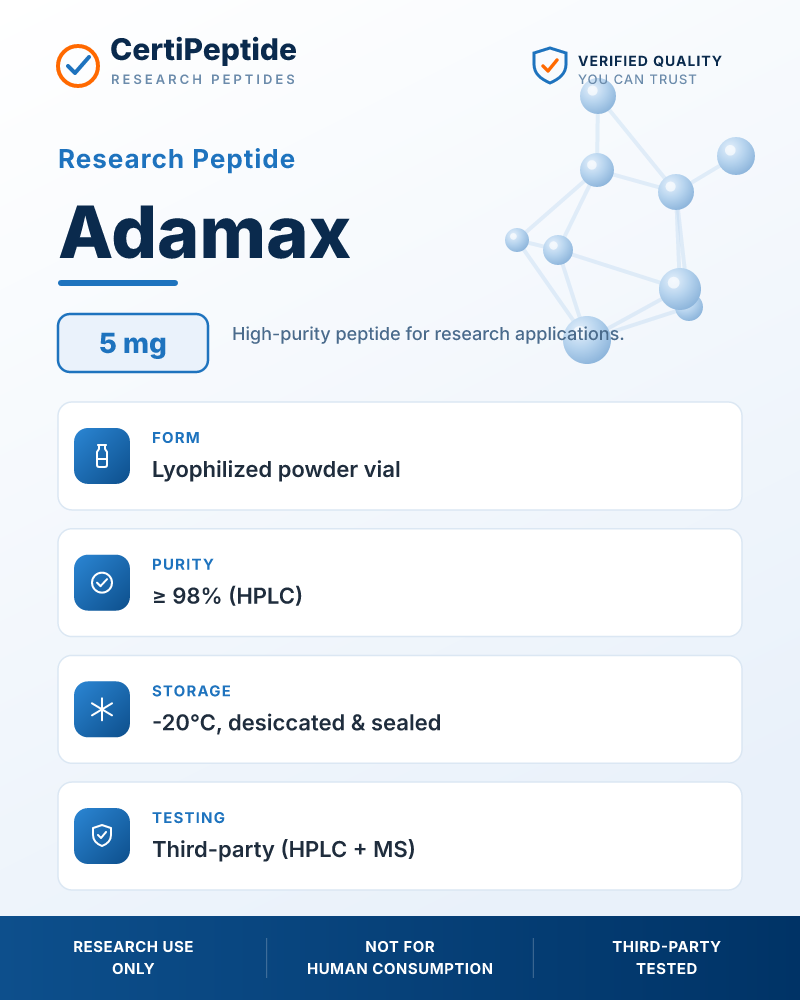
**Adamax vs FOXO4-DRI** is less a head-to-head of interchangeable tools and more a contrast between two research peptides with distinct biological targets. Adamax is studied mainly in neurobiology and cognitive-model contexts as a modified peptide analog. FOXO4-DRI is investigated for disruption of FOXO4–p53 interactions and selective effects on senescent cell populations in preclinical models. Choosing **Adamax or FOXO4-DRI** depends on endpoint design—neuronal signaling and behavior assays versus senescence, apoptosis, and aging-biology readouts—not on interchangeable “performance.” This Adamax FOXO4-DRI comparison summarizes mechanisms, study designs, overlap, and practical lab considerations for research-use-only work.
Why Compare Adamax vs FOXO4-DRI in Laboratory Research?
Investigators often search **Adamax vs FOXO4-DRI** when building peptide panels for aging, stress-response, or systems-biology projects. The comparison is useful because both appear in catalogs of research peptides and both touch pathways loosely associated with cellular stress and organismal resilience in model systems. They are not mechanistic twins.
Adamax is typically framed in the literature and supplier literature as a structural relative of ACTH/Melanocortin-fragment–derived research peptides (often discussed alongside Semax-class analogs), with adamantane-related modification used to alter stability or distribution properties in experimental settings. FOXO4-DRI (FOXO4-D-Retro-Inverso) is a designed peptide reported to interfere with the FOXO4–p53 interaction, enabling studies of senescent-cell clearance and related phenotypes in cell and animal models.
For protocol design, the **Adamax FOXO4-DRI comparison** therefore starts with primary hypothesis: neuroplasticity/neuromodulation endpoints versus senescence-selective apoptosis and tissue-rejuvenation-style readouts in controlled research models.
What Is Adamax in Research Contexts?
Adamax is referenced as a research peptide analog associated with cognitive and neuroprotective experimental literature on related compounds. In laboratory settings, work on this chemical class often examines:
- Gene-expression changes in neuronal or glial culture systems
- Markers of neurotrophic signaling (for example, pathways linked to BDNF in model tissues)
- Behavioral or electrophysiological endpoints in approved animal protocols
- Stability, plasma/tissue distribution, and metabolite profiling under controlled conditions
Because public primary literature specifically titled “Adamax” can be thinner than for parent analogs, rigorous labs is researched in the context of Adamax as a defined chemical entity that must be characterized (identity, purity, solubility) before mechanistic claims. Studies should report lot analytics, vehicle, exposure conditions, and species/cell-line context rather than extrapolating from related peptides alone.
Research questions suited to Adamax-oriented designs include modulation of learning-and-memory paradigms in rodents, oxidative or inflammatory challenge models in neural tissue, and comparative pharmacology versus non-adamantylated analogs.
What Is FOXO4-DRI in Research Contexts?
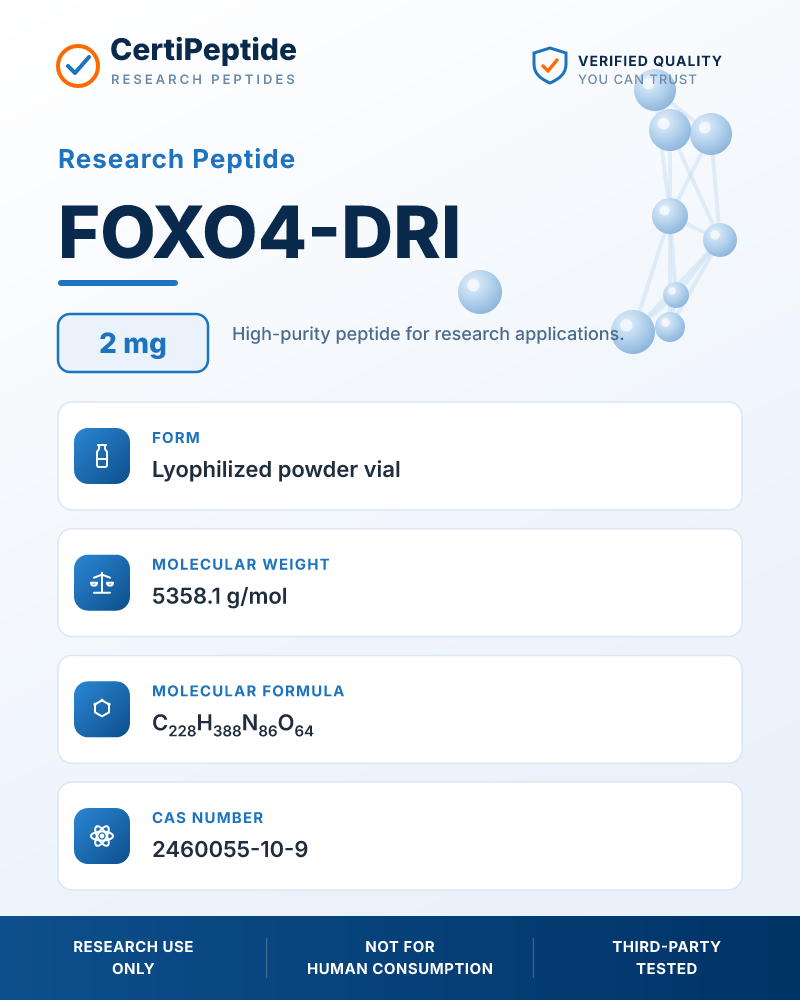
FOXO4-DRI is a D-retro-inverso peptide designed to target the interaction between the transcription factor FOXO4 and p53. Preclinical publications have explored its use in models where senescent cells accumulate and contribute to tissue dysfunction phenotypes. Core research themes include:
- Disruption of FOXO4–p53 binding in biochemical and cellular assays
- Preferential induction of apoptosis in senescent versus non-senescent cells in culture
- Changes in senescence-associated secretory phenotype (SASP) markers
- Functional recovery measures in aged or damage models under institutional animal-care oversight
FOXO4-DRI work is therefore anchored in geroscience and cell-stress biology. Experimental designs commonly include SA-β-gal staining, p16/p21 pathway markers, multiplex cytokine panels, histology, and functional assays matched to the organ system under study.
Unlike broad cytotoxic agents, the research interest in FOXO4-DRI centers on selectivity hypotheses—whether senescent populations can be reduced with measurable downstream effects in model organisms—always within non-clinical, research-use frameworks.
Adamax vs FOXO4-DRI: Core Mechanistic Differences
| Dimension | Adamax (research framing) | FOXO4-DRI (research framing) |
| --- | --- | --- |
| Primary research niche | Neurobiology, cognitive/neurotrophic model systems | Senescence, FOXO4–p53, geroscience |
| Putative intervention point | Peptide-analog signaling relevant to CNS models | Protein–protein interaction blockade |
| Typical cell systems | Neuronal, glial, mixed CNS cultures | Senescent fibroblasts and other stressed cell models |
| Common in vivo endpoints | Behavior, neurochemistry, injury models | Tissue function, senescence burden, age-related phenotypes |
| Structural notes | Modified peptide analog (adamantane-associated designs discussed in class literature) | D-retro-inverso peptide engineering for stability/PPI targeting |
**Mechanism depth:** Adamax-class research is pathway-diffuse in the public record and often hypothesis-generating around neuromodulation. FOXO4-DRI research is more tightly tied to a defined PPI (FOXO4–p53) and a senescence-selective apoptosis hypothesis. That difference drives assay choice more than branding.
**Readout timelines:** Neurobehavioral or expression studies with Adamax-type peptides may use acute-to-subchronic windows depending on the model. Senescence-clearance studies with FOXO4-DRI often require time for cell death, clearance, and tissue remodeling markers to appear.
**Off-target and specificity work:** Both demand controls. For Adamax, include vehicle, scrambled or related-analog comparators, and orthogonal pathway markers. For FOXO4-DRI, include non-senescent controls, interaction assays where feasible, and markers distinguishing senescence-specific death from general toxicity.
Similarities Relevant to Study Design
Despite divergent biology, **Adamax or FOXO4-DRI** selections share practical research similarities:
1. **Research-use peptide handling** — Both are handled as laboratory reagents: documented storage, reconstitution solvents, avoidance of repeated freeze–thaw where stability is unknown, and analytical verification (HPLC, MS) when conclusions are publication-grade.
2. **Model-dependence** — Outcomes are cell-type, species, age, and stress-model dependent. Neither should be treated as a universal “positive control” without pilot data.
3. **Systems biology adjacency** — Stress response, inflammation-adjacent markers, and organism-level resilience phenotypes can appear in both literatures, which is why comparison searches arise—even when primary targets differ.
4. **Need for rigorous controls** — Blinded scoring for histology/behavior, power analysis, and pre-registered endpoints strengthen either program.
5. **No clinical substitution** — Both are discussed here strictly as tools for non-clinical investigation; study reports should not imply human therapeutic use.
Choosing Adamax or FOXO4-DRI for a Protocol
Use a decision tree driven by the independent variable you can measure:
**Lean toward Adamax when the primary question is:**
- CNS gene expression, synaptic markers, or neurotrophic pathway modulation in vitro/in vivo
- Comparative structure–activity work among melanocortin-fragment–related research peptides
- Behavioral neuroscience endpoints under approved protocols
**Lean toward FOXO4-DRI when the primary question is:**
- Whether reducing senescent cell burden alters a defined tissue phenotype
- FOXO4–p53 interaction biology and downstream apoptosis selectivity
- SASP composition, fibrosis-adjacent remodeling, or age-stratified model comparisons
**Consider parallel arms (not “stacking” as a clinical idea, but factorial design in research) when:**
- You explicitly want to separate neuromodulatory signatures from senescence-burden signatures in the same aging model
- Multi-omics will be used to disentangle CNS versus peripheral senescence contributions
In factorial designs, power carefully: interaction effects require larger n, and vehicle matching must be identical across arms.
Experimental Design Notes for an Adamax FOXO4-DRI Comparison Study
If the study goal is a true side-by-side **Adamax FOXO4-DRI comparison**, standardize the non-biological variables first:
- **Identity and purity:** Certificate of analysis, independent LC-MS spot checks on receipt.
- **Solubility and vehicle:** Document solvents, pH, filters, and adsorption to plastics; peptides differ in stickiness and solvent needs.
- **Exposure metrics:** For cells, report concentration, duration, serum conditions, and senescence induction method (e.g., irradiation, oncogene, serial passage) when relevant. For animals, report route, formulation, and schedule only as research parameters—not as human guidance.
- **Endpoint battery:**
- Shared panel: viability, basic metabolic markers, selected cytokines
- Adamax-focused: neuronal markers, BDNF-related transcripts/proteins, behavior batteries if in vivo
- FOXO4-DRI-focused: SA-β-gal, p16INK4a, cleaved caspase in senescent vs control cells, tissue histopathology
- **Statistics:** Predefine primary endpoints; correct for multiplicity on exploratory omics.
Avoid interpreting a null on one peptide as “weaker” without confirming target engagement. A CNS-leaning peptide may look inert on senescence assays; a senolytic-oriented peptide may look inert on acute synaptic readouts.
Analytical and Quality Considerations for Both Peptides
Research suppliers list **Adamax** and **FOXO4-DRI** as research chemicals. Quality practices that protect data integrity include:
- Verifying sequence and stereochemistry expectations (especially important for D-retro-inverso designs like FOXO4-DRI)
- Monitoring aggregation or precipitation in media
- Using endotoxin-aware workflows for cell work when inflammation readouts matter
- Aliquoting to reduce degradation
- Recording lot numbers in ELNs for reproducibility
When publishing or internal-reporting a comparison, include negative controls and, where possible, a mechanistic positive control appropriate to each pathway rather than cross-using the other peptide as a universal benchmark.
Limitations and Evidence Gaps
An honest **Adamax vs FOXO4-DRI** review for scientists should flag gaps:
- Direct head-to-head peer-reviewed studies are uncommon; most “comparison” reasoning is cross-literature synthesis.
- Adamax-specific mechanistic maps may rely partly on analogy to related research peptides—validate in your system.
- FOXO4-DRI results can vary with senescence induction method, cell origin, and delivery/formulation variables in vivo.
- Translation beyond controlled laboratory models is outside the scope of research-reagent discussion.
These limits argue for pilot dose–response (in the research concentration sense), target-engagement assays, and transparent reporting rather than catalog-based assumptions.
Practical Summary for Research Teams
- **Adamax** fits programs centered on neural signaling, cognitive-model biomarkers, and analog comparison within related peptide families.
- **FOXO4-DRI** fits programs centered on FOXO4–p53 biology, senescent-cell selective apoptosis hypotheses, and geroscience endpoints.
- Similarities are operational (peptide handling, need for analytics, model dependence), not mechanistic identity.
- A high-quality **Adamax FOXO4-DRI comparison** standardizes chemistry QC and vehicles, then diverges assays to match each hypothesized pathway.
- Selection of **Adamax or FOXO4-DRI** should follow the measurable biological question, institutional approvals, and available orthogonal readouts—not marketing adjacency in research catalogs.
FAQ
Is Adamax the same type of research tool as FOXO4-DRI? No. Adamax is generally positioned in neuro-focused peptide research, while FOXO4-DRI is studied for FOXO4–p53 interference and senescence-related models. They answer different experimental questions.
Can one study use both Adamax and FOXO4-DRI? Yes, in a factorial or multi-arm preclinical design when the goal is to separate neuromodulatory signatures from senescence-burden effects. Arms need matched vehicles, adequate power, and pathway-specific endpoints.
Which endpoints distinguish Adamax vs FOXO4-DRI most clearly? Neuronal gene/protein markers and behavior-linked measures align more with Adamax-class questions. Senescence markers (e.g., SA-β-gal, p16), apoptosis selectivity in senescent cultures, and SASP profiling align with FOXO4-DRI questions.
Why do researchers search “Adamax or FOXO4-DRI” if mechanisms differ? Both appear in stress, aging-adjacent, and resilience-themed research portfolios. Catalog proximity and overlapping high-level themes drive comparison queries even when molecular targets diverge.
What QC matters most before comparing these peptides in vitro? Confirm identity/purity, document reconstitution, control endotoxin where relevant, and run vehicle and non-target cell controls so stability or toxicity artifacts are not misread as pathway biology.
Explore Further
Browse our [research peptide catalog](/shop) and review third-party [lab reports & COAs](/lab-reports) for every batch.
---
**Research use only.** The information above is provided for educational and laboratory research purposes only. The compounds discussed are not approved for human or veterinary use, diagnosis, treatment, or the prevention of any disease. Nothing here is medical advice.