TL;DR
Laboratory investigations of 5-Amino-1MQ vs SLU-PP-332 focus on their distinct roles in metabolic pathway modulation. Researchers examine these compounds separately for NNMT inhibition and ERR agonism effects in cell and animal models.
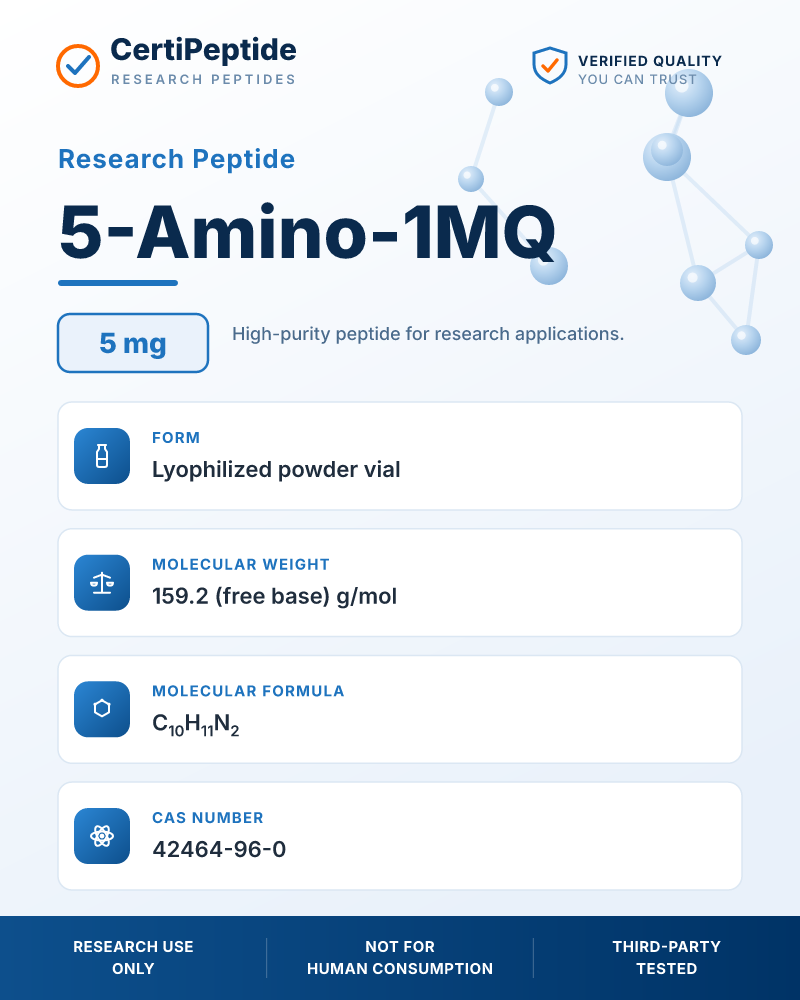
5-Amino-1MQ vs SLU-PP-332 in Metabolic Research The comparison of 5-Amino-1MQ vs SLU-PP-332 centers on their utility as research tools for exploring energy homeostasis. 5-Amino-1MQ is studied as an NNMT inhibitor that may influence NAD+ levels and fat cell metabolism in vitro. SLU-PP-332 is investigated as an ERR pan-agonist that activates mitochondrial biogenesis pathways in preclinical models. Both appear in studies targeting obesity-related cellular processes but operate through non-overlapping targets.
Mechanisms of Action 5-Amino-1MQ functions primarily by inhibiting nicotinamide N-methyltransferase, an enzyme linked to altered methylation cycles in adipocytes. In research settings, this inhibition has been associated with changes in gene expression related to lipid storage. SLU-PP-332, by contrast, binds estrogen-related receptors to upregulate oxidative phosphorylation genes. Studies often contrast these actions to understand selective versus broad metabolic activation. Laboratory data suggest 5-Amino-1MQ may reduce NNMT activity dose-dependently in cell cultures, while SLU-PP-332 demonstrates ERR subtype selectivity in reporter assays.
Research Applications and Study Designs In metabolic research, 5-Amino-1MQ is frequently applied to high-fat diet mouse models to assess body composition changes and glucose handling. SLU-PP-332 appears in endurance and muscle metabolism protocols where researchers measure mitochondrial density and exercise-mimetic responses. When conducting 5-Amino-1MQ or SLU-PP-332 experiments, investigators typically use separate cohorts to avoid cross-interference. Common endpoints include qPCR for metabolic genes, Western blots for protein markers, and respirometry for mitochondrial function. Both compounds support investigations into age-related metabolic decline without direct human application.
Similarities Between the Compounds 5-Amino-1MQ and SLU-PP-332 share a research focus on energy expenditure pathways. Each has been evaluated for effects on white adipose tissue browning and insulin sensitivity in rodent models. Researchers note that both may influence PGC-1α expression indirectly, though via different upstream signals. In comparative literature reviews, they are grouped under next-generation metabolic modulators suitable for in vitro screening libraries.
Key Differences in Research Profiles Key distinctions emerge in target specificity and downstream signaling. 5-Amino-1MQ primarily affects the methionine cycle and NAD+ salvage, whereas SLU-PP-332 drives nuclear receptor transcription. Pharmacokinetic studies in animals reveal differing half-lives and tissue distribution patterns. 5-Amino-1MQ shows higher solubility in aqueous buffers, facilitating certain cell-based assays, while SLU-PP-332 requires optimized vehicle formulations for in vivo delivery. These differences guide selection in study design depending on the metabolic node under investigation.
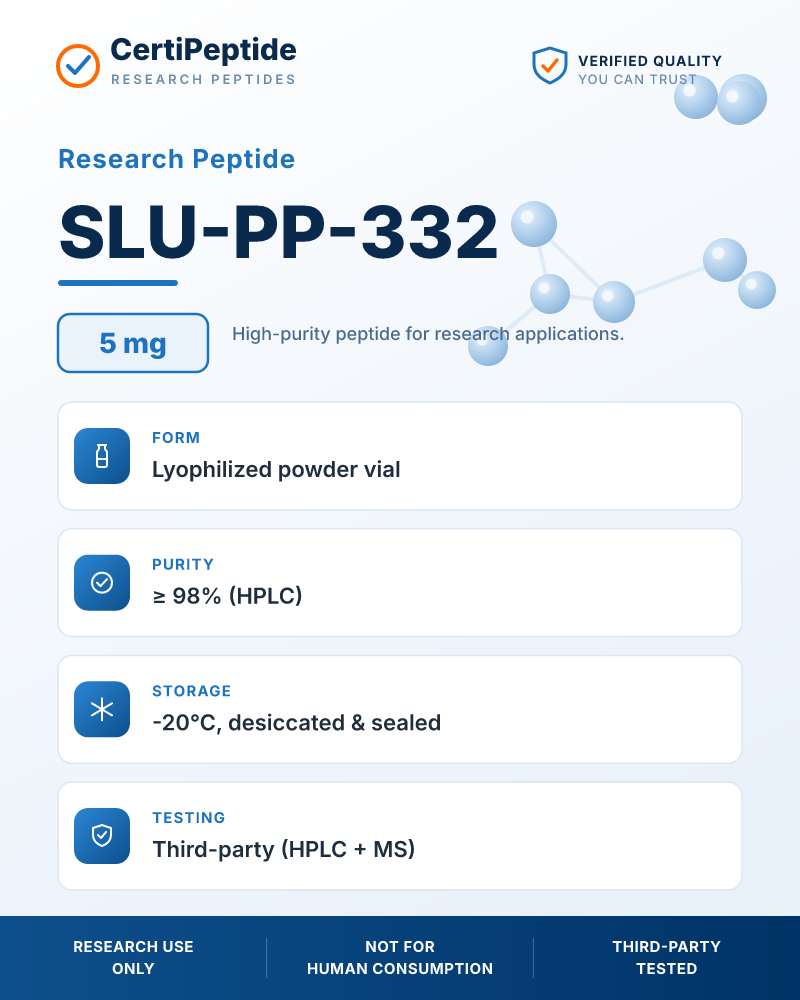
Practical Considerations for Laboratory Use When sourcing 5-Amino-1MQ or SLU-PP-332 for experiments, purity verification via HPLC and mass spectrometry remains essential. Storage conditions typically involve desiccated, low-temperature environments to maintain stability. Researchers often validate activity through functional assays before initiating longer-term animal protocols. Combination studies remain limited, with most published work evaluating each compound independently to isolate mechanistic contributions.
Future Directions in Comparative Studies Ongoing research may expand direct head-to-head evaluations of 5-Amino-1MQ vs SLU-PP-332 in shared models of diet-induced metabolic stress. Such designs could clarify additive or opposing effects on mitochondrial output and substrate utilization. Advanced techniques like single-cell RNA sequencing may further delineate cell-type-specific responses to each molecule.
Frequently Asked Questions
What is the main mechanistic difference between 5-Amino-1MQ and SLU-PP-332?
5-Amino-1MQ inhibits NNMT while SLU-PP-332 acts as an ERR agonist, leading to distinct effects on methylation cycles versus mitochondrial gene transcription in research models.
Can 5-Amino-1MQ and SLU-PP-332 be studied together?
Current literature primarily examines them separately; combined protocols require careful validation to distinguish individual contributions in metabolic assays.
What research models are common for these compounds?
Rodent models of diet-induced obesity and cell culture systems assessing mitochondrial function are frequently used for both 5-Amino-1MQ and SLU-PP-332 studies.
How do solubility properties differ for laboratory handling?
5-Amino-1MQ generally offers better aqueous solubility, whereas SLU-PP-332 may need specific formulation strategies for consistent delivery in experimental settings.
Explore Further
Browse our [research peptide catalog](/shop) and review third-party [lab reports & COAs](/lab-reports) for every batch.
---
**Research use only.** The information above is provided for educational and laboratory research purposes only. The compounds discussed are not approved for human or veterinary use, diagnosis, treatment, or the prevention of any disease. Nothing here is medical advice.