TL;DR
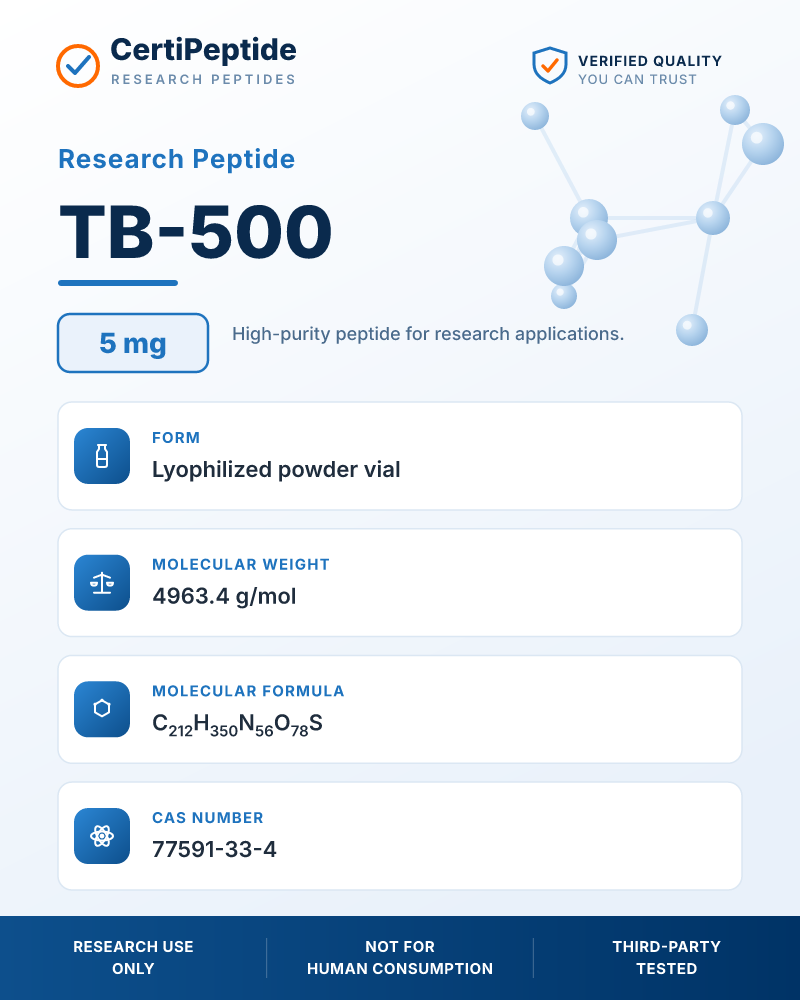
**TB-500 vs TB-500 Fragment** comparisons center on length, domain focus, and experimental readouts. Full-length **TB-500** (synthetic thymosin β4–related sequence) is studied as a multi-domain peptide that interacts with G-actin and broader cytoskeletal and cell-migration pathways. **TB-500 Fragment** preparations typically isolate shorter bioactive motifs (commonly actin-binding or N-terminal–related sequences) so researchers can test domain-specific hypotheses with simpler structure–activity designs. Neither product is interchangeable by default: sequence identity, purity, salt form, and assay endpoints should drive selection in controlled laboratory models.
Why Compare TB-500 or TB-500 Fragment in Study Design?
When planning a **TB-500 TB-500 Fragment comparison**, investigators usually ask three questions: (1) Do we need the full primary sequence and its conformational context? (2) Are we isolating a discrete binding motif for mechanistic work? (3) How will molecular weight, stability, and detection methods affect dosing in vitro or in non-clinical models?
In research catalogs, **TB-500** generally denotes a synthetic peptide aligned with thymosin β4 (Tβ4) research literature—classically a 43-residue polypeptide implicated in actin sequestration and related cellular processes. **TB-500 Fragment** labels cover truncated sequences derived from functional regions of that scaffold. Fragment work is useful when the goal is epitope mapping, competitive binding, or reducing off-target interactions that may arise from multi-domain full-length material.
Both materials are supplied for laboratory research only. Study outcomes depend on validated identity (e.g., MS/HPLC), handling, and model relevance—not on marketing synonyms.
Molecular Structure and Sequence Scope
Full-length TB-500 context
Research descriptions of **TB-500** typically map to thymosin β4’s multi-region architecture: N-terminal motifs associated with certain signaling readouts in the literature, a central actin-binding region, and C-terminal elements that may influence localization or interactions in cell-based systems. The intact chain supports experiments on conformation-dependent binding, sequestration of monomeric actin, and multi-pathway cellular phenotypes (migration, cytoskeletal remodeling, and related endpoints reported in preclinical literature).
What “TB-500 Fragment” usually means
**TB-500 Fragment** is not a single universal sequence across every supplier. In practice, fragments are chosen to represent:
- Actin-binding core motifs used in binding and polymerization assays
- Short N-terminal peptides explored for discrete pathway probes
- Other truncated analogs designed for SAR (structure–activity relationship) panels
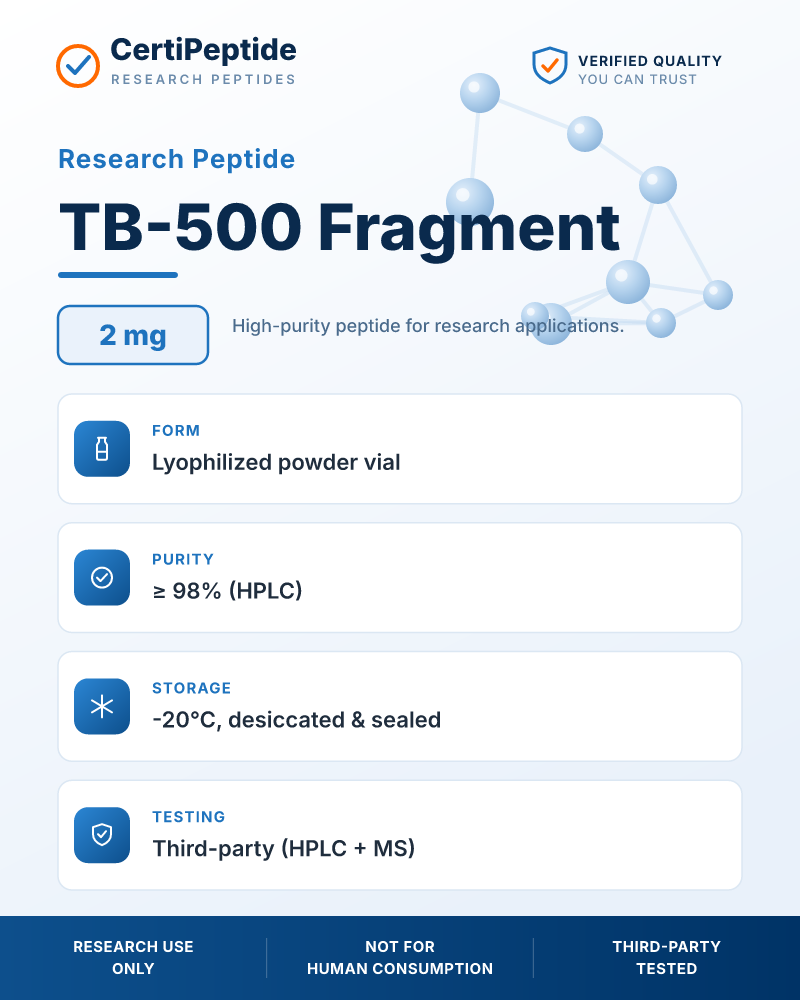
Because fragment identity varies, every lot should be verified against the certificate of analysis (sequence, molecular weight, purity). A rigorous **TB-500 vs TB-500 Fragment** paper or internal report always states the exact amino-acid string, modifications (e.g., acetylation), and counter-ion.
Practical implications of length
| Attribute | TB-500 (full-length research peptide) | TB-500 Fragment |
| --- | --- | --- |
| Sequence span | Broader, multi-domain | Domain- or motif-focused |
| Conformational complexity | Higher | Lower |
| Typical use | Systems-level cell assays | Mechanistic / binding / SAR |
| Analytical simplicity | More complex peptide map | Often simpler LC-MS |
| Hypothesis type | Holistic Tβ4-related biology | Isolated motif contribution |
Mechanisms and Endpoints Studied in the Lab
Shared research themes
Both **TB-500** and fragment analogs appear in literature-adjacent research themes involving:
- G-actin interaction and cytoskeletal dynamics
- Cell migration and wound-closure style scratch assays *in vitro*
- Angiogenesis-related cellular models (endothelial tube formation, etc.) as experimental systems
- Gene-expression or pathway panels tied to repair-biology hypotheses in non-clinical settings
Full-length material may engage multiple interaction surfaces simultaneously. Fragments help test whether a single motif is necessary or sufficient for a measured endpoint.
Where fragments sharpen the question
Using **TB-500 Fragment** can:
- Reduce confounding from secondary domains
- Enable alanine scans and competitive peptide controls
- Simplify conjugation, labeling, or surface-plasmon-resonance setups
- Support dose–response curves focused on one pharmacophore in cell-free assays
Where full-length TB-500 remains preferable
Choose **TB-500** when the study needs:
- Closer analogy to native-length Tβ4 research reagents
- Phenotypes that may require cooperative domain effects
- Comparability to prior full-sequence publications
- Exploratory multi-omics after exposure in cell culture
In short, **TB-500 or TB-500 Fragment** is not a purity contest—it is a hypothesis-fit decision.
Similarities That Matter for Reproducibility
Despite length differences, quality research practice is researched in the context of both classes similarly:
1. **Identity confirmation** — HPLC purity plus mass spectrometry; optional amino-acid analysis.
2. **Handling** — Lyophilized peptides are moisture-sensitive; use appropriate diluents and aliquot strategies for freeze–thaw control.
3. **Vehicle controls** — Match solvent, pH, and carrier proteins across arms.
4. **Blinding and randomization** — Especially in multi-well migration or imaging studies.
5. **Endotoxin and residual solvent awareness** — Relevant for cell-based work.
6. **Documentation** — Lot numbers, storage temperature logs, and reconstitution timestamps.
These controls matter as much as the structural choice when interpreting a **TB-500 TB-500 Fragment comparison**.
Designing a Head-to-Head Laboratory Comparison
A clean comparison protocol might include:
1. Define equimolar vs equal-mass logic
Fragments and full-length chains differ in molecular weight. Equimolar dosing is usually more interpretable for receptor/motif hypotheses; equal-mass dosing can mislead. State the rationale in the methods.
2. Match analytical characterization
Run both materials through the same identity panel before the biological assay. If the fragment is a truncated analog, include a scrambled-sequence control of equal length.
3. Select orthogonal endpoints
Examples used in cytoskeletal and migration research workflows:
- Actin polymerization / sequestering assays (cell-free)
- Live-cell imaging of cytoskeletal reporters
- Transwell or scratch migration quantitation
- qPCR or proteomics for pathway context
- Viability/cytotoxicity counterscreens to separate pathway effects from nonspecific stress
4. Time course and stability checks
Shorter peptides can differ in proteolytic stability in serum-containing media. Include remaining-peptide measurements (LC-MS) if incubation is prolonged.
5. Statistical plan
Power the study for the primary endpoint; pre-register contrasts (full-length vs fragment vs vehicle vs scramble).
Analytical and Supply Considerations for TB-500 and TB-500 Fragment
Research buyers evaluating **TB-500** alongside **TB-500 Fragment** should review:
- **Sequence disclosure** — Full amino-acid list, not only a trade name
- **Purity threshold** suitable for the assay (e.g., ≥95% or higher for sensitive cell work)
- **Counter-ion and residual TFA** — May affect certain in vitro systems; acetate exchange is sometimes requested
- **Solubility guidance** for laboratory reconstitution (still not human-use instruction)
- **Storage** — Typically desiccated, frozen, protected from light per COA
Natural mention in procurement notes: labs often source full-length **TB-500** for broad phenotypic screens and **TB-500 Fragment** when building motif-level SAR libraries or binding controls under the same quality system.
Interpreting Literature and Avoiding Name Confusion
Nomenclature drift is common. “TB-500” in commercial research contexts is frequently used as a convenient label for synthetic Tβ4-related material, while academic papers prefer “thymosin β4” or specific fragment residue numbers (for example, central actin-binding sequences discussed in structural studies). Always crosswalk:
- Residue numbering vs native Tβ4
- Post-translational or synthetic caps (Ac-, amidation)
- Batch-specific MW
A published effect attributed to “TB-500” cannot be assumed for an arbitrary fragment without sequence alignment and assay replication.
Choosing TB-500 vs TB-500 Fragment: Decision Checklist
**Lean toward TB-500 when you need:**
- Multi-domain biology and literature alignment with full-length Tβ4 reagents
- Exploratory cell phenotypes rather than single-site binding
- Comparability to prior full-sequence internal data
**Lean toward TB-500 Fragment when you need:**
- Domain isolation and cleaner negative/scrambled controls
- Easier peptide synthesis variants for SAR
- Focused biophysical assays (SPR, fluorescence polarization, co-sedimentation)
**Run both when you need:**
- To test sufficiency vs necessity of a motif inside the parent sequence
- To bridge mechanistic and phenotypic narratives in one manuscript or report
Summary
A careful **TB-500 vs TB-500 Fragment** evaluation is researched in the context of the pair as related but non-identical research tools. Full-length **TB-500** supports broader thymosin β4–aligned cellular investigations; **TB-500 Fragment** materials enable motif-centric mechanistic designs. Similarities in quality control, vehicle matching, and endpoint rigor matter as much as sequence differences. For reproducible science, specify exact sequences, compare on an equimolar basis when mechanisms are the goal, and let the hypothesis—not the catalog name—decide **TB-500 or TB-500 Fragment** for each arm of the study.
FAQ
Explore Further
Browse our [research peptide catalog](/shop) and review third-party [lab reports & COAs](/lab-reports) for every batch.
---
**Research use only.** The information above is provided for educational and laboratory research purposes only. The compounds discussed are not approved for human or veterinary use, diagnosis, treatment, or the prevention of any disease. Nothing here is medical advice.