TL;DR: Mazdutide vs Dulaglutide highlights key distinctions in dual versus single incretin receptor agonism, with both compounds serving as tools for metabolic pathway research in controlled laboratory environments.
Mazdutide vs Dulaglutide represents an important comparison for researchers examining incretin mimetics. Both peptides are studied for their effects on GLP-1 receptor signaling, though their profiles diverge in receptor selectivity and structural design. This article examines laboratory findings, mechanistic variations, and experimental contexts without reference to clinical use.
Structural Characteristics in Research
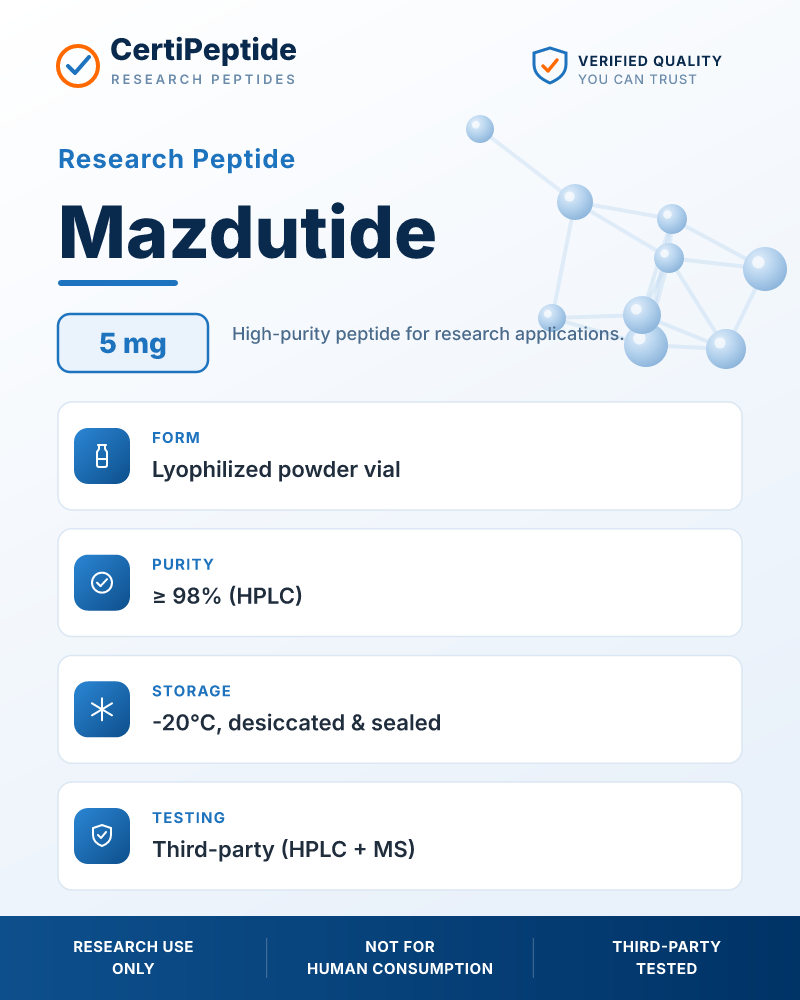
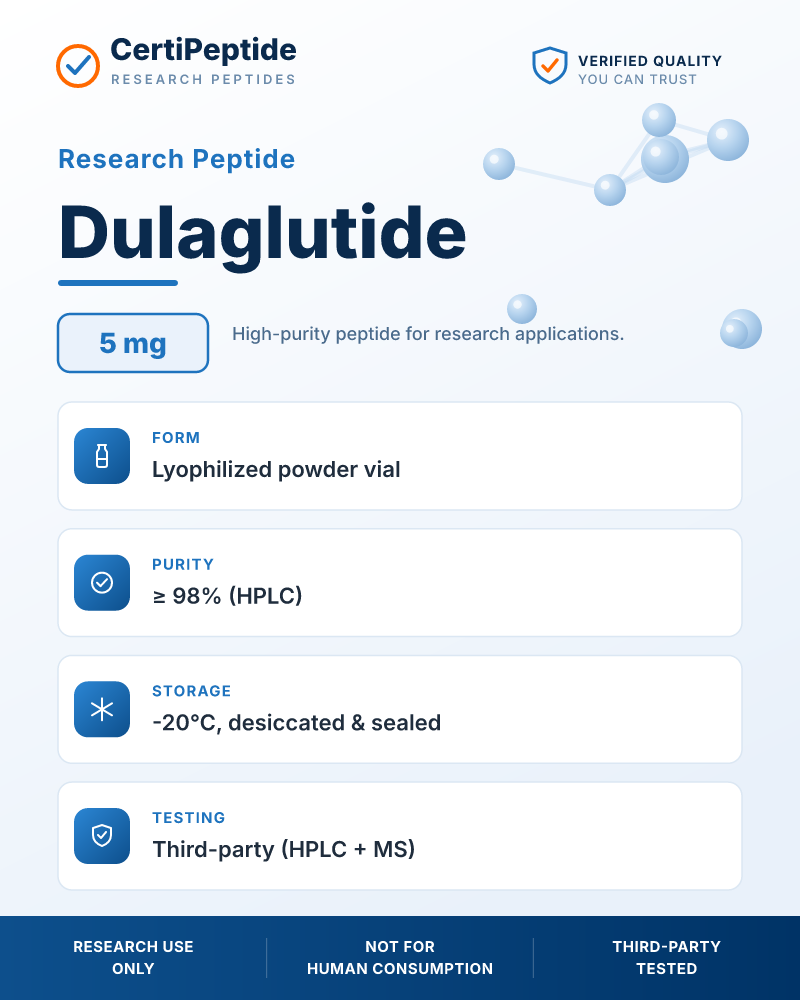
Mazdutide is a synthetic dual agonist peptide targeting GLP-1 and GIP receptors. Its sequence incorporates modifications that enhance stability for in vitro and animal model assays. Dulaglutide, by contrast, consists of a GLP-1 analog fused to an Fc fragment, providing extended half-life properties useful in prolonged cell-culture or rodent studies.
Laboratory investigations often focus on binding affinity measurements and downstream cAMP signaling assays. Researchers compare these attributes to understand how each molecule interacts with isolated receptor preparations.
Receptor Activity and Signaling Pathways
GLP-1 and GIP Engagement
Mazdutide demonstrates activity at both GLP-1 and GIP receptors in binding studies, allowing examination of synergistic incretin effects on glucose-dependent insulin secretion pathways in pancreatic beta-cell models. Dulaglutide primarily activates GLP-1 receptors, enabling isolated study of that pathway without concurrent GIP stimulation.
Duration and Stability Metrics
In stability assays, Dulaglutide's Fc fusion contributes to resistance against proteolytic degradation, making it suitable for longer-duration experiments tracking sustained receptor occupancy. Mazdutide's modifications prioritize balanced dual agonism while maintaining sufficient plasma stability for short-to-medium term animal model protocols.
Mazdutide vs Dulaglutide in Laboratory Studies
Direct head-to-head experiments frequently assess dose-response curves in metabolic tissue explants or transgenic mouse lines. Mazdutide studies often explore combined GLP-1/GIP signaling on lipid metabolism markers, whereas Dulaglutide research isolates GLP-1-mediated suppression of glucagon release in isolated islet preparations.
Comparative proteomics and transcriptomics datasets reveal overlapping yet distinct gene expression changes, particularly in pathways regulating energy homeostasis. These findings support the use of both compounds as complementary tools rather than interchangeable reagents.
Experimental Applications and Model Systems
Researchers employ Mazdutide in diet-induced obesity rodent models to investigate dual agonist impacts on body composition parameters under controlled feeding conditions. Dulaglutide appears more commonly in studies focused solely on GLP-1 receptor desensitization kinetics or antibody-mediated clearance mechanisms.
Cell-based assays using HEK293 cells transfected with human or rodent receptors allow quantification of EC50 values and bias toward specific signaling cascades. Such data inform selection of the appropriate peptide for a given experimental endpoint.
Analytical Techniques for Comparison
Mass spectrometry and ELISA methods quantify peptide concentrations in biological matrices during pharmacokinetic profiling experiments. Fluorescence polarization assays measure receptor-ligand interactions with high throughput, facilitating rapid Mazdutide Dulaglutide comparison across multiple concentrations.
Western blot analysis of phosphorylated CREB and ERK proteins provides downstream readouts of receptor activation, highlighting subtle differences in signal duration and intensity between the two molecules.
Considerations for Research Design
When planning studies involving Mazdutide or Dulaglutide, investigators account for species-specific receptor sequence variations that may alter potency rankings. Buffer composition, temperature, and incubation times require optimization to ensure reproducible results across replicate experiments.
Both peptides remain restricted to research-use-only contexts, with all work conducted under approved institutional protocols for non-human applications.
Frequently Asked Questions
What is the main difference between Mazdutide and Dulaglutide in research?
Mazdutide acts as a dual GLP-1/GIP agonist while Dulaglutide targets GLP-1 receptors alone, allowing distinct pathway investigations in lab models.
Can Mazdutide and Dulaglutide be used interchangeably in studies?
No, their differing receptor profiles make them suitable for complementary rather than identical experimental designs in metabolic research.
How do researchers measure stability of these peptides?
Stability is assessed via proteolytic degradation assays, mass spectrometry, and cell-based signaling duration experiments under controlled conditions.
Are Mazdutide or Dulaglutide approved for any human applications?
Both compounds are supplied strictly for laboratory research use only and are not approved or indicated for laboratory research.
Explore Further
Browse our [research peptide catalog](/shop) and review third-party [lab reports & COAs](/lab-reports) for every batch.
---
**Research use only.** The information above is provided for educational and laboratory research purposes only. The compounds discussed are not approved for human or veterinary use, diagnosis, treatment, or the prevention of any disease. Nothing here is medical advice.