TL;DR
Botulinum Toxin research focuses on understanding its neurotoxic properties through controlled laboratory experiments. This article covers the compound's basic characteristics, molecular mechanism, and common investigative techniques employed by researchers.
What is Botulinum Toxin
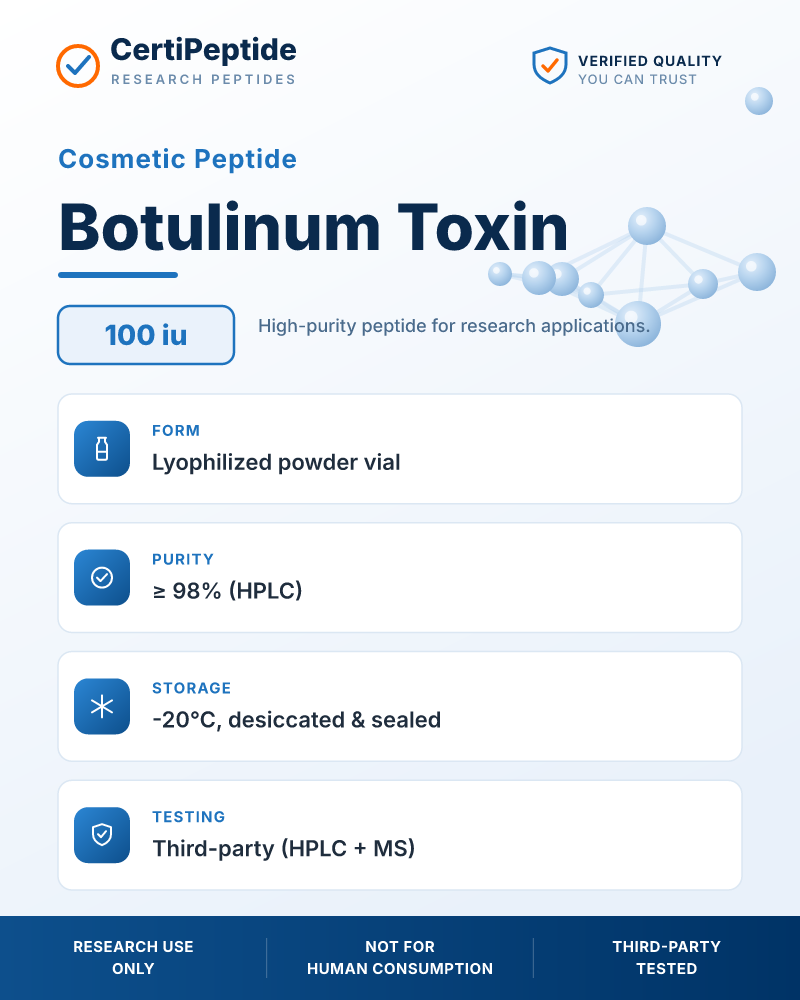
Botulinum Toxin is a protein produced by Clostridium botulinum bacteria. In Botulinum Toxin research, scientists examine its structure and effects exclusively in vitro or in animal models. Researchers frequently acquire Botulinum Toxin for experiments exploring neuromuscular signaling pathways.
Botulinum Toxin Research
Botulinum Toxin research encompasses biochemical assays, receptor binding studies, and cellular response analyses. Early investigations established its classification into serotypes, while modern work emphasizes recombinant variants and detection methods. Laboratory protocols often include SDS-PAGE, ELISA, and fluorescence-based activity assays to quantify potency and purity.
Historical Context in Laboratory Settings
Initial Botulinum Toxin research dates to the early 20th century, with foundational studies isolating the toxin from contaminated food sources. Subsequent experiments mapped its immunogenicity and enabled development of antitoxins for research reagents.
Botulinum Toxin Mechanism
The Botulinum Toxin mechanism involves cleavage of SNARE proteins, preventing acetylcholine vesicle release at synapses. In research models, this action is studied using neuronal cell cultures and electrophysiological recordings. Investigators track zinc-dependent protease activity of the light chain after heavy chain-mediated endocytosis.
Molecular Interactions
Researchers detail how the heavy chain binds synaptic vesicle proteins such as SV2 or synaptotagmin. Following translocation, the light chain specifically hydrolyzes SNAP-25 or VAMP, depending on serotype. These steps are quantified via mass spectrometry and immunoblotting in controlled lab environments.
How Researchers Study Botulinum Toxin
Common approaches in Botulinum Toxin research include high-throughput screening for inhibitors, structural crystallography of toxin domains, and gene expression profiling in exposed cells. Advanced techniques feature cryo-electron microscopy for complex visualization and microfluidic devices for real-time release monitoring.
Experimental Models
Cell-based assays utilize PC12 or primary neuronal cultures to measure transmitter release. Animal studies, where permitted, employ rodent models for localized injection followed by behavioral or histological endpoints. All work adheres to biosafety level requirements appropriate for the serotype under investigation.
Applications in Scientific Investigation
Botulinum Toxin serves as a tool compound in studies of synaptic plasticity and secretory pathways. Researchers compare wild-type and engineered variants to dissect structure-function relationships, supporting broader neuroscience and cell biology inquiries.
Frequently Asked Questions
What is Botulinum Toxin used for in research?
In laboratory settings, Botulinum Toxin is studied for its effects on neurotransmitter release and SNARE protein function using in vitro and animal models.
How does the Botulinum Toxin mechanism work at the molecular level?
The mechanism centers on proteolytic cleavage of SNARE proteins by the toxin light chain, blocking synaptic vesicle fusion in experimental neuronal systems.
What methods do researchers use to study Botulinum Toxin?
Common techniques include cell culture assays, electrophysiological measurements, mass spectrometry, and structural biology approaches such as crystallography.
Is Botulinum Toxin considered a peptide in research contexts?
Yes, Botulinum Toxin is a large protein studied alongside research peptides to explore proteolytic activity and cellular uptake pathways.
Explore Further
Browse our research peptide catalog and review third-party lab reports & COAs for every batch.
---
Research use only. The information above is provided for educational and laboratory research purposes only. The compounds discussed are not approved for human or veterinary use, diagnosis, treatment, or the prevention of any disease. Nothing here is medical advice.